
Carbon monoxide detectors measure CO concentration in parts per million and sound an alarm before levels reach a dangerous threshold, giving your household time to evacuate safely. That single function makes them one of the most important safety devices in any home. Here is what you need to do right now:
- Install a detector on every floor of your home and outside each sleeping area.
- Schedule a professional inspection of every fuel-burning appliance at least once a year.
- If an alarm sounds, evacuate immediately, get fresh air, and call 911.
Who faces the greatest risk:
- Infants and young children — their faster breathing rate means faster CO uptake.
- Elderly adults — reduced physiological reserve makes symptoms escalate quickly.
- People with heart or lung conditions — CO competes directly with oxygen in the bloodstream.
- Pregnant people — CO crosses the placenta and affects fetal development.
- Pets — they often show symptoms before humans do, making them an early warning sign.
Detectors are a safety net. They catch what appliance failures produce. They do not prevent those failures from happening, which is why annual professional maintenance is the upstream action that matters most.
Key Takeaways
CO detectors measure concentration in ppm and alarm based on dose, making correct placement outside sleeping areas on every floor the single most protective installation decision a homeowner can make.
| Point | Details |
|---|---|
| Placement is the priority | Install one detector on every floor and outside each sleeping area; add one near major fuel-burning appliances. |
| Certification standard to look for | Choose detectors certified to UL 2034; NFPA 720 governs where they must be installed per local code. |
| Maintenance keeps detectors reliable | Test monthly, replace batteries twice a year, and replace the entire unit at the manufacturer’s stated end-of-life (typically 5–10 years). |
| Respond immediately when an alarm sounds | Evacuate, call 911, seek fresh air, and get medical attention if symptoms are present; never re-enter until cleared. |
| Mdtechservices adds the prevention layer | Licensed technicians in Orange County and Los Angeles County inspect appliances, venting, and HVAC systems to address CO risks before a detector alarm is ever needed. |
Table of Contents
- What is the role of carbon monoxide detectors in your home?
- What sensor types are inside CO detectors?
- Where should you install CO detectors in your home?
- How do alarm thresholds and U.S. standards define detector performance?
- How do you test and maintain CO detectors?
- What CO detectors cannot do: common misconceptions
- What should you do the moment a CO alarm sounds?
- What are the signs of CO poisoning and who is most at risk?
- U.S. standards, federal guidance, and local codes for CO alarms
- Why professional appliance and HVAC inspections matter
- Mdtechservices’s commitment to CO safety in your home
- Mdtechservices can help you stay ahead of CO risks
- Sources
What is the role of carbon monoxide detectors in your home?
Carbon monoxide is colorless, odorless, and tasteless. Without a detector, you have no sensory warning that it is accumulating. The role of carbon monoxide detectors is straightforward: they continuously sample the air, measure CO concentration in parts per million (ppm), and trigger an audible alarm when concentration and exposure time together reach a threshold that poses a health risk.
The key word is together. A detector does not simply alarm at a fixed ppm ceiling. It uses a dose-based logic: a lower concentration sustained over a longer period can trigger the alarm just as a higher concentration over a shorter period would. This matters because CO from a slowly failing furnace may build gradually overnight while everyone sleeps.
Digital-readout detectors display the current ppm level on a screen, letting you see whether CO is present even below alarm-trigger thresholds. Single-station alarm-only units give you no readout; they simply sound when the dose threshold is crossed. Both types protect you, but a digital readout lets you spot a slow, low-level buildup and call a technician before the alarm ever sounds.
NIST’s technical analysis of CO dispersion in residential buildings confirms that airflow, room geometry, and building mixing patterns all affect how quickly CO reaches a detector. That complexity is exactly why placement on every floor, not just near the source, is the standard recommendation.
What sensor types are inside CO detectors?
Not all detectors use the same technology, and the differences affect accuracy, longevity, and susceptibility to nuisance alarms.
- Electrochemical sensors are the most common type in residential detectors. They use a chemical reaction to generate a measurable electrical current proportional to CO concentration. Accuracy is high, false-alarm rates are low, and most units with electrochemical sensors carry a 5–7 year service life.
- Biomimetic sensors use a gel that changes color when it absorbs CO, mimicking hemoglobin. They are less expensive but can be slower to respond at low concentrations and more sensitive to humidity.
- Semiconductor (metal oxide) sensors use a heated tin oxide element whose electrical resistance changes in the presence of CO. They tend to be less selective, meaning other gases can trigger a response, which raises false-alarm risk. They are common in lower-cost units.
- Photoelectric/optical sensors are primarily smoke-detection technology but appear in combination smoke-CO units. CO detection accuracy in these hybrid units depends heavily on the secondary electrochemical element.
Regardless of sensor type, the certification that matters is UL 2034, the Underwriters Laboratories standard for single- and multiple-station CO alarms. A detector that meets UL 2034 has been tested for alarm timing, false-alarm resistance, and end-of-life signaling. The EPA recommends detectors certified to UL 2034 as the baseline for any residential installation.
Most sensors degrade over time even when the unit appears to function. Manufacturers typically rate detectors at 5–10 years depending on sensor chemistry. Check the manufacture date on the back of your unit; if it is past the manufacturer’s stated end-of-life, replace it regardless of whether it passed its last test.
Pro Tip: When shopping, look for the UL 2034 mark on the packaging, not just a generic “CO alarm” label. Some imported units carry no recognized certification and may not alarm at the correct thresholds.
Where should you install CO detectors in your home?
Placement determines whether a detector actually protects sleeping occupants, which is when CO poisoning is most dangerous. The CPSC recommends installing a CO alarm on every level of the home and outside each separate sleeping area. The EPA adds that the hallway near every sleeping area is the most protective single location.
Placement checklist:
- One detector on each floor, including the basement.
- One outside every separate sleeping area or bedroom cluster.
- An additional detector near major fuel-burning appliances (furnace, water heater, gas dryer) — but not directly above or within a few feet of the appliance itself, where brief combustion byproducts can cause nuisance alarms.
- One in an attached garage, mounted on the wall between the garage and the living space.
- Avoid placing detectors inside kitchens, directly above stoves, or in bathrooms where steam can interfere with sensor accuracy.
MedlinePlus guidance specifically calls out placing a detector on each floor and near major gas-burning appliances as the two most critical installation decisions.
For a split-level home, treat each level as its own floor. In a basement with a furnace, place one detector at breathing height on the basement ceiling or upper wall, not on the floor where CO may not accumulate first. For apartments, the same floor-and-sleeping-area logic applies within your unit.
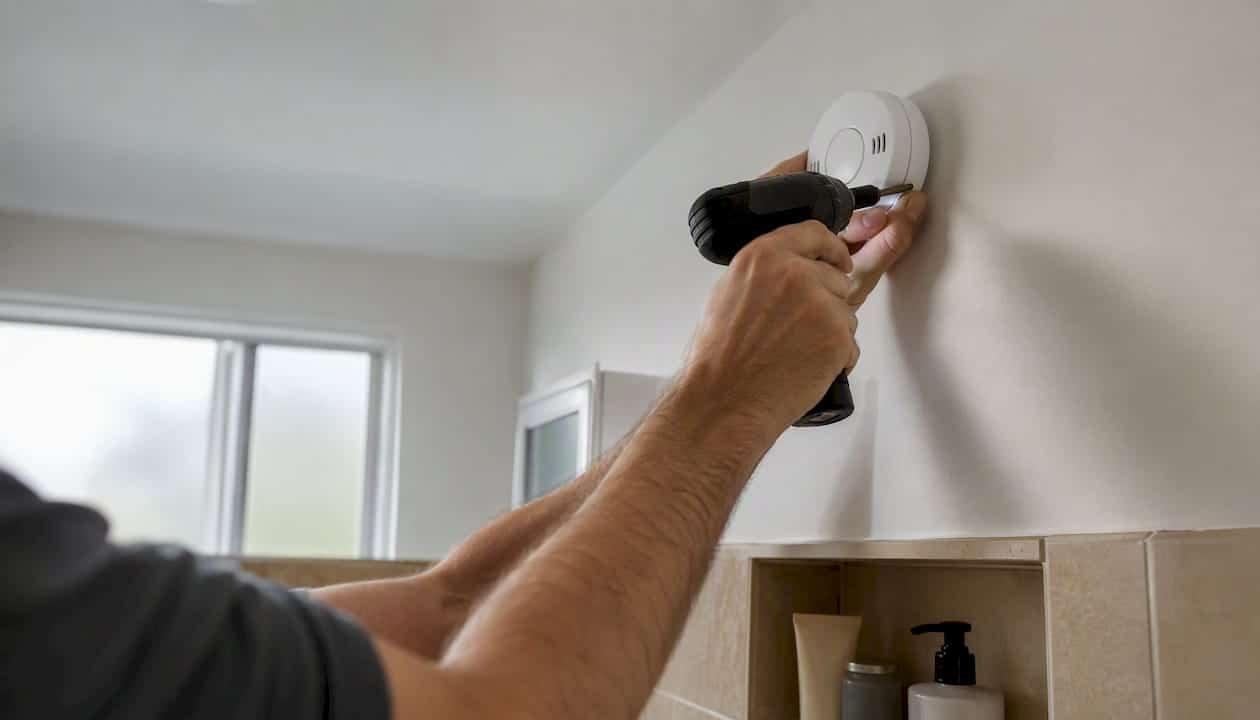
NIST’s CO dispersion research shows that CO mixes with room air rather than stratifying like some other gases, so wall or ceiling mounting at roughly 5 feet is generally effective. The exact height matters less than the floor-and-sleeping-area placement rule.
Pro Tip: Interconnected alarms — wired or wireless — are the most reliable setup for larger homes. When one unit detects CO, every alarm in the house sounds simultaneously, waking occupants on every floor at once.
How do alarm thresholds and U.S. standards define detector performance?
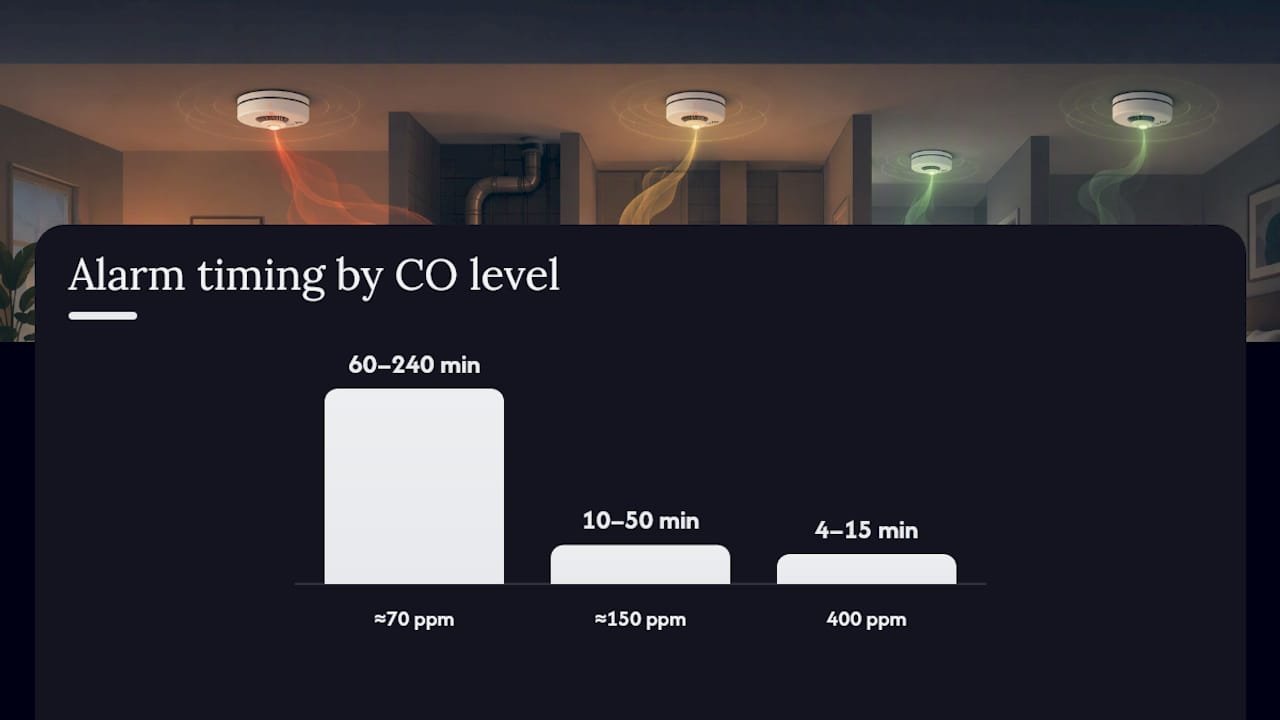
A CO detector does not alarm the moment it detects any CO. UL 2034 defines specific ppm/time relationships that must trigger an alarm. At lower concentrations (around 70 ppm), the standard allows up to 60–240 minutes before the alarm must sound. At higher concentrations (around 150 ppm), the alarm must sound within 10–50 minutes. At 400 ppm, the alarm must sound within 4–15 minutes. These windows are designed to protect a healthy adult; they are tighter for vulnerable groups, which is why the placement rules for sleeping areas matter so much.
Key standards and agencies:
- UL 2034 (Underwriters Laboratories): the primary product-performance standard for residential CO alarms in the U.S. Defines alarm timing, false-alarm resistance, and end-of-life notification requirements.
- NFPA 720 (National Fire Protection Association): the installation code that specifies where CO alarms must be placed in residential occupancies. Many state and local building codes adopt NFPA 720 by reference.
- CPSC (U.S. Consumer Product Safety Commission): provides consumer guidance on CO alarm selection, placement, and testing, and tracks CO-related incidents.
- CDC (Centers for Disease Control and Prevention): publishes health guidance on CO poisoning prevention, including recommendations to install battery-operated or battery-backup detectors near sleeping areas.
Federal legislative activity has reinforced these standards. A congressional resolution referencing ANSI/UL 2034 and NFPA 720 encouraged states to require compliant alarms and supported grant programs to help vulnerable households install them.
Digital-readout units display real-time ppm values, which is useful for identifying a slow buildup that has not yet triggered the alarm. Peak-history displays go further: they record the highest CO level the detector has measured since it was last reset, giving a technician a data point to work from during an inspection. Alarm-only units provide none of this information, though they still meet UL 2034 requirements.
How do you test and maintain CO detectors?
A detector you cannot rely on is worse than no detector, because it creates false confidence. Maintenance is straightforward and takes minutes.
Monthly:
- Press the test button on the unit. A loud alarm tone confirms the battery, circuitry, and alarm mechanism are working.
- Note that the test button does not verify sensor accuracy. It confirms the electronics work; it does not expose the sensor to actual CO.
Twice a year (use clock-change dates as reminders):
- Replace batteries in battery-only units, or test the backup battery in hardwired units.
- Vacuum the detector vents gently with a soft brush attachment to remove dust that can impede airflow to the sensor.
- Check the manufacture date on the back of every unit.
End-of-life signs:
- The unit emits a chirping pattern different from the low-battery chirp, often accompanied by a display message like “END” or “ERR.”
- Frequent nuisance alarms with no identifiable CO source.
- The unit fails to sound during the monthly test.
- The manufacture date exceeds the manufacturer’s stated service life, typically 5–7 years for electrochemical sensors and up to 10 years for some models.
The CDC recommends replacing detectors per manufacturer instructions and installing battery-operated or battery-backup units to maintain protection during power outages. The Mayo Clinic adds that checking batteries at least twice a year is a minimum standard, not a ceiling.
What CO detectors cannot do: common misconceptions
Detectors are reliable within their design limits. Outside those limits, they offer no protection, and misunderstanding those limits can be dangerous.
Common misconceptions:
- “My CO detector will alert me to a gas leak.” No. CO detectors respond to carbon monoxide only. Natural gas and propane are detected by separate gas-leak detectors. These are different devices. For guidance on identifying gas leaks, see Mdtechservices’s homeowner gas leak safety guide.
- “A CO detector means I don’t need appliance maintenance.” The CPSC and EPA are explicit on this point: detectors are a backup layer. Annual professional inspection of fuel-burning appliances is the primary prevention step.
- “If the alarm hasn’t sounded, CO isn’t present.” A detector below its alarm threshold may still be registering low-level CO. A digital-readout unit showing any consistent reading above zero warrants a call to a technician.
- “Placing a detector anywhere in the room is fine.” Placement near stoves, fireplaces, or exhaust vents can cause nuisance alarms from brief, normal combustion byproducts. Placement in a dead-air corner can delay detection. Follow the CPSC and NFPA 720 placement rules.
- “One detector is enough.” A single detector on the main floor does not protect sleeping occupants on upper floors. Every floor and every sleeping area needs coverage.
Understanding gas safety at home goes hand in hand with knowing what a CO detector can and cannot do.
Pro Tip: If your detector alarms frequently with no identifiable source, do not disable it. Move it away from the kitchen or any vent, replace the battery, and call a technician to inspect your appliances. Nuisance alarms are often a sign of a real, low-level problem.
What should you do the moment a CO alarm sounds?
Treat every alarm as real. CO poisoning can incapacitate you before you realize what is happening, so the response must be automatic.
- Get everyone out immediately. Leave the building now. Do not stop to gather belongings, investigate the source, or open windows first. Take pets with you.
- Call 911 from outside. Emergency responders have equipment to measure CO levels and identify the source. Do not re-enter the building until they clear it.
- Seek fresh air and stay there. Move away from the building. If anyone has symptoms (headache, nausea, dizziness, confusion), call for emergency medical help immediately.
- Get medical attention if symptoms are present. CO poisoning is treated with high-flow oxygen. Do not assume symptoms will resolve on their own.
- Do not re-enter until cleared by emergency responders. Even after the source is identified, CO may still be present at dangerous levels.
- After the all-clear, call a qualified technician. Before you use any fuel-burning appliance again, have it inspected. Mdtechservices serves Orange County and Los Angeles County and can inspect and repair the appliance or HVAC system responsible.
The Mayo Clinic is direct: if the alarm sounds, leave the home immediately and call 911 or emergency medical services. The CPSC reinforces that you should not try to locate the source yourself.
Emergency contacts to keep accessible:
- 911 for immediate evacuation and fire department response.
- Your gas utility’s emergency line if you suspect a gas appliance is involved.
- Your HVAC or appliance technician for post-clearance inspection and repair.
What are the signs of CO poisoning and who is most at risk?
CO poisoning mimics the flu, which is why it is so often missed. The critical difference: flu symptoms do not improve when you leave the house. CO poisoning symptoms do.
Early symptoms (low-to-moderate exposure):
- Mild to moderate headache
- Nausea and vomiting
- Shortness of breath
- Dizziness and fatigue
Severe symptoms (high or prolonged exposure):
- Confusion and disorientation
- Chest pain
- Muscle weakness
- Loss of consciousness
The Cleveland Clinic notes that symptoms often improve when the person moves away from the exposure source, which is the clearest diagnostic clue. If multiple people in your household develop flu-like symptoms at the same time, especially in winter when windows are closed and heating systems run continuously, treat it as a CO emergency.
The CDC identifies infants, elderly adults, and people with heart or respiratory conditions as the most vulnerable groups. These individuals may reach dangerous exposure levels faster and with less warning than a healthy adult. Pets are often the first to show symptoms because of their smaller body mass and faster respiratory rate. A dog or cat that is lethargic or unwell for no apparent reason, combined with any human symptoms, is a red flag worth acting on immediately.
Monitoring household air quality indicators more broadly, including CO levels, gives you a more complete picture of the air your family breathes every day.
U.S. standards, federal guidance, and local codes for CO alarms
The regulatory framework for CO alarms in the U.S. operates at multiple levels, and knowing which rules apply to your home can determine whether you are legally required to have detectors installed.
Key standards and agencies:
- UL 2034: The product standard every residential CO alarm sold in the U.S. should meet. It governs alarm timing, false-alarm resistance, and end-of-life notification.
- NFPA 720: The installation code adopted by many states and local jurisdictions. It specifies placement requirements for new construction and, in many cases, for existing homes when they are sold or renovated.
- CPSC: Provides consumer guidance and tracks CO incidents nationally. Their Q&A resource is the most accessible official reference for homeowners.
- CDC: Publishes health-focused prevention guidance and tracks CO poisoning mortality and morbidity data.
- NIST: Conducts technical research on CO detection and dispersion that informs both product standards and placement recommendations.
At the federal level, a congressional resolution citing ANSI/UL 2034 and NFPA 720 has encouraged states to mandate compliant alarms and supported funding for vulnerable households. Most states now require CO alarms in new residential construction, and many require them in existing homes at the point of sale.
Action item: Check your state and local building department’s current requirements. California, for example, requires CO alarms in all single-family homes and in dwelling units in multi-unit buildings. Requirements for rental properties may differ from owner-occupied homes, and local amendments to NFPA 720 can add requirements beyond the base standard.
Why professional appliance and HVAC inspections matter
A CO detector catches what a failing appliance produces. A professional inspection prevents the failure from happening in the first place. That distinction is the difference between a safety net and actual prevention.
Fuel-burning appliances, including furnaces, boilers, water heaters, gas dryers, and gas ranges, produce CO as a byproduct of combustion. When they are properly adjusted and vented, CO exits the home through the flue. When they are not, CO enters your living space. The CPSC and EPA both recommend annual professional inspection of all fuel-burning appliances as the primary CO prevention measure.
What a qualified technician checks during an inspection:
- Flue and venting integrity: cracks, blockages, and improper connections that allow CO to back-draft into the home.
- Combustion efficiency and flame pattern: a yellow or orange flame on a gas burner indicates incomplete combustion and elevated CO output.
- Heat exchanger condition: a cracked heat exchanger on a furnace is one of the most common sources of CO in homes.
- CO output measurement: direct testing of exhaust gas CO concentration.
- Appliance adjustments: burner calibration, gas pressure, and air-fuel ratio.
Understanding why proper venting matters for gas appliances is a practical starting point before scheduling an inspection. A broader appliance safety inspection guide walks through what technicians examine and what homeowners should ask about. The role of HVAC in property safety extends the same logic to your heating and cooling system as a whole.
Pro Tip: Schedule your furnace inspection in early fall, before heating season begins. Technicians are less busy, and you will catch any issues before the appliance runs continuously in cold weather.
Mdtechservices’s commitment to CO safety in your home
At Mdtechservices, we see CO safety from both sides: the detector that warns you and the appliance condition that determines whether a warning ever becomes necessary. Our licensed technicians serve homeowners across Orange County and Los Angeles County, and we treat every service call as a safety inspection, not just a repair. When a customer calls us after a CO alarm, we do not just fix the obvious problem. We check venting, combustion, heat exchangers, and gas pressure to confirm the appliance is safe before it runs again. Preventative inspections, rapid response, and clear owner education are how we approach every job.
Mdtechservices can help you stay ahead of CO risks
Knowing the importance of carbon monoxide detectors is the first step. Acting on that knowledge is what keeps your household safe. Mdtechservices offers residential appliance inspection and repair, HVAC checks, and gas appliance conversions for homeowners in Orange County and Los Angeles County. Our licensed technicians identify the combustion and venting issues that cause CO buildup before a detector ever needs to alarm.

After a CO alarm, the sequence is: evacuate, call 911, get medical attention if needed, and then call us. We will inspect the appliance or HVAC system responsible, confirm it is safe, and get your home back to normal. Use our residential appliance troubleshooting guide to understand what may have triggered the alarm, or book a professional inspection directly. If your HVAC system is involved, our HVAC repair guide explains what the inspection covers and what to expect from the service visit.
Sources
These authoritative sources provide original guidance on CO detection, symptoms, placement, and standards.
- Cpsc
- Carbon Monoxide Poisoning Basics | CDC
- How Do Carbon Monoxide Detectors Work? | NIST
- What about carbon monoxide detectors? | US EPA
- Carbon monoxide poisoning: MedlinePlus Medical Encyclopedia
- BILLS-117hr1460ih (Sense of Congress on CO alarms) | govinfo