
A circuit breaker is a resettable overcurrent protection device that automatically cuts power to a circuit when it detects dangerous conditions — overloads, short circuits, ground faults, or hazardous arcing. Every wiring circuit in your home runs through one, and that single device stands between a minor electrical problem and a house fire. The National Electrical Code (NEC), published by the National Fire Protection Association (NFPA), classifies circuit breakers as the primary overcurrent protection devices (OCPDs) in residential load centers, and UL (Underwriters Laboratories) testing confirms that a properly listed breaker protects against electrical shock, fire, and mechanical failure.
Here is what every homeowner should know right now:
- A circuit breaker protects your home’s wiring from overheating and fire by interrupting current before damage occurs.
- Unlike a fuse, a resettable breaker can be manually reset after it trips — no replacement needed.
- NEC Articles 210.8 and 210.12 require GFCI and AFCI protection in specific areas of your home; if your panel lacks these, your home may not meet current code.
- If a breaker trips once, turn off the loads on that circuit and reset it once. If it trips again, stop and call a licensed electrician.
Table of Contents
- How does a circuit breaker work?
- What types of circuit breakers will you find in a residential panel?
- Circuit breakers vs. fuses: what’s the real difference for homeowners?
- What do the numbers and labels on a breaker actually mean?
- Why do breakers trip, and what should you do when one does?
- Signs your breaker or panel may be failing
- What maintenance can you safely do yourself?
- Field notes on dedicated circuits and breaker sizing for appliances
- Key Takeaways
- What our technicians see most often in the field
- Mdtechservices can help when your breakers keep tripping
- Useful sources for homeowners who want to go further
How does a circuit breaker work?
Every breaker in your panel monitors the current flowing through its circuit and opens the circuit the moment that current exceeds a safe threshold. Think of it as a traffic officer posted at every circuit: normal traffic flows through freely, but the moment a dangerous surge appears, the officer throws up a hand and stops everything.
Two primary mechanisms handle most residential trips.
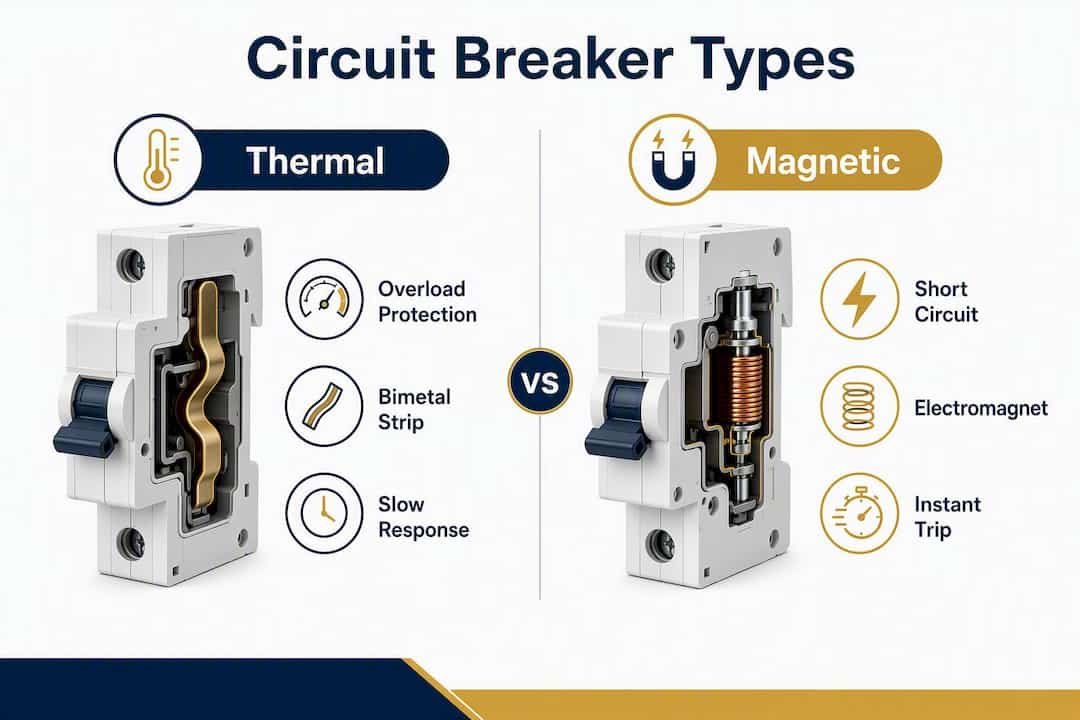
Thermal (bimetal) trip handles overloads. A bimetal strip inside the breaker bends as it heats up from excess current. When the strip bends far enough, it releases a latch and opens the circuit. This response is intentionally gradual — a brief surge from a motor starting up won’t trip it, but sustained overcurrent will.
Magnetic trip handles short circuits. A short circuit sends a massive current spike almost instantly. An electromagnet inside the breaker responds to that spike in milliseconds, snapping the contacts open before wiring can overheat. The speed difference between thermal and magnetic trips is significant: thermal trips take seconds to minutes, magnetic trips take fractions of a second.
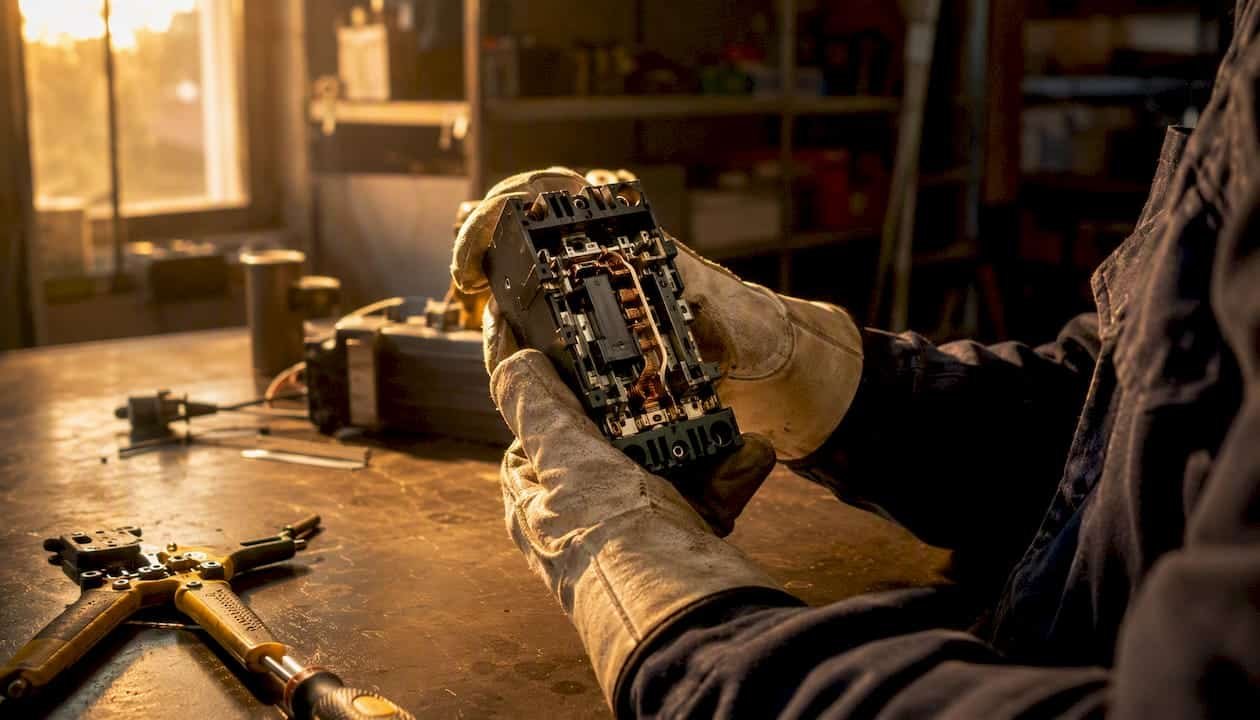
Modern breakers, including many from Eaton, Schneider Electric, and Square D, also incorporate electronic trip units that use sensors and microprocessors to monitor current with greater precision. These are common in molded-case breakers for larger loads.
When contacts open under load, an electric arc forms between them. Arc interruption chambers inside the breaker extinguish that arc safely, preventing it from sustaining itself and causing damage. Without this feature, opening a breaker under fault conditions could be as dangerous as the fault itself.
What types of circuit breakers will you find in a residential panel?
Most homes contain several breaker types, each designed to stop a specific kind of electrical hazard. Knowing which type protects which circuit helps you understand what your panel is actually doing.
- Standard thermal-magnetic (MCB): Protects against overloads and short circuits. Found on most general-purpose circuits (lighting, outlets, small appliances).
- GFCI breaker: Detects ground faults — tiny current leaks to ground that can cause electrocution — and trips in as little as 1/40th of a second. Required by NEC Article 210.8 in wet locations.
- AFCI breaker: Detects dangerous arcing in wiring or cords that could ignite a fire. Required by NEC Article 210.12 in most living spaces, including bedrooms.
- Dual-function AFCI/GFCI: Combines both protections in a single breaker. Eaton and Square D both offer dual-function models that satisfy both NEC requirements at once.
- Miniature circuit breaker (MCB): The standard single- or double-pole breaker most homeowners see in their panel.
- Molded-case circuit breaker (MCCB): Larger, higher-capacity breakers used for main disconnects, subpanels, and heavy appliances.
- Main breaker: Controls power to the entire panel; typically a large double-pole breaker at the top of the load center.
Where each type is typically required or installed
| Breaker Type | Typical Location | Primary Protection |
|---|---|---|
| Standard thermal-magnetic | General lighting, outlets | Overload, short circuit |
| GFCI breaker | Kitchen, bathroom, garage, outdoor, basement | Ground-fault shock |
| AFCI breaker | Bedrooms, living rooms, dining rooms | Arc-fault fire |
| Dual-function AFCI/GFCI | Any location requiring both protections | Arc-fault + ground-fault |
| Double-pole 30A | Dryer, water heater | Overload, short circuit |
| Double-pole breakers rated for electric ranges and ovens typically provide the necessary overload and short circuit protection | ||
| Double-pole breakers for HVAC or AC units provide protection against overloads, short circuits, and motor inrush current | ||
| Main breakers at the top of the main panel serve as the whole-home disconnect device |
Pro Tip: Dual-function breakers save panel space and satisfy two NEC requirements with one device, but when one trips, you won’t immediately know whether a ground fault or an arc fault caused it. Note the trip type displayed on the breaker face before resetting, and share that detail with your electrician.
Circuit breakers vs. fuses: what’s the real difference for homeowners?
Both devices protect circuits from overcurrent, but they do it differently and have very different practical implications for your home.
A fuse contains a metal element that melts and permanently breaks the circuit when current exceeds its rating. Once it blows, you replace it. A circuit breaker uses mechanical contacts that open and can be reset manually after the fault is cleared. That distinction drives nearly every practical difference between the two.
| Feature | Circuit Breaker | Fuse |
|---|---|---|
| Reset after trip | Yes — flip the switch | No — must be replaced |
| Response to short circuit | Magnetic trip: milliseconds | Melts quickly, but speed varies by type |
| Precision of protection | Consistent trip curve | Varies; may degrade over time |
| Cost per event | No replacement cost | Replacement cost each time |
| Availability | Reset on-site immediately | Requires correct replacement fuse on hand |
| Nuisance trip risk | Can be adjusted or upgraded | Fixed by fuse rating |
| NEC compliance (new construction) | Required in new residential panels | Permitted in existing installations |
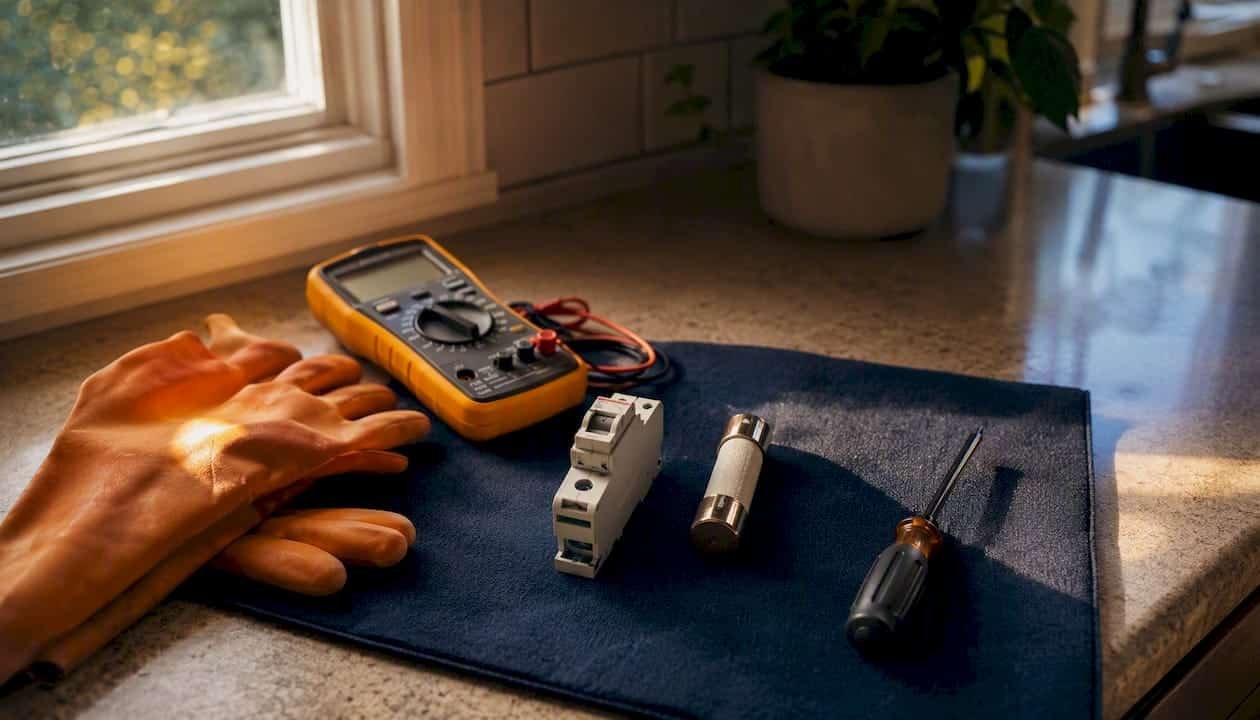
Fuse boxes are still found in older homes, particularly those built before the 1960s. They work, but they carry real drawbacks: homeowners sometimes install a higher-rated fuse to stop nuisance trips, which removes the protection entirely and creates a fire hazard. Breakers make that mistake much harder to make accidentally. For any home with a fuse box, a licensed electrician can assess whether an upgrade to a modern breaker panel makes sense.
What do the numbers and labels on a breaker actually mean?
The markings stamped on a breaker face tell you exactly what that device is rated to handle. Reading them correctly helps you spot a mismatch before it becomes a problem.
Amperage rating is the most visible number — 15, 20, 30, 50, and so on. This is the continuous current the breaker is designed to carry without tripping. The breaker must match the wire gauge on that circuit: a 20A breaker on 14-gauge wire (rated for 15A) is a code violation and a fire risk. For a plain-language breakdown of these terms, the appliance electrical terminology guide from Mdtechservices covers the most common labels homeowners encounter.
Voltage rating appears as 120V (single-pole) or 240V (double-pole). Most standard outlets and lighting circuits run on 120V. Large appliances like dryers, ovens, and HVAC units require 240V double-pole breakers.
Interrupting capacity (AIC rating) is the maximum fault current the breaker can safely interrupt without failing. Residential panels typically see fault currents up to 10,000 amps; most residential breakers carry a 10,000A AIC rating. Panels near utility transformers or in commercial-adjacent settings may require higher ratings.
UL listing or classification confirms the breaker passed independent safety testing. Look for “UL Listed” or “UL Classified” on the breaker label. A UL-classified breaker has been tested for use in specific panel brands other than its own manufacturer’s — this matters when replacing a breaker in a panel from a different brand.
| Label | What It Means | Why It Matters |
|---|---|---|
| 15A / 20A / 30A | Amperage rating | Must match circuit wire gauge |
| 120V / 240V | Voltage rating | Must match circuit voltage |
| 10,000AIC | Interrupting capacity | Must meet or exceed panel’s available fault current |
| UL Listed | Tested by UL for safety | Confirms device meets safety standards |
| UL Classified | Tested for use in specific other-brand panels | Required for cross-brand replacement |
| HACR | Rated for heating, AC, and refrigeration loads | Required for HVAC circuits |
Warning: Never replace a breaker with a different amperage, an unlabeled device, or a breaker not rated for your panel. Installing a non-classified breaker in a panel it wasn’t tested for can void your panel warranty and violate NEC requirements.
Why do breakers trip, and what should you do when one does?
A breaker trips because current exceeded the safe limit for that circuit, or because a ground fault or arc fault was detected. The four most common causes are overloads (too many devices on one circuit), short circuits (a hot wire contacts a neutral or ground), ground faults (current leaks to ground through a person or wet surface), and arc faults (damaged or loose wiring creates dangerous sparking).
For a deeper look at why a specific appliance may be causing repeated trips, the residential appliance troubleshooting guide from Mdtechservices walks through common appliance-related causes.
Follow this sequence when a breaker trips:
- Turn off or unplug devices on the tripped circuit. Reduce the load before you attempt a reset.
- Locate the tripped breaker. It will be in the middle position (not fully on, not fully off) or fully off, depending on the panel design.
- Push the breaker firmly to the OFF position first, then flip it back to ON. A partial reset won’t hold.
- Restore devices one at a time. This helps you identify which device caused the overload.
- Monitor for 10–15 minutes. If the breaker holds, the issue was likely a temporary overload.
- Label the circuit if it isn’t already labeled in your panel directory.
- If it trips again immediately or within minutes, stop. Do not reset a second time.
Call a licensed electrician if you notice:
- The breaker trips repeatedly on the same circuit
- A burning smell or scorch marks near the panel or outlet
- The panel feels warm to the touch
- Visible sparking or arcing
- The breaker won’t stay in the ON position
- The trip involves your main breaker, HVAC unit, or a large appliance
Pro Tip: Before calling a pro, unplug every device on the tripped circuit and try the reset. If it holds with nothing connected, plug appliances back in one at a time to isolate the problem. This simple step often cuts diagnostic time in half and helps the technician arrive with the right parts.
Signs your breaker or panel may be failing
A breaker that trips once is doing its job. A breaker that trips repeatedly, or a panel that shows physical warning signs, is telling you something more serious is wrong.
Act immediately (turn off power, leave the area, call an emergency electrician):
- Burning smell from the panel or any outlet
- Visible scorch marks, melted plastic, or discoloration on breakers or the panel interior
- Audible crackling or buzzing from the panel
- Flickering lights across multiple circuits combined with repeated trips
Schedule within 24–48 hours:
- A breaker that trips two or more times on the same circuit within a week without an obvious overload cause
- A breaker that feels warm or hot to the touch
- A breaker that won’t stay in the ON position after a proper reset
- Lights that dim noticeably when a large appliance starts
Monitor and label (low urgency, but worth noting):
- A single trip that doesn’t repeat after load reduction
- Occasional nuisance trips on a circuit with a motor-driven appliance
Older panels deserve special attention. Panels from the 1960s–1980s, particularly certain vintage brands that have since been discontinued, are known to have reliability issues with breakers that no longer trip reliably under fault conditions. If your home has an older panel and you’re unsure of its condition, a licensed electrician can evaluate whether an upgrade is warranted. Main disconnects and service entrance equipment should only be inspected and serviced by a licensed professional — never by a homeowner.
What maintenance can you safely do yourself?
Routine breaker maintenance is straightforward, and most of it takes less than five minutes a month. The key is knowing where the homeowner’s role ends and the licensed electrician’s begins.
Monthly homeowner checklist:
- Test GFCI breakers: Press the TEST button on any GFCI breaker or outlet. Power to that circuit should cut immediately. Press RESET to restore it. Per NEC guidance, GFCI devices should be tested regularly to confirm they function.
- Test AFCI breakers: Press the TEST button on AFCI breakers the same way. The breaker should trip. Reset and confirm power returns.
- Visually inspect the panel cover: Look for scorch marks, rust, moisture, or pest intrusion around the panel exterior. Do not open the panel cover yourself.
- Check for unusual sounds or smells: Any buzzing, crackling, or burning odor near the panel warrants a call to a licensed electrician.
- Keep the panel area clear: Maintain at least 36 inches of clear working space in front of the panel per NEC requirements. Never store items directly in front of it.
- Maintain a circuit labeling log: A written or photographed record of which breaker controls which circuit saves time during troubleshooting and speeds up any technician visit.
For a structured inspection checklist you can use before a technician arrives, the appliance safety inspection guide from Mdtechservices is a practical starting point.
What homeowners must never do:
- Open the panel cover and touch the bus bars or service entrance wires — these remain energized even with the main breaker off
- Replace a breaker unless you hold a valid electrical license
- Bypass a breaker or install a higher-rated breaker to stop nuisance trips
Pro Tip: A licensed electrician should perform AIC verification, panel load calculations, and any motor-start current studies for heavy appliances like HVAC units. These aren’t DIY tasks — they require calibrated instruments and code knowledge that go beyond what a visual inspection can reveal.
Field notes on dedicated circuits and breaker sizing for appliances
High-draw appliances don’t just need more power — they often need a circuit designed specifically for them. This is one of the most common issues Mdtechservices technicians encounter in Orange County and Los Angeles County homes.
A dedicated circuit serves one appliance only, with no other outlets or devices sharing the load. Electric dryers, ranges, ovens, and central air conditioning units generally require dedicated circuits with amperage and voltage ratings appropriate to their appliance specifications.
HVAC and other motor-driven appliances create a specific challenge: inrush current. When a compressor or motor starts, it draws several times its normal running current for a fraction of a second. A standard breaker sized to the running current may nuisance-trip on that startup surge. Technicians address this by specifying motor-rated breakers with time-delay characteristics, or by verifying that the breaker’s trip curve matches the motor’s inrush profile. For HVAC-specific electrical concerns, Mdtechservices covers the diagnostic process in detail in the HVAC repair guide.
When a technician arrives to diagnose a nuisance-tripping HVAC breaker, they’ll typically measure startup current with a clamp meter, compare it against the breaker’s trip curve, and confirm the breaker is both correctly sized and UL-classified for the panel it’s installed in. Installing a non-classified breaker in a mismatched panel can void the panel warranty and violate NEC requirements — a detail that matters when an insurance claim is involved.
Before a technician arrives, note:
- The make and model of the appliance causing trips
- How long the appliance has been on the circuit and when trips started
- Any recent changes (new appliance, recent electrical work, panel additions)
- Whether the trip is immediate on startup or occurs after the appliance has been running
This information cuts diagnostic time significantly and helps the technician confirm the right breaker spec on the first visit.
Key Takeaways
A circuit breaker is your home’s primary defense against electrical fires and shock — reset it once after a trip, but repeated trips always require a licensed electrician.
| Point | Details |
|---|---|
| Reset safely, once only | Turn off loads first, reset the breaker once, and call a pro if it trips again. |
| Test GFCI/AFCI monthly | Press the TEST button on GFCI and AFCI breakers every month to confirm they function. |
| Match breaker to wire and panel | Amperage, voltage, AIC rating, and UL classification must all match the circuit and panel brand. |
| Red flags need a pro | Burning smell, scorch marks, warm panel, or repeated trips on the same circuit require a licensed electrician. |
| Mdtechservices for appliance and HVAC circuits | Mdtechservices diagnoses breaker trips, installs dedicated circuits, and sizes breakers for HVAC and major appliances in Orange County and Los Angeles County. |
What our technicians see most often in the field
The most common panel problems we encounter in Orange County and Los Angeles County homes aren’t mysterious. They’re almost always one of three things: panels that haven’t been touched since the 1980s and have breakers that no longer trip reliably, circuits that were never designed for the appliances now running on them, and DIY wiring work that looked fine on the surface but created a hazard inside the wall.
Older panels concern us most. A breaker that looks fine from the outside can have internal contacts that have degraded to the point where they won’t open under a real fault. That’s not a nuisance problem — it’s a fire risk that a visual inspection from the homeowner’s side of the panel cover won’t catch.
Before we arrive, the most useful thing you can do is write down which circuits trip, when they trip (immediately on startup or after running a while), and what appliances are on those circuits. If you’ve had any electrical work done recently, note that too. Clear access to the panel — nothing stacked in front of it — means we can get to work immediately rather than spending the first ten minutes moving storage.
Our priority on every visit is NEC and UL compliance. That means we won’t install a breaker that isn’t rated for your panel, and we won’t size a circuit based on what’s convenient — only on what the code and the appliance nameplate require.
Mdtechservices can help when your breakers keep tripping
When a breaker trips once and stays reset, you’ve handled it correctly. When it trips repeatedly, or when you see any of the red flags covered above, the safe move is a professional diagnosis — not another reset.
Mdtechservices serves homeowners across Orange County and Los Angeles County with licensed electrical diagnosis, dedicated circuit installation, HVAC breaker sizing, and panel-related appliance hookups. If your dryer, oven, or AC unit keeps tripping its breaker, our technicians can measure inrush current, confirm breaker compatibility, and install the correctly rated circuit the first time. We work to NEC and UL standards on every job, and we carry the parts most residential panels need on the truck.
Ready to stop guessing and get a confirmed diagnosis? Book an appliance repair or installation service with Mdtechservices, or call us directly to schedule an inspection at your home.
This article provides general educational information about residential circuit breakers. For questions about your specific electrical system, consult a licensed electrician and refer to the current edition of the NEC or your local authority having jurisdiction.
Useful sources for homeowners who want to go further
The sources below are the most authoritative references on residential circuit breakers, NEC requirements, and UL safety standards. They’re worth bookmarking if you’re researching a panel upgrade or trying to understand a specific code requirement.
- NFPA 70 (National Electrical Code) — The governing U.S. code for residential electrical installations, including GFCI (Article 210.8), AFCI (Article 210.12), and overcurrent protection requirements.
- UL — product safety and listing information — Explains what “UL Listed” and “UL Classified” mean for circuit breakers and how to verify a breaker’s compatibility with your panel.
- Circuit breaker — Wikipedia — A solid foundational overview of breaker types, operating principles, and the resettable vs. fuse distinction.
- Eaton — residential circuit breakers — Product and fundamentals resource covering AFCI, GFCI, dual-function, and UL-classified residential breaker families.
- Residential electronic circuit breaker basics — ABB Electrification U.S. — A manufacturer-level explanation of how residential breakers monitor current and protect load centers.
- What is a circuit breaker? A homeowner’s guide — A practical homeowner-focused explainer covering residential breaker basics and common questions.
- Why your circuit breaker keeps tripping: causes and fixes — Practical troubleshooting guidance on the most common trip causes and when to call a professional.