
TL;DR:
- A professional home energy audit evaluates your house’s performance and provides a prioritized, cost-effective improvement plan.
- Different levels of audits range from basic inspections to comprehensive energy modeling, guiding HVAC, appliance, and plumbing decisions.
A professional home energy audit tells you exactly how your house performs and gives you a prioritized, cost-effective plan for every appliance, HVAC, and plumbing decision ahead. The U.S. Department of Energy describes it as a multi-phase assessment that can run from a short visit to several hours depending on property size and diagnostic depth. The Building Performance Institute (BPI) sets the national standard for what auditors must test, report, and disclose. Research from Lawrence Berkeley National Laboratory (LBNL) confirms that homeowners act on audit findings most when the auditor translates numbers into specific, room-by-room solutions. Done right, an audit prevents the single most expensive sequencing mistake in home improvement: replacing HVAC equipment before fixing the envelope it has to condition.
Table of Contents
- What a professional home energy audit actually covers
- What the main diagnostic tests reveal about your home
- What homeowners and property managers gain from an energy audit
- How audit results should change your HVAC, appliance, and plumbing decisions
- What to expect during an audit: timeline, cost, and report contents
- How to pick a qualified auditor before you book
- How to prepare so your auditor can target real problems
- What to do with the audit report once you have it
- Real-world examples of audit impact on energy savings
- Common challenges with energy audits and how to handle them
- Software and tools auditors use to analyze audit data
- How evolving energy codes are shaping audit standards
- How energy audits connect to green building certifications
- Key Takeaways
- What local contractors actually do with audit data
- Mdtechservices is ready to implement your audit recommendations
- Authoritative sources and where to read more
What a professional home energy audit actually covers
Energy efficiency assessments fall into three levels, each with a different scope and deliverable.
- Level 1 (Walk-Through Survey): A one-hour visual inspection of the home’s envelope, mechanical systems, and utility bills. The auditor identifies obvious inefficiencies and low-cost fixes. No diagnostic equipment is required.
- Level 2 (Survey with Diagnostics): Adds blower door testing, duct leakage measurement, and infrared scanning. The report includes prioritized measures with cost-benefit estimates. This is the most common residential level.
- Level 3 / Building Performance Audit: Full diagnostic testing plus computerized energy modeling. RESNET defines this as a comprehensive HERS rating that produces a score on the HERS Index, supports financing, and qualifies for certain federally sponsored mortgage products. Takes 3–4 hours for an average home.
The ANSI/BPI-1100-T-2023 standard specifies required diagnostic tools, report contents, and a code of ethics that includes conflict-of-interest disclosure. BPI certification or an equivalent credential matters beyond quality assurance: many utility rebate programs and state incentive plans require a certified auditor for the homeowner’s documentation to qualify.
What the main diagnostic tests reveal about your home
Each tool answers a specific question about where your home is losing energy or creating a safety risk.
| Diagnostic Tool | What It Measures | Homeowner Symptom or Risk |
|---|---|---|
| Blower door (calibrated) | Whole-house airtightness (air changes per hour) | Drafts, high heating/cooling bills, uneven temperatures |
| Duct leakage tester | Conditioned air lost through duct system | Rooms that won’t cool or heat, high utility bills |
| Infrared camera | Insulation gaps, thermal bridges, moisture intrusion | Cold walls, condensation, mold risk |
| Combustion analyzer | Flue gas composition, CO levels, appliance efficiency | Carbon monoxide risk, backdrafting, unsafe gas appliances |
The DOE’s diagnostic guidance recommends running the blower door and infrared camera together: the blower door depressurizes the house, and the IR camera then shows exactly where conditioned air is escaping. A properly calibrated blower door with a manometer is required for reliable airtightness metrics; an uncalibrated test can locate leaks but cannot produce the numbers needed for energy modeling or post-work verification.
BPI’s standard requires combustion safety and ventilation checks as part of any comprehensive audit because gas appliances that backdraft or spill combustion gases are a direct health hazard, not just an efficiency problem.
What homeowners and property managers gain from an energy audit
The importance of energy audits goes well beyond a lower utility bill.
- Prioritized, cost-effective measures: The report ranks improvements by return on investment, so you spend money where it matters most first.
- Right-sized HVAC: Audit data quantifies the envelope’s actual load, preventing contractors from installing oversized equipment that short-cycles and fails early.
- Rebate and incentive eligibility: Audit documentation is commonly required to qualify for utility rebates and federal tax credit pathways. Programs like NYSERDA in New York require specific audit protocols from certified providers before any rebate is approved.
- Combustion safety and indoor air quality: Ventilation and combustion checks catch carbon monoxide risks and moisture problems before they become expensive repairs or health emergencies.
- Improved comfort: Sealing air leaks and adding insulation eliminates the drafts and hot/cold rooms that no amount of thermostat adjustment can fix.
NYSERDA’s guidance notes that implementing recommended upgrades typically cuts a home’s energy use by 5–30%. Air sealing and attic insulation are consistently the quickest wins because they reduce load on every mechanical system in the house simultaneously.
How audit results should change your HVAC, appliance, and plumbing decisions

Audit findings directly affect whether you repair, replace, or re-size equipment. The BPI standard is explicit: replacing HVAC before fixing envelope leakage leads to oversized equipment and higher lifecycle costs. An audited envelope gives your contractor the load calculations needed to select the correct capacity unit, which means fewer service calls and a longer equipment life.
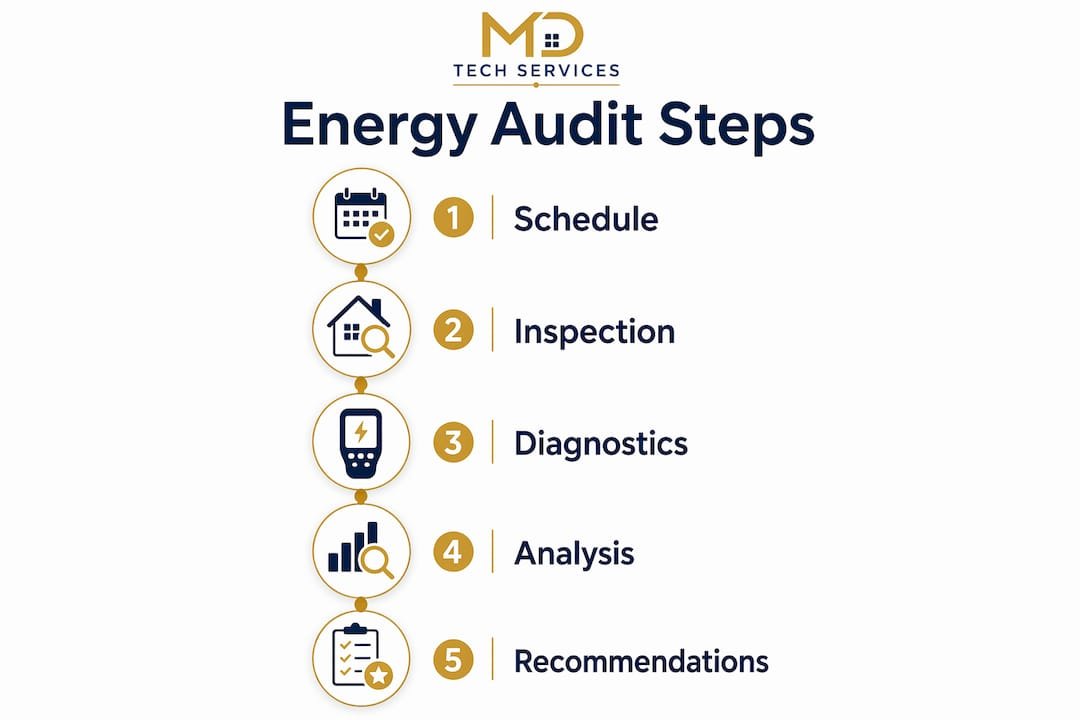
Air sealing and insulation can reduce the required heating and cooling capacity enough to justify a smaller, less expensive system. That savings on equipment cost often offsets a significant portion of the weatherization work itself.
Plumbing decisions follow the same logic. Combustion safety tests flag whether a water heater is backdrafting. Hot water distribution audits reveal whether pipe insulation or a recirculation pump would reduce standby losses. When an audit identifies moisture intrusion, that finding determines whether a plumbing repair is the root cause or whether envelope work comes first.
Pro Tip: Follow this sequence every time: seal and insulate the envelope first, retest airtightness to confirm results, then right-size and install mechanical systems. Skipping the retest before equipment selection is the most common contractor error audit findings are designed to prevent. See Mdtechservices’s HVAC efficiency tips for how this plays out in Southern California homes.
What to expect during an audit: timeline, cost, and report contents
Timeline: A Level 1 walk-through takes roughly one hour. A Level 2 diagnostic audit runs two to four hours. A full HERS rating with modeling can take longer, depending on house size and access to mechanical systems.
Cost: DOE guidance lists typical residential audit costs at roughly $100–$500 for common diagnostic audits, with comprehensive modeling pushing costs higher. Many contractors reduce or waive the audit fee when they perform the subsequent work. State and utility programs often subsidize or fully cover the cost for qualifying households.
What the report contains:
- Diagnostic results (airtightness measurements, duct leakage percentages, IR findings)
- Combustion safety and ventilation assessment results
- Prioritized improvement measures ranked by cost-effectiveness
- Cost-benefit estimates and projected annual savings for each measure
- Safety findings requiring immediate attention
- Documentation package for rebate and tax credit applications
| Report Element | Why It Matters |
|---|---|
| Prioritized measure list | Tells you what to fix first for the best return |
| Cost-benefit analysis | Lets you compare bids and evaluate payback periods |
| Safety findings | Flags combustion or moisture hazards requiring prompt action |
| Incentive documentation | Required by most utility and state rebate programs |
How to pick a qualified auditor before you book
Credentials determine both the quality of the work and your eligibility for incentives. Look for BPI certification, a RESNET/HERS rater designation, or a DOE Home Energy Score Certified Assessor. State programs like NYSERDA maintain lists of approved providers; using an auditor outside that list can disqualify your rebate application entirely.
Before booking, ask these questions:
- What diagnostic equipment do you use? (Blower door and IR camera are non-negotiable for a Level 2 audit.)
- Can you provide a sample report showing prioritized measures and cost-benefit analysis?
- Do you or your company also sell the improvements you recommend? If yes, how do you disclose that conflict? BPI’s standard requires transparency here.
- Will you help with incentive paperwork and post-work verification testing?
LBNL research found that the auditor’s ability to explain findings conversationally drove homeowner follow-through more than the numeric report alone. Communication skill is a real vetting criterion, not a soft preference.
How to prepare so your auditor can target real problems
Good preparation turns a general inspection into a targeted diagnostic session.
- Gather 12 months of utility bills so the auditor can establish a baseline before arriving.
- Write down room-by-room comfort complaints: which rooms are always cold, where condensation appears, which areas smell musty.
- Note any recent equipment replacements (water heater, furnace, AC unit) and their ages.
- Locate and clear access to the attic, crawlspace, and all HVAC equipment.
- Secure pets and plan to walk through the home with the auditor during the inspection.
Specific anecdotal details, like a damp closet or a bedroom that never reaches the set temperature, help the auditor prioritize diagnostic time. DOE preparation guidance confirms that utility bill history and comfort complaints together allow the auditor to tailor diagnostics to actual usage patterns rather than running a generic checklist.
What to do with the audit report once you have it
Turning a report into completed work requires a clear procurement process.
- Review the prioritized measure list and decide which scope you want: full retrofit, phased work by season, or quick fixes only.
- Share the full audit report with every contractor you solicit. Ask for line-item pricing tied specifically to the audit’s diagnostic findings, not generic estimates.
- Require post-work verification testing (blower door retest after air sealing, duct leakage retest after duct work) as a contract condition.
- Track incentive paperwork deadlines; most rebate programs require documentation submitted within a set window after work completion.
A simple email to contractors works well: “Attached is my home energy audit completed by [auditor name]. I am requesting bids for the following measures listed in the report: [list]. Please price each measure separately and confirm whether your scope includes post-work verification testing.” That framing filters out contractors who cannot work from diagnostic data.
Real-world examples of audit impact on energy savings
A 100-year-old home in Cleveland documented by AP News showed how a professional assessment identified the specific combination of air sealing, insulation, and HVAC upgrades needed before any equipment was replaced. The auditor’s hour-long interview established goals and comfort priorities before a single diagnostic test ran.
NYSERDA’s EmPower+ program provides a practical case at scale: low- and moderate-income New York households receive no-cost assessments followed by targeted upgrades including air sealing and appliance replacement. The program’s structure, assessment first then contractor referral, reflects the sequencing principle that audits exist to enforce. Homes that follow the full sequence consistently land within the 5–30% energy reduction range NYSERDA documents.
For property managers overseeing multifamily buildings, utility-run programs offer on-site assessments of both common areas and tenant units, with reports that quantify savings opportunities and available incentives by measure.
Common challenges with energy audits and how to handle them
Auditor conflict of interest: Some auditors also sell the improvements they recommend. Ask directly whether they profit from your upgrades and request a written conflict-of-interest disclosure. BPI’s ethics standard requires this transparency.
Incomplete diagnostics: A walk-through without a blower door or IR camera cannot quantify leakage or locate insulation gaps reliably. If a quote does not include these tools, you are getting a Level 1 assessment regardless of what it is called.
Report without prioritization: A list of problems with no cost-benefit ranking leaves you guessing where to start. Audit reports that include clear cost-benefit analyses and post-work verification plans materially increase homeowner follow-through on higher-cost measures.
Incentive timing: Rebate programs change. Verify current program rules with your utility or state energy office before committing to a scope, because work completed before an audit or outside program guidelines typically does not qualify.
Software and tools auditors use to analyze audit data
Beyond the physical diagnostic instruments, auditors rely on energy modeling software to convert field measurements into projected savings. The most widely used platforms in U.S. residential auditing include:
REM/Rate and EnergyPlus are the primary modeling engines behind HERS ratings. They take blower door results, insulation R-values, window specifications, and mechanical system data to calculate annual energy use and model the impact of proposed improvements.
Home Energy Score (DOE): A standardized scoring tool that produces a 1–10 rating comparable across homes. Auditors certified by the DOE’s Home Energy Score program use this tool to generate a score that can appear in real estate listings and support financing decisions.
Audit reporting platforms like OptiMiser and similar field software allow auditors to enter diagnostic data on-site and generate formatted reports with prioritized measures and cost-benefit tables. These tools reduce reporting time and improve consistency across auditors working within the same utility program.
How evolving energy codes are shaping audit standards
The 2021 and 2024 editions of the International Energy Conservation Code (IECC) tightened airtightness requirements for new construction, which has a direct effect on existing-home audits: homes built before these standards are now measurably below current code, and audit findings increasingly reference IECC benchmarks when recommending air sealing targets.
California’s Title 24 energy code, which applies directly to Orange County and Los Angeles County homes, sets some of the strictest residential efficiency requirements in the country. Audits conducted on California properties reference Title 24 compliance thresholds for insulation, HVAC efficiency ratings, and ventilation rates. When audit findings show a home is below Title 24 standards, that gap often determines permit requirements for replacement equipment.
ASHRAE Standard 62.2 governs residential ventilation and is referenced in BPI’s auditing standard. As homes are tightened through air sealing, mechanical ventilation becomes necessary to maintain indoor air quality, and auditors are required to assess ventilation adequacy as part of any comprehensive diagnostic audit.
How energy audits connect to green building certifications
An energy audit is the foundation document for several sustainability certification pathways.
ENERGY STAR Certified Homes requires verified performance testing, including blower door and duct leakage results, that mirrors what a comprehensive audit produces. Homes pursuing this certification after a retrofit use their audit diagnostics as the baseline documentation.
LEED for Homes and WELL Building Standard both incorporate energy performance metrics that align with audit findings. Property managers pursuing green certification for multifamily buildings typically use audit data to establish the baseline score and identify the measures needed to reach certification thresholds.
Home Energy Score functions as a lightweight certification signal for real estate: a score of 6 or above indicates above-average efficiency and can be disclosed in MLS listings. Audits that include a Home Energy Score give property owners a marketable, standardized efficiency credential alongside the technical report. Building envelope improvements identified in audits, including energy-efficient doors and windows, directly affect both the score and certification eligibility.
Key Takeaways
A professional home energy audit is the single most reliable tool for making correct, cost-effective decisions about HVAC, appliance, and plumbing work in any U.S. home.
| Point | Details |
|---|---|
| Seal before you replace | Fix envelope leaks and insulation before sizing or installing any new HVAC equipment. |
| Insist on diagnostics | A blower door, duct leakage tester, and IR camera are required for a reliable Level 2 audit. |
| Verify auditor credentials | BPI certification or equivalent is required for most utility rebate and state incentive programs. |
| Audit costs $100–$500 | Many contractors reduce or waive the fee when they perform the subsequent work. |
| Mdtechservices implements audit findings | For Orange County and LA County homeowners, Mdtechservices handles HVAC, appliance, plumbing, and gas conversion work tied directly to audit recommendations. |
What local contractors actually do with audit data
Most homeowners assume the audit report speaks for itself. In practice, how a contractor reads and applies that data determines whether the work actually delivers the projected savings.
When our technicians at Mdtechservices receive an audit report before a service call, the first thing we look at is the blower door result and the duct leakage percentage. Those two numbers tell us whether an HVAC replacement will perform as specified or whether the envelope needs attention first. In Southern California’s climate zones, this matters more than most homeowners expect: a home in Orange County or LA County with significant duct leakage into an unconditioned attic can lose a substantial portion of conditioned air before it reaches the living space, and no equipment upgrade fixes that without addressing the ducts.
California’s Title 24 requirements add a layer that out-of-state audit guides rarely mention. Permit-required HVAC replacements in our service area must meet current efficiency minimums, and an audit that documents existing conditions gives both the homeowner and the contractor the baseline needed to confirm compliance. For gas appliance conversions, combustion safety findings in the audit directly inform how we approach the LP to natural gas conversion and whether additional ventilation work is required before the conversion is safe.
The insulation and HVAC relationship in our local climate is also shaped by shading and solar gain in ways that a generic national audit template may underweight. We factor those local conditions into every equipment recommendation we make from audit data.
Mdtechservices is ready to implement your audit recommendations
Getting an audit report is step one. Having a licensed, experienced local team execute the work correctly is what actually lowers your bills and keeps your home safe. Mdtechservices serves Orange County and Los Angeles County homeowners and property managers with HVAC repair and installation, appliance repair and installation, plumbing services, and gas appliance conversions, all performed by licensed technicians who know how to work from audit findings.
When you book with Mdtechservices, attach your audit report to the service request and we will price each recommended measure separately, confirm post-work verification testing, and help you gather the documentation your rebate program requires. Whether your audit points to a duct repair, a new HVAC system, a water heater replacement, or a gas conversion, our team handles it from the first diagnostic call through final sign-off. For HVAC work specifically, start with our HVAC repair guide to understand what the service involves, then book your evaluation online or call us directly to get your audit recommendations on the schedule.
Authoritative sources and where to read more
- U.S. Department of Energy (DOE): Primary guidance on professional home energy assessments, diagnostic techniques, and the Home Energy Score program.
- ANSI/BPI-1100-T-2023 (BPI): The national standard for home energy auditing, covering required diagnostics, report contents, and auditor ethics.
- Lawrence Berkeley National Laboratory (LBNL): Research on homeowner experiences with audits and what drives follow-through on recommendations.
- RESNET: Defines the three audit levels and the HERS rating system used in financing and real estate disclosures.
- Property Inspection Authority: Practical summary of audit processes, ratings, and incentive documentation requirements.
- NYSERDA and your local utility: Contact your state energy office or utility for current rebate program rules, approved auditor lists, and income-qualified no-cost assessment options. NYSERDA’s EmPower+ program is one of the most comprehensive models for how state programs structure audit-to-upgrade pathways.