
TL;DR:
- Rapid response services deploy licensed technicians quickly to prevent damage from appliance and HVAC failures. Proper preparation and clear communication protocols ensure fast, reliable repairs, protecting property value and tenant safety.
Rapid response services are defined as organized, on-call repair systems that deploy licensed technicians to address urgent residential appliance and HVAC failures before they escalate into costly damage. The role of rapid response services in property management is to close the gap between a breakdown and a fix, protecting both the property and the people living in it. When a refrigerator fails in the middle of summer or an HVAC system stops working during a heat wave, every hour without service increases the risk of food loss, structural damage, and tenant complaints. Mdtechservices operates on this principle across Orange County and Los Angeles County, providing fast, expert dispatch for exactly these situations.
What benefits do rapid response services provide to property owners?
Fast intervention is the single greatest benefit rapid response teams deliver. Early intervention by a trained team significantly improves outcomes compared to delayed service calls. That principle applies directly to home repairs: a refrigerant leak caught within two hours causes far less damage than one discovered the next morning.
Property owners and managers who use rapid response services consistently report four core advantages:
- Reduced repair time. A technician who arrives within hours stops a problem from compounding. A slow-draining condensate line becomes a ceiling water stain if left overnight.
- Expert diagnostics on the first visit. Rapid response teams carry the tools and parts needed for the most common failures, which means fewer return trips and faster resolution.
- Lower total repair costs. Catching a failing compressor early costs far less than replacing a flooded floor. Early professional intervention consistently reduces long-term damage and associated costs.
- Stronger tenant relationships. Tenants who see fast action from their property manager trust the management team more. That trust reduces turnover and protects your rental income.
Pro Tip: Keep a written log of every appliance and HVAC unit on your property, including model numbers and last service dates. When you call for rapid response, that information cuts diagnostic time in half.
Rapid response also protects your property’s reputation. A single unresolved emergency posted on a review platform can cost you future tenants. Speed of resolution is one of the most visible signals of professional property management.
How do rapid response services work in urgent appliance and HVAC repairs?
A rapid response service operates as a coordinated chain, not a single technician showing up at your door. Effective rapid response requires communication protocols, immediate access to expertise, and standardized triggering criteria working together. Each link in that chain must function correctly for the outcome to be fast and reliable.
The typical workflow follows these steps:
- Trigger identification. The property owner or tenant reports a failure. Clear criteria define what qualifies as an emergency, such as total HVAC loss during temperatures above 90°F or a refrigerator that has been warm for more than four hours.
- Dispatch coordination. A dispatcher receives the call, confirms the issue type, and assigns the closest available licensed technician. Dispatch coordinators and customer service representatives trained in triage are a standard part of professional rapid response teams.
- Assessment on arrival. The technician performs a structured diagnostic to identify the root cause, not just the symptom. This step prevents repeat failures.
- Repair or stabilization. The technician completes the repair if parts are available, or stabilizes the system to prevent further damage while parts are sourced.
- Documentation and follow-up. The service call is logged with response time, diagnosis, and repair details. Tracking granular process metrics like response time and time-to-repair is what separates improving teams from stagnant ones.
The table below shows how team roles divide during a typical rapid response call.
| Team Role | Primary Responsibility | Impact on Outcome |
|---|---|---|
| Dispatcher | Receives call, triages urgency, assigns technician | Reduces time from report to dispatch |
| Lead Technician | Diagnoses system, performs repair | Determines repair quality and speed |
| Parts Coordinator | Sources and delivers needed components | Prevents delays from missing parts |
| Customer Service Rep | Updates property owner throughout the call | Maintains trust and clear communication |

Technology also plays a growing role. AI-based triage tools for HVAC dispatch now allow after-hours calls to be assessed and routed automatically, cutting the gap between a tenant’s call and a technician’s arrival.
What types of urgent repairs require rapid response?
Common residential emergencies requiring rapid response include HVAC failures during extreme weather and major appliance breakdowns that directly affect tenant safety and comfort. Delays in these situations cause damage that grows with every passing hour.
The most frequent urgent repair categories are:
- HVAC system failures. A complete loss of cooling during a Southern California heat wave creates health risks for elderly tenants and families with young children. A loss of heat in winter can cause pipe damage on top of the comfort issue.
- Refrigerator and freezer failures. A refrigerator that stops cooling loses safe food temperatures within four hours. For property managers who provide furnished units, this is both a tenant safety issue and a liability concern.
- Gas appliance malfunctions. A stove or range with a faulty gas valve or ignition system poses a direct safety risk. These calls require licensed technicians, not a wait-and-see approach.
- Ice machine breakdowns. For properties with shared amenities, an ice machine failure during summer months generates immediate tenant complaints and can indicate a larger refrigerant or water supply issue.
The consequences of delayed repairs go beyond the immediate fix. A tenant who waits 48 hours for a working HVAC system in July has a legitimate complaint and a legal basis for rent reduction in many California jurisdictions. Speed is not just a service quality issue. It is a legal and financial one.
For property owners in Los Angeles and Orange County, reviewing urgent repair scenarios specific to the region helps set realistic response time expectations before an emergency happens.
How can property owners optimize their use of rapid response services?
Preparation before an emergency determines how fast and effective the response will be. Rapid response systems work best when triggering criteria are standardized and communication channels are already established. Waiting until a crisis to figure out who to call adds unnecessary time to every step.
The most effective preparation steps are:
- Create a written emergency contact list. Include your primary repair provider, a backup, and utility emergency lines. Post it in a shared location accessible to property staff and tenants.
- Define what counts as an emergency. Not every appliance issue requires rapid response. Set clear thresholds, such as total system failure versus reduced performance, so tenants and staff know when to escalate.
- Establish a service-level agreement. A formal agreement with your repair provider should specify maximum response times for different emergency categories. This removes ambiguity and holds the provider accountable.
- Document all equipment. Maintain a current list of every appliance and HVAC unit with model numbers, installation dates, and warranty status. This information speeds up every service call.
Pro Tip: Schedule a non-emergency inspection of your HVAC systems before summer and winter each year. Technicians who already know your equipment respond faster and more accurately during an emergency.
A common mistake property owners make is calling rapid response for issues that qualify as routine maintenance. This wastes response capacity and can delay service for genuine emergencies. Tracking response times and outcomes over time also helps you evaluate whether your current provider is meeting agreed standards. If response times are drifting longer, that data gives you a clear basis for a conversation or a change.
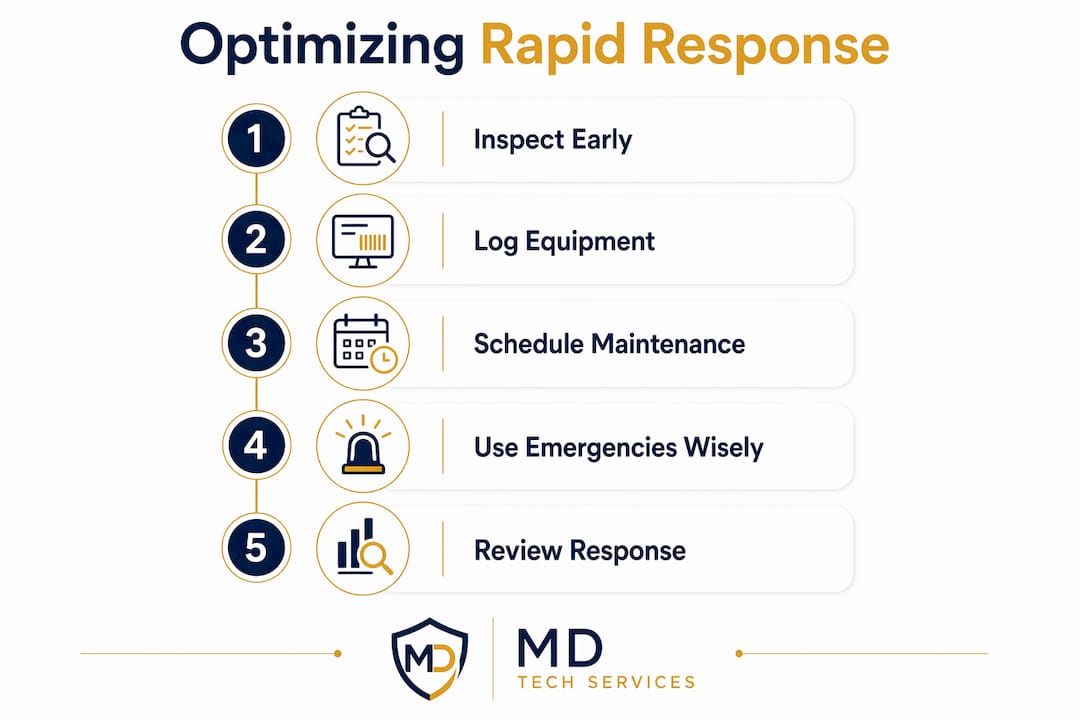
Reducing appliance downtime through proactive maintenance is the most reliable way to reduce how often you need emergency service in the first place.
Key Takeaways
Rapid response services protect property value and tenant safety by closing the gap between a system failure and a qualified repair, and preparation before an emergency determines how well that gap gets closed.
| Point | Details |
|---|---|
| Speed determines damage scope | Every hour of delay after an appliance or HVAC failure increases repair cost and tenant impact. |
| Team coordination drives results | Dispatchers, technicians, and parts coordinators must work together for fast, reliable outcomes. |
| Preparation cuts response time | Written emergency contacts, equipment logs, and defined triggers reduce time lost during a crisis. |
| Service agreements create accountability | A formal agreement with response time standards holds your provider to measurable commitments. |
| Tracking metrics improves outcomes | Logging response times and repair results lets you identify gaps and improve your emergency process. |
What I’ve learned after years of urgent repair calls
Property owners often underestimate how much the quality of a rapid response depends on what happens before the emergency. The call itself is almost the easy part. What slows everything down is the missing model number, the tenant who didn’t know who to contact, or the property manager who assumed the HVAC was under warranty when it wasn’t.
The most prepared property owners I’ve worked with treat rapid response like a fire drill. They run through the scenario before it happens. They know which technician covers their area, they have the service agreement in writing, and their tenants have a single number to call. When something breaks at 10 p.m. on a Friday, those owners get a technician on-site within hours. The unprepared ones are still making calls at midnight.
The other thing worth saying directly: not every provider who calls themselves a rapid response service actually operates that way. Response time guarantees mean nothing without the dispatch infrastructure and licensed technicians to back them up. Ask your provider specifically how they handle after-hours calls and what their average time-to-arrival looks like for your area. If they can’t answer that question with a number, that tells you something.
Rapid response is a system. Build it before you need it, and it works exactly as intended.
— MDTECH
Mdtechservices rapid response for appliances and HVAC
When an appliance or HVAC system fails at your property, you need a licensed technician who knows the equipment and can arrive fast. Mdtechservices serves property owners and managers across Orange County and Los Angeles County with expert repair and installation for major residential appliances and HVAC systems.

Whether you are dealing with a refrigerator that stopped cooling, an HVAC unit that went down overnight, or a gas appliance that needs immediate attention, Mdtechservices provides the licensed expertise and responsive dispatch to get your property back to normal quickly. Learn more about residential appliance repair and HVAC repair services to understand what a qualified rapid response looks like for your specific situation.
FAQ
What is the role of rapid response services in home repairs?
Rapid response services deploy licensed technicians quickly after an appliance or HVAC failure to stop damage from escalating and restore function as fast as possible. Their core role is to close the time gap between a breakdown and a qualified repair.
How fast should a rapid response service arrive?
Response time depends on the provider and the agreement in place, but a professional rapid response service for residential appliances and HVAC should arrive within a few hours for critical failures. A written service-level agreement specifying maximum response times is the best way to set clear expectations.
What qualifies as an emergency requiring rapid response?
Total HVAC failure during extreme weather, a refrigerator that has lost cooling for more than four hours, and any gas appliance malfunction qualify as emergencies. Urgent repair examples for Southern California homeowners illustrate the most common scenarios.
How do rapid response teams handle after-hours calls?
Professional rapid response teams use dedicated dispatch coordinators and, increasingly, automated triage systems to receive and route after-hours calls. The goal is to assign a technician without waiting for normal business hours.
How can property managers reduce the need for emergency repairs?
Scheduled preventive maintenance on HVAC systems and major appliances before peak seasons is the most effective way to reduce emergency calls. Keeping detailed equipment records also speeds up every service interaction, whether routine or urgent.