
TL;DR:
- Homeowners often misjudge their HVAC airflow balance, leading to increased energy costs and discomfort. Proper airflow ensures even temperature and humidity control, prolonging system lifespan and reducing energy waste. Regular professional assessments and maintenance help maintain optimal system performance and indoor comfort.
Most homeowners assume their HVAC system handles air distribution automatically. Set the thermostat, hear the system kick on, and trust that every room gets what it needs. That assumption costs real money and real comfort. Understanding why balanced air flow matters is the first step toward a home that stays consistently comfortable, uses less energy, and puts far less strain on expensive equipment. This article covers the fundamentals, the effects on your daily life, and the practical steps you can take to get your system performing the way it should.
Table of Contents
- Key Takeaways
- Why balanced air flow matters: the fundamentals
- How airflow balance shapes comfort and air quality
- Energy efficiency and HVAC performance benefits
- Common causes and signs of unbalanced airflow
- Practical steps for achieving balanced airflow
- What I’ve learned from years of HVAC service calls
- Get your home’s airflow professionally assessed
- FAQ
Key Takeaways
| Point | Details |
|---|---|
| Balance means equal supply and return | Your HVAC needs matched supply and return air to prevent pressure problems that hurt comfort and air quality. |
| Imbalance raises energy bills | A system fighting poor airflow works harder than needed, driving up monthly costs and wearing out components faster. |
| Humidity control depends on airflow | Proper airflow removes moisture from your home; without it, damp conditions and mold risk increase significantly. |
| Most signs are easy to spot | Hot or cold rooms, dusty vents, and uneven humidity are reliable indicators that your airflow is out of balance. |
| Professional assessment pays off | Routine airflow measurement catches problems early and extends the life of your HVAC equipment. |
Why balanced air flow matters: the fundamentals
Your HVAC system does not just heat or cool air. It moves air in a continuous loop, and that loop has two equally important sides: supply and return. Supply ducts push conditioned air into your rooms. Return ducts pull stale air back to the system to be filtered, conditioned, and redistributed. When those two sides are not matched, you get an imbalance.
Balanced airflow means each room receives the right volume of air and sends the right volume back. The result is stable pressure throughout your home and consistent conditions in every space. When the balance breaks down, some rooms become pressurized and others become depressurized. Air finds its own path through gaps around doors, windows, and electrical outlets, carrying dust, humidity, and outdoor pollutants with it.
A key measurement professionals use to diagnose balance issues is static pressure. Think of it as the resistance your blower motor pushes against. When ducts are too small, vents are blocked, or returns are undersized, static pressure rises beyond design limits and the system strains to move air at all.
Pro Tip: If you notice a door slamming shut or swinging open on its own when your HVAC runs, that is a physical sign of pressure imbalance between rooms. It is not a quirk of your house. It is your system telling you something is wrong.
Here are the most common ways an imbalance makes itself known:
- Hot or cold spots in specific rooms regardless of thermostat setting
- Rooms that feel stuffy or stale even when the system runs frequently
- Excessive dust accumulation near certain vents or registers
- Audible whistling or rushing sounds from vents under high pressure
- Poor indoor air quality including persistent odors or allergy symptoms
How airflow balance shapes comfort and air quality
Temperature consistency is the most obvious benefit homeowners notice after getting their airflow balanced. When every room receives its correct supply volume, the thermostat reading in the hallway actually reflects conditions throughout the entire house. Without balance, you end up with a bedroom that is ten degrees warmer than the living room, and no amount of thermostat adjustment fixes that without overcooling or overheating other areas.

Imbalanced airflow causes inconsistent temperatures because rooms with excess supply air get overcooled or overheated, while rooms starved of airflow never reach the set temperature. Residents compensate by lowering or raising the thermostat, which wastes energy and still does not solve the underlying problem.
The humidity story is just as important. Your air conditioning system removes moisture from the air by passing it over a cold evaporator coil. That process only works properly when airflow moves at the right rate across that coil. Too little airflow, and moisture stays in the air. Humidity control through balanced airflow is what prevents the damp, sticky conditions that lead to mold growth and condensation on walls and windows.
Here is how unbalanced airflow creates a cascade of comfort problems:
- A room with a blocked return or undersized duct receives less conditioned air than designed.
- The room temperature drifts from the target, and humidity rises because moisture removal is reduced.
- The occupant feels uncomfortable and adjusts the thermostat, shifting the imbalance to another area.
- The system runs longer cycles trying to satisfy a thermostat that does not represent the whole house.
- Indoor air quality degrades as stale air circulation fails to meet minimum ventilation standards.
One detail most homeowners miss: an oversized air conditioner that short-cycles, shutting off before completing a full run, often fails to pull enough moisture out of the air even when it hits the target temperature. The home feels cold but clammy, which is a direct result of poor airflow and sizing and balance issues working against each other.
Energy efficiency and HVAC performance benefits
This is where the importance of air flow becomes measurable in dollars. When your system operates with balanced airflow, it runs within its designed parameters. The blower motor moves the volume of air it was built to move, the compressor cycles at the rate it was designed for, and the system satisfies your thermostat setting efficiently.
| Condition | System Behavior | Energy Impact |
|---|---|---|
| Balanced airflow | Runs within design spec | Lower monthly bills, normal wear |
| Excess static pressure | Blower motor overworks | Higher bills, premature motor failure |
| Insufficient return air | Negative pressure, dust infiltration | Poor air quality, filter clogging |
| Blocked supply vents | Uneven distribution | Comfort complaints, longer run times |
Proper air balancing reduces energy consumption by delivering conditioned air exactly where it is needed, cutting waste and operational costs. The flip side is equally clear. A system fighting poor airflow runs longer, cycles more often, and wears out faster.
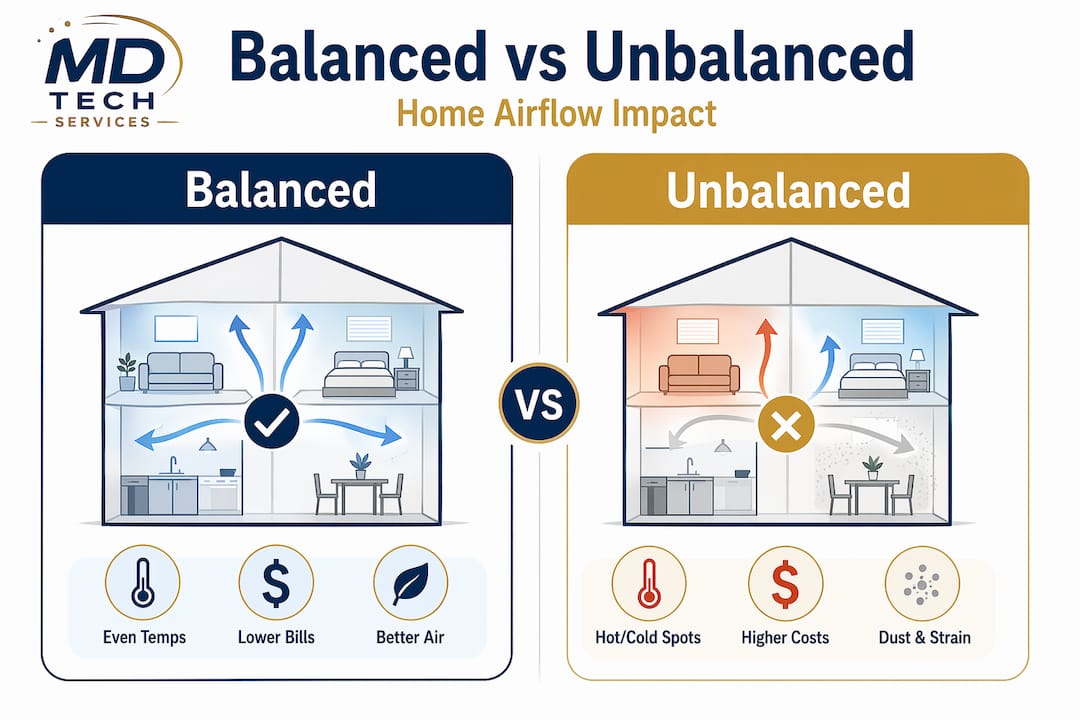
High static pressure caused by airflow imbalance stresses HVAC motors and compressors directly, reducing system lifespan in ways that are not always visible until something fails. A blower motor running against excessive resistance heats up, draws more current, and reaches the end of its service life years ahead of schedule.
Pro Tip: Ask your HVAC technician to measure static pressure during any service visit. A reading significantly above the manufacturer’s design specification is a warning sign you can act on before anything breaks.
The long-term financial case for balanced airflow benefits is straightforward. Lower monthly energy bills, fewer emergency repair calls, and equipment that lasts its full expected service life all add up to hundreds or thousands of dollars saved over the life of your system.
Common causes and signs of unbalanced airflow
Most residential airflow problems trace back to a handful of root causes. Knowing them helps you describe symptoms accurately when you call a technician, and it helps you spot problems before they become expensive.
Common root causes:
- Clogged or dirty air filters. A filter that is overdue for replacement restricts airflow significantly and raises static pressure throughout the entire system. Inspecting HVAC filters regularly is one of the simplest ways to protect airflow balance.
- Closed or blocked supply vents. Many homeowners close vents in unused rooms thinking it saves energy. It does not. It increases static pressure and forces the system out of balance.
- Undersized return air ducts. Return-air bottlenecks cause blower motors to work harder and pull dust and allergens from attics or crawl spaces into the living area.
- Duct leaks and poor duct design. Conditioned air escaping into unconditioned spaces before it reaches the room is both an energy loss and a distribution failure.
- Poorly designed original duct layout. Many homes were built without proper Manual D duct calculations, meaning the system was never balanced to begin with.
Signs to watch for in your home:
- One room is consistently warmer or cooler than the rest of the house
- Humidity feels uneven between floors or wings of the home
- You hear whistling, rattling, or rushing noises from vents or ductwork
- Dust builds up quickly on surfaces near certain registers
- Your HVAC system shows signs of short cycling or running continuously without satisfying the thermostat
Maintenance neglect accelerates every one of these problems. A small filter restriction grows into a significant pressure issue over months. A minor duct leak widens over seasons. Catching these issues early, through regular maintenance, keeps small problems from becoming system-wide failures.
Practical steps for achieving balanced airflow
Getting your airflow balanced does not always require major work. Start with the checks you can do yourself, and then call in professionals for the diagnostic work that requires proper tools.
- Replace your air filter on schedule. Check your filter monthly and replace it every one to three months depending on filter type and household conditions. A clean filter is the single most accessible airflow improvement available to any homeowner.
- Open all supply vents. Go through every room and confirm every supply register is fully open. Closing vents in unused rooms is a common habit that hurts the entire system.
- Check for obstructions. Furniture, rugs, and curtains placed directly over or in front of registers block airflow. A few inches of clearance makes a real difference.
- Inspect visible ductwork for leaks. In accessible areas like basements, attics, or garages, look for disconnected joints or visible gaps. Foil tape rated for duct use can seal minor leaks.
- Schedule a professional airflow measurement. Routine professional assessments detect imbalances early, prevent costly repairs, and extend equipment life. A technician with a flow hood and manometer can measure actual airflow volumes against your system’s design specs.
- Ask about Manual D duct evaluation. If your home has persistent comfort problems, a duct design review using Manual D calculations identifies structural issues that no amount of adjustment can fix without duct modifications.
Pro Tip: If you have a two-story home and the upstairs is always warmer than the downstairs, the problem is almost always a combination of undersized return air capacity on the upper floor and heat gain from the roof. A professional can measure both and tell you exactly what your system needs.
Consistent maintenance is the foundation of lasting airflow balance. Home ventilation efficiency depends on clean filters, sealed ducts, and a system that is checked at least once a year by a licensed technician.
What I’ve learned from years of HVAC service calls
I have been inside hundreds of homes where the homeowner had no idea their airflow was off. They thought the house was just drafty, or that some rooms were always going to be uncomfortable, or that high energy bills were simply the cost of living in a hot climate. In almost every case, the root problem was airflow balance.
The most surprising thing I have seen is how often the original installation is the source of the problem. Ductwork sized for a previous, smaller unit. Returns added as afterthoughts. Vents positioned for aesthetics rather than airflow. The system runs, so nobody questions it until the compressor fails early or the energy bill becomes hard to ignore.
What I know from direct experience is that homeowners who invest in a professional airflow assessment almost always get a return on that investment within a single cooling or heating season. The savings show up in lower energy costs, and the comfort improvement is immediate. More importantly, the repairs they avoid by catching problems early far exceed the cost of the assessment itself.
My honest advice is this: do not wait for a breakdown. The signs of imbalanced airflow are visible well before anything fails. If you have rooms that never feel right or energy bills that do not match your usage habits, your airflow is worth examining now.
— MDTECH
Get your home’s airflow professionally assessed
If anything in this article sounds familiar, your home may already be dealing with the effects of unbalanced airflow. The good news is that a professional diagnosis gives you a clear picture of exactly what is happening and what it takes to fix it.

At Mdtechservices, our licensed technicians serve homeowners across Orange County and Los Angeles County with thorough HVAC diagnostics, airflow balancing, and repair services. We measure actual performance, identify the root cause of comfort and efficiency problems, and give you honest recommendations. Whether you need a complete HVAC repair assessment or want to work through an HVAC troubleshooting process before something fails, we are ready to help. Call us or book online to schedule your assessment today.
FAQ
What does balanced airflow mean in a home HVAC system?
Balanced airflow means the volume of air your system supplies to each room matches the volume returned, creating stable pressure throughout the house. When supply and return are matched, your system distributes conditioned air evenly and operates within its design parameters.
How does unbalanced airflow affect energy bills?
An HVAC system fighting poor airflow runs longer cycles and puts more strain on the blower motor and compressor, which directly increases energy consumption and monthly costs. Fixing the balance allows the system to satisfy your thermostat efficiently and reduces unnecessary run time.
Can closed vents cause airflow problems?
Yes. Closing vents in unused rooms increases static pressure across the entire duct system, forcing the blower motor to work harder and pushing airflow out of balance. All supply vents should remain open for the system to function as designed.
How does airflow affect indoor humidity?
Your air conditioner removes moisture by moving air across a cold evaporator coil, and that process depends on adequate airflow. Poor or imbalanced airflow reduces moisture removal, leaving the air feeling damp and creating conditions where mold and condensation can develop.
When should I call a professional about airflow balance?
Call a licensed HVAC technician if you have rooms with persistent temperature differences, rising energy bills without increased usage, or signs like excessive dust, humidity complaints, or unusual system sounds. Early professional measurement catches problems before they result in expensive equipment failures.