
TL;DR:
- A high-efficiency furnace, also known as a condensing furnace, uses a secondary heat exchanger and PVC venting to recover more heat from exhaust gases, significantly reducing fuel bills. Its higher upfront cost is offset over time by energy savings, especially in colder climates with heavy heating needs. Proper installation and home insulation are essential for maximizing benefits and ensuring safety.
If you’re replacing your heating system or buying a new home, understanding what is a high-efficiency furnace can mean the difference between a smart long-term investment and a costly mistake. Many homeowners assume that paying more upfront for a furnace is hard to justify. The reality is more nuanced. High-efficiency models, technically called condensing furnaces, use a fundamentally different heat-recovery process that can reduce your fuel bills significantly over time. This article covers how they work, what they cost, and how to decide if one is right for your home.
Key Takeaways
| Point | Details |
|---|---|
| AFUE rating defines efficiency | Furnaces rated 90% AFUE or higher qualify as high-efficiency, or condensing, units. |
| Two heat exchangers are key | A secondary heat exchanger captures extra heat from exhaust gases that standard furnaces waste. |
| Installation costs more upfront | High-efficiency units cost roughly $8,100–$8,900 installed versus $4,100–$4,900 for standard models. |
| Payback period is real | Energy savings can recover the price difference in 5 to 15 years depending on climate and fuel costs. |
| Climate and usage affect value | Homeowners in colder climates with heavy heating use get the most benefit from condensing furnaces. |
What is a high-efficiency furnace and how it works
A high-efficiency furnace, known in the industry as a condensing furnace, is any gas furnace with an Annual Fuel Utilization Efficiency (AFUE) rating of 90% or higher. That number tells you how much of the fuel you pay for actually becomes heat inside your home. A 95% AFUE furnace converts 95 cents of every dollar of gas into usable heat. Only 5 cents escapes as waste.
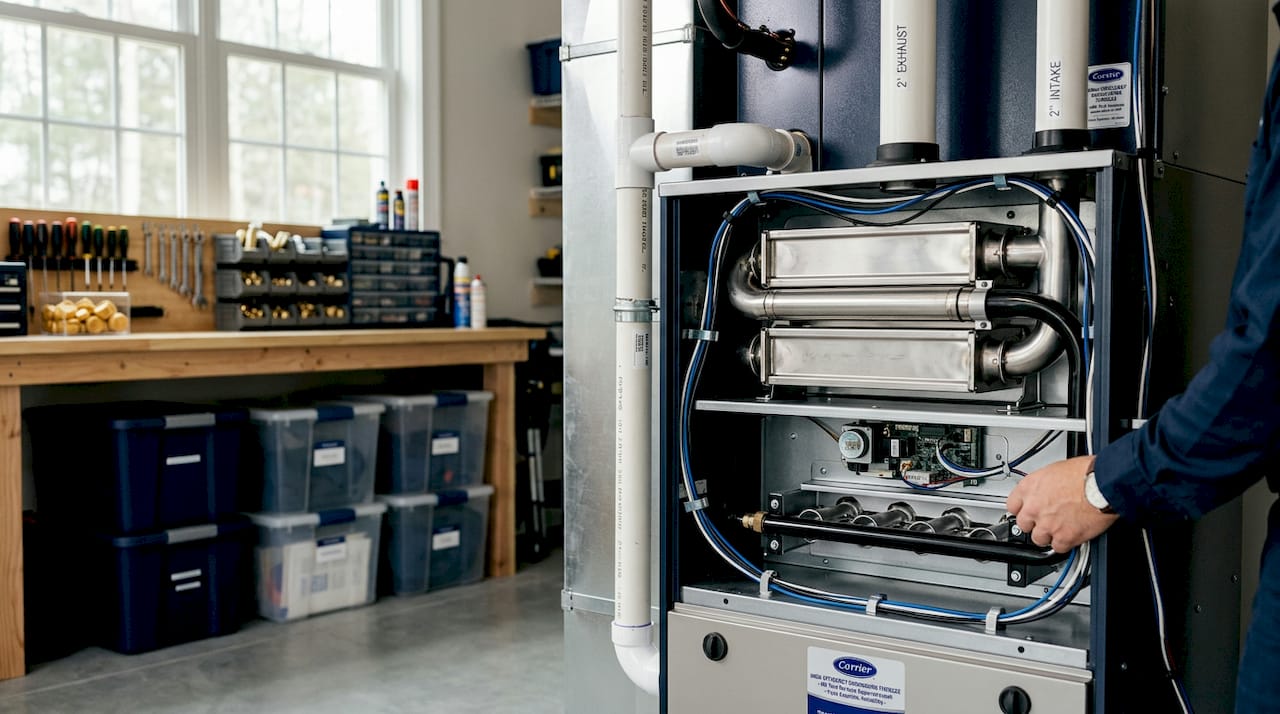
Standard furnaces stop at one heat exchanger. Heat from the burner warms the air in that exchanger and the exhaust gases exit through a metal flue pipe at very high temperatures. A condensing furnace adds a secondary heat exchanger that pulls additional heat out of those exhaust gases before they leave the system. The gases cool down so much in that second exchanger that the water vapor inside them actually condenses into liquid, which is exactly where the name “condensing furnace” comes from.
Because the exhaust is much cooler after this process, the vent pipe does not need to be made of metal. Condensing furnaces use PVC plastic venting instead. This is one of the easiest ways to identify what type of furnace you have. PVC venting versus metal tells the story at a glance.
Here is what distinguishes a condensing furnace technically:
- AFUE of 90% to 98.5%, compared to 80% for standard models
- Two heat exchangers for maximum heat recovery from combustion gases
- PVC vent pipes due to lower exhaust temperatures
- Sealed combustion, drawing air from outside rather than from inside your home
- Condensate drain line, required to remove the water produced during the condensing process
- EnergyGuide label, which displays the AFUE rating and lets you compare units
The sealed combustion design is worth highlighting because it does more than improve efficiency. It isolates the combustion process from your indoor air, which reduces the risk of exhaust gases, including carbon monoxide, leaking into living spaces. The Department of Energy recommends sealed combustion condensing furnaces specifically because of those combined safety and efficiency advantages.
Pro Tip: When shopping for a new furnace, check the vent pipe coming out of the unit. PVC pipe means you are looking at a condensing model. Metal flue pipe means a standard unit. You can also check the EnergyGuide label for the AFUE rating before the installer even turns the system on.
High-efficiency vs standard furnace comparison
The differences between these two furnace types go well beyond efficiency ratings. Understanding them helps you make a genuinely informed decision and avoid surprises after installation day.
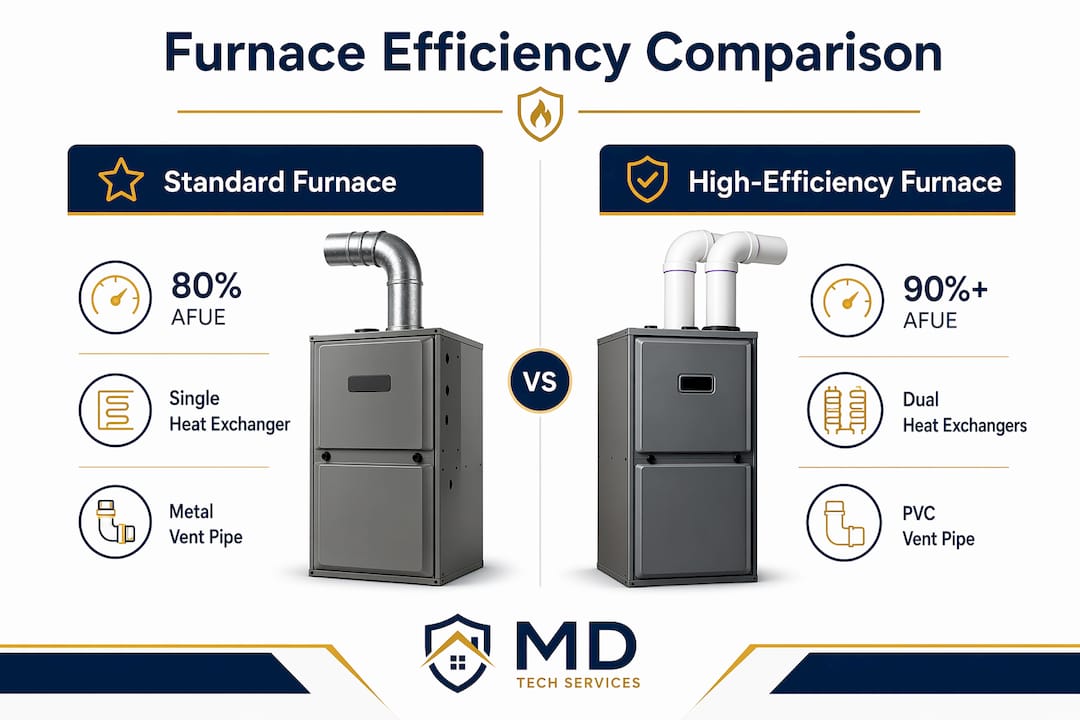
| Feature | Standard furnace (80% AFUE) | High-efficiency furnace (90%+ AFUE) |
|---|---|---|
| AFUE rating | ~80% | 90% to 98.5% |
| Vent material | Metal flue pipe | PVC plastic pipe |
| Heat exchangers | One | Two (primary and secondary) |
| Combustion air source | Indoor air | Sealed outdoor air intake |
| Condensate drainage | Not required | Required |
| Installed cost | $4,100–$4,900 | $8,100–$8,900 |
| Environmental impact | Higher emissions | Fewer emissions per BTU |
The practical installation differences matter as much as the numbers. Standard furnaces vent straight up through a metal flue, often shared with a water heater, and that pipe gets extremely hot. Condensing furnaces vent through PVC pipes that can run horizontally out through a side wall. That flexibility is a genuine installation advantage for homes where vertical venting is difficult or costly.
There are four key operational differences that affect your experience as a homeowner:
- Fuel consumption. Moving from an 80% AFUE furnace to a 97% model means saving about 17 cents per dollar of fuel burned. For a home spending $1,800 per winter on gas heat, that is roughly $300 per year in savings.
- Exhaust temperature. The cool exhaust from a condensing furnace is safer and creates more flexible venting options, as described above.
- Water production. The condensate created by the secondary heat exchanger must drain somewhere. Your installer needs to plan for a condensate drain line, either to a floor drain or a condensate pump if gravity drainage is not available.
- Combustion air. Standard furnaces pull air from inside your home to feed the burner. Condensing furnaces use a dedicated sealed pipe to draw air from outside, which prevents depressurization issues in tightly sealed homes.
On the environmental side, lower fuel consumption directly means fewer emissions. If reducing your home’s carbon footprint matters to you, a condensing furnace delivers measurable improvement over a standard unit.
Understanding high-efficiency furnace costs
This is where many homeowners hesitate, and it is worth looking at the numbers honestly. A 95% AFUE unit costs roughly $8,100–$8,900 installed compared to $4,100–$4,900 for an 80% model. That is a difference of about $3,500 to $4,500 depending on your home and contractor.
Why does the installation cost so much more? A few reasons:
- New venting. If your home currently has a standard furnace with metal flue venting, the contractor needs to run new PVC pipes. This takes additional labor and materials.
- Condensate drainage. Installing a drain line or condensate pump adds both time and cost.
- Sealed combustion air intake. A dedicated air supply pipe must be run to the exterior of the home.
- Equipment cost. Condensing furnaces have more components, including the secondary heat exchanger, which raises the unit price itself.
The payback period, meaning the time it takes for energy savings to cover the price difference, typically falls between 5 and 15 years. That range is wide because so many variables are involved, including your local gas prices, how cold your winters are, and how well your home is insulated.
Pro Tip: Ask your installer for a heat load calculation before they size your new furnace. An oversized furnace, even a high-efficiency one, will short-cycle, meaning it turns on and off too frequently. Oversizing and duct issues can erase the efficiency gains you paid for.
You can also check whether federal or state rebate programs apply to your purchase. In California, utility companies and state energy programs periodically offer rebates on high-efficiency HVAC equipment. These can reduce your net upfront cost by several hundred dollars, which shortens the payback window.
How your climate and home affect the value
Not every homeowner benefits equally from upgrading to a condensing furnace. A few honest questions help you figure out where you stand.
How cold are your winters? Homeowners in areas with long, cold heating seasons use their furnaces far more hours per year. More hours of operation means more opportunities for the efficiency gains to translate into dollar savings. If you live somewhere with mild winters and the furnace runs 400 hours per season rather than 1,200, your annual savings will be much smaller and your payback period much longer.
How old is your current furnace? Older furnaces from the 1990s or early 2000s often run at 60% to 70% AFUE, well below even the current 80% minimum. Replacing a 65% AFUE furnace with a 95% model is a much larger jump in savings than replacing a newer 80% unit.
Here are additional factors that determine whether a high-efficiency furnace will pay off for you:
- Home insulation quality. A poorly insulated home forces any furnace to run longer. Seal and insulate first, then upgrade the furnace.
- Thermostat management. A programmable or smart thermostat paired with a condensing furnace maximizes your fuel savings by reducing run time when the home is empty.
- Regular maintenance. A condensing furnace that has dirty filters, clogged condensate drains, or unmaintained burners cannot deliver its rated AFUE. Annual HVAC maintenance tips keep the system performing as promised.
- Gas prices in your area. Higher gas costs mean larger dollar savings from efficiency gains, which shortens payback.
- When high-efficiency may not pencil out. If you plan to sell your home within three to five years, you may not stay long enough to recover the premium. In that case, a quality 80% AFUE unit might be the more practical choice.
You can find a helpful HVAC efficiency checklist that walks through how to evaluate your current system before deciding on an upgrade.
My honest take after seeing hundreds of installations
I have seen homeowners at every stage of this decision, and a few things consistently stand out.
The biggest surprise for most people is not the furnace price. It is the installation complexity. Many assume you can swap a standard furnace for a condensing model and the job is straightforward. In reality, venting changes, condensate drainage, and sealed combustion air piping can add meaningful time and cost to the project. I have seen installations where the PVC venting alone added three to four hours of labor because of where the furnace sat in the home.
What I have also learned is that the AFUE number on the box is a promise, not a guarantee. Installation quality per ANSI/ACCA standards is what turns that promise into real savings. A well-installed 95% unit will outperform a poorly installed 97% unit every single time. Always ask your contractor whether they perform a proper Manual J heat load calculation and verify duct integrity before the job starts.
My genuine belief is that for homeowners in colder climates who plan to stay in their homes for at least seven to ten years, a condensing furnace is a sound investment. The fuel savings are real, the indoor air quality benefits from sealed combustion are real, and the technology is proven. But it only delivers if the installation is done right and the home is reasonably well insulated.
Do not make the decision based on the AFUE rating alone. Make it based on the full picture.
— MDTECH
Let Mdtechservices handle your furnace installation right

At Mdtechservices, we work with homeowners across Orange County and Los Angeles County who are making exactly this kind of heating decision. Our licensed technicians understand the full scope of what a proper condensing furnace installation involves, from PVC venting and condensate drain planning to verifying duct integrity before the job is complete. If you are weighing whether to repair your current system or replace it entirely, our appliance repair and installation guide can help you think through that decision clearly. For furnace repair questions or full HVAC service, our residential HVAC repair guide covers what to expect from professional service. Call us or book online to get reliable advice from experienced technicians who work in your community.
FAQ
What AFUE rating qualifies as high-efficiency?
Any furnace with an AFUE rating of 90% or higher qualifies as a high-efficiency, or condensing, furnace. The best models currently reach 98.5% AFUE.
How does a high-efficiency furnace differ from a standard one?
A condensing furnace uses a secondary heat exchanger to recover heat from exhaust gases that a standard furnace vents away as waste, producing more heat per dollar of fuel burned.
What does a high-efficiency furnace cost to install?
Installed costs for a 95% AFUE condensing furnace typically run between $8,100 and $8,900, compared to $4,100 to $4,900 for a standard 80% unit, with the difference driven by venting and drainage requirements.
How long does it take to recoup the extra cost?
The payback period for a high-efficiency furnace typically falls between 5 and 15 years, depending on your local gas prices, climate, and how frequently you run the heat.
Can any home install a condensing furnace?
Most homes can accommodate a condensing furnace, but the installation requires PVC venting to an exterior wall and a condensate drain line. Homes with limited access to exterior walls or no floor drain nearby may face higher installation costs.