
Water hammer is a pressure shock that happens when moving water is stopped or redirected too fast, sending a bang through your pipes. The fastest homeowner fix is to secure any loose pipes you can reach and install a water hammer arrestor, or check whether your system pressure is too high. If you see a leak or the banging keeps happening after those steps, treat it as a job for a licensed plumber, not a weekend project.
TL;DR:
- Fast-closing appliance valves, such as those in washing machines and dishwashers, are the primary causes of water hammer in residential plumbing.
- Installing a sealed water hammer arrestor near the problematic valve is the most effective long-term fix, replacing outdated air chambers that often waterlog over time.
- High or unstable water pressure, confirmed by a pressure gauge reading, significantly contributes to persistent banging and should be addressed with a pressure-reducing valve.
- Securing loose pipes and adding foam padding can alleviate immediate noise but do not replace the need for proper arrestors and pressure regulation for lasting results.
- If banging continues after DIY fixes or if leaks and high-pressure readings are present, consulting a licensed plumber for diagnosis and professional repairs is necessary.
Table of Contents
- What happens inside your pipes during water hammer
- Common causes of water hammer in residential plumbing
- Why banging pipes are worth fixing, not ignoring
- How to tell true water hammer from other pipe noises
- Fixes and prevention that actually hold up
- When to bring in a licensed plumber
- A practical read on how these repairs should go
- How MDTech Services helps when water hammer won’t quit
- Sources
- FAQ
What happens inside your pipes during water hammer
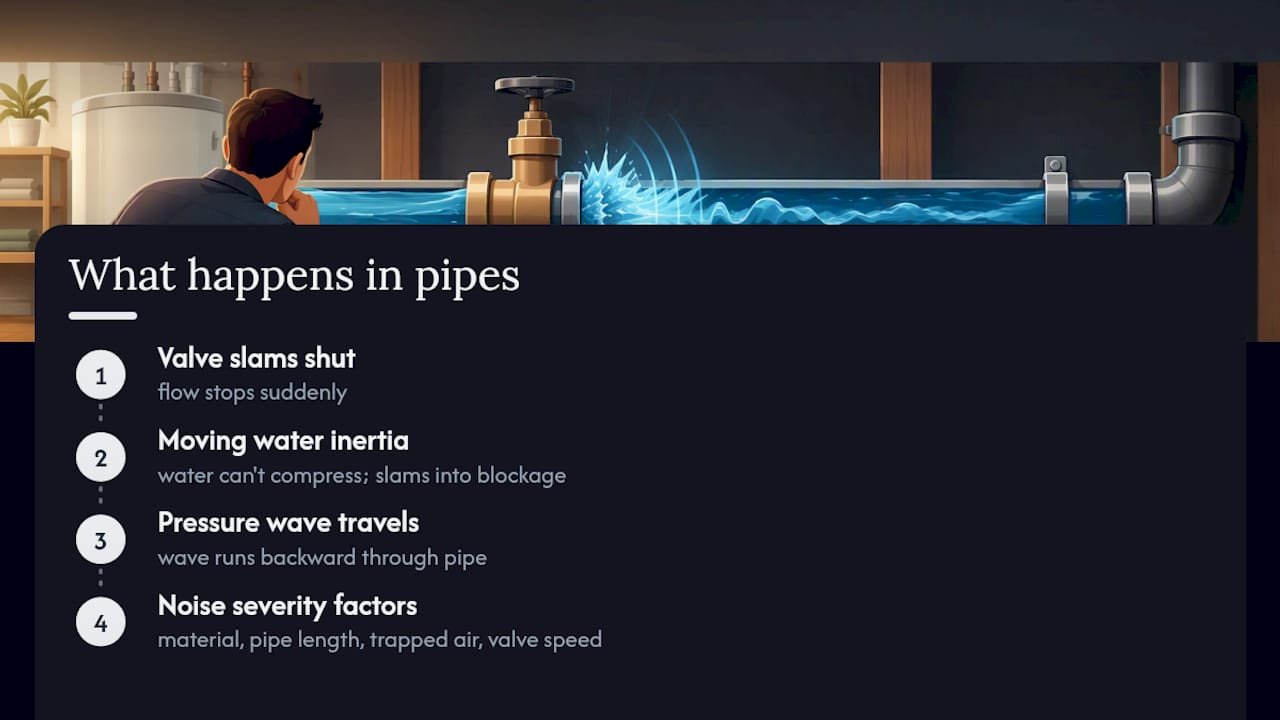
Water hammer starts the moment flowing water gets stopped suddenly, usually by a valve slamming shut. Water barely compresses, so instead of absorbing the stop, the moving mass slams into the blockage and sends a pressure wave backward through the pipe. That wave hits elbows, fittings, and pipe walls, which is what you hear as the bang. According to WVU Extension, engineers separate true water hammer, a sudden transient spike, from surge, a slower pressure oscillation that needs different fixes. How bad the noise gets depends on pipe material, pipe length, whether air pockets are trapped inside, and how fast the offending valve closes.
Common causes of water hammer in residential plumbing
Most household water hammer traces back to a short list of culprits, and matching your symptom to the right one saves you from replacing the wrong part.
- Fast-closing solenoid valves in washing machines, dishwashers, and ice makers snap shut almost instantly, which is the single most common trigger noted by WVU Extension.
- Loose or unsupported pipes amplify the shock because they can move and slap against framing instead of staying still when the wave hits.
- Entrapped air pockets or water-column separation change how the pressure wave travels and can make banging louder or more erratic.
- Pump starts, stops, and sudden manual valve closures create their own transient spikes, separate from appliance valves.
Not every noise is water hammer, though. A vibrating fill valve or the ticking of thermal expansion can sound similar but calls for a different fix entirely, so it pays to diagnose before you buy parts.
Why banging pipes are worth fixing, not ignoring
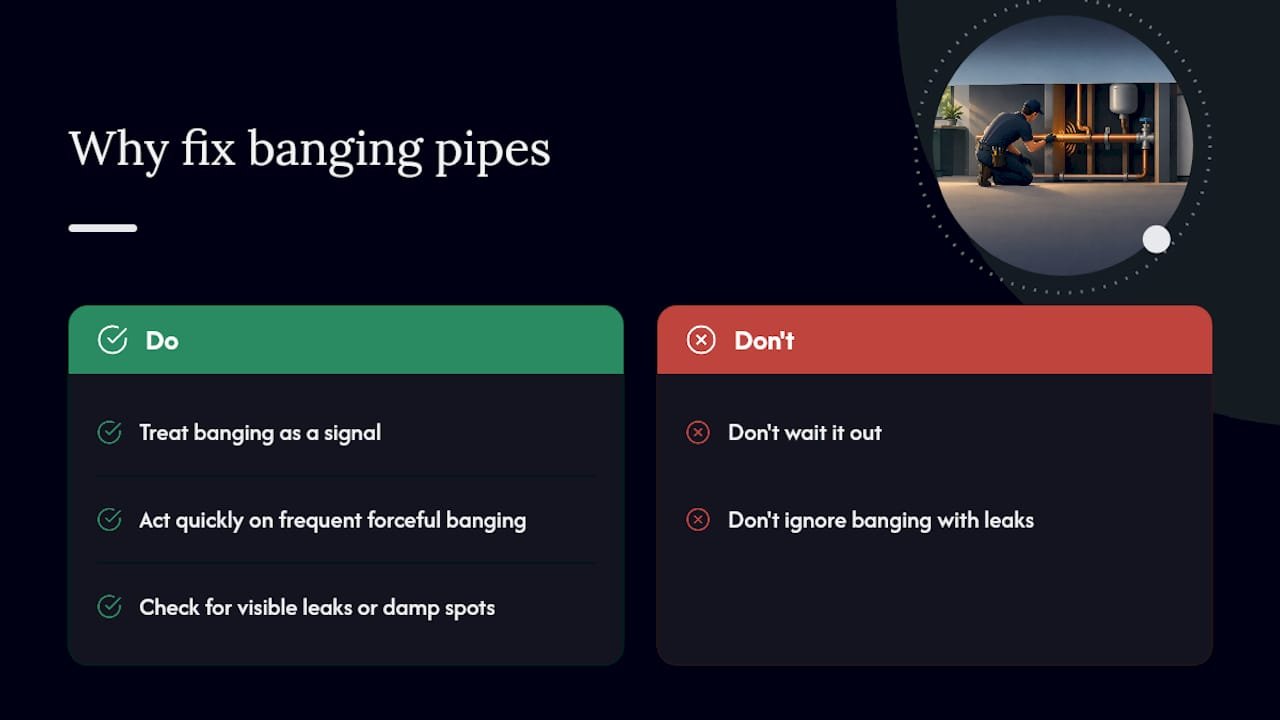
The noise itself is a nuisance, but it is really a symptom of stress traveling through your walls and ceilings. Repeated hammering pounds on joints, fittings, and appliance valves, and that repeated stress is what eventually causes leaks or fitting failure. Because water is nearly incompressible, the weakest point in the system absorbs the shock every single time, and that point rarely stays intact forever. Treat frequent, forceful banging, or any banging paired with a visible leak or damp spot, as a signal to act quickly rather than wait it out.
How to tell true water hammer from other pipe noises
Before you touch any hardware, run a short diagnostic so you are not fixing the wrong problem.
- Note which fixture triggers the noise and confirm it happens the same way every time you use that fixture.
- Reproduce it on purpose: run the fixture and shut it off, then cycle the washing machine or dishwasher through a fill.
- Listen at risers and near fixtures to narrow down where the shock originates in the wall.
- Check for loose straps or visible pipe movement anywhere the noise seems loudest.
- Measure your water pressure with a gauge at an outdoor spigot or hose bib.
If your reading is high or unstable instead of holding steady, write down the pressure reading you see. It matters to whoever fixes the problem, whether that is you or a plumber, and it points toward pressure regulation rather than a simple arrestor as the real fix. A pressure gauge test is worth doing before you assume the cause.
Fixes and prevention that actually hold up
Once you know the trigger, the fix usually falls into one of three categories: securing the pipe, absorbing the shock, or lowering the pressure that is driving it.
Short-term DIY steps cost little and often help immediately.
- Secure loose pipes with metal straps or hangers so they cannot move when the shock hits.
- Add foam padding anywhere a pipe touches wood framing to cut down on rattling.
- Tighten any loose fittings you can access without disassembling anything.
Water hammer arrestors are the standards-based fix for the pressure wave itself. Municipal plumbing guidance, including Chicago’s plumbing code documentation, notes that old-style air chambers are no longer considered reliable because they tend to waterlog over time. Sealed arrestors, installed near the quick-closing valve or riser causing the problem, hold up better and should conform to ASSE 1010 performance requirements. Model plumbing code guidance states an arrestor should be installed wherever a quick-closing valve is in use.
Pressure regulation matters just as much as the arrestor itself. If your gauge reading came back high, a pressure-reducing valve brings the whole system down to a safer range and reduces how hard every valve closure hits the pipe.
Air-relief or vacuum breaker fittings address entrapped air directly, since trapped air pockets make the transient wave worse, not better, according to WVU Extension.
Homeowners can often install an arrestor at an accessible supply line themselves: shut off the main, drain the branch, and use fittings rated for the connection. Sizing and placement should still follow manufacturer instructions alongside PDI-WH201 guidance, since an arrestor in the wrong spot does little good.
Pro Tip: Test your static water pressure before buying an arrestor. High pressure alone can mimic water hammer symptoms, and no arrestor fixes that.
When to bring in a licensed plumber
Some situations are worth handing off rather than troubleshooting further on your own.
- Banging that continues after you have secured pipes and installed an arrestor.
- Any visible leak, damp drywall, or water stain near a pipe run.
- Pressure readings that are consistently high or that swing unpredictably.
- Appliance valves that keep failing or leaking despite replacement.
A plumber will measure your pressure, trace the affected risers, map out which fixtures are involved, and recommend where an arrestor or pressure-reducing valve belongs. Before the visit, jot down which fixture triggers the noise, when it happens, and the model of any appliance involved. A quick set of photos helps too. For more on matching a symptom to a repair, see common household plumbing issues and when to call a pro, or review water valve repair and installation for what a diagnostic visit typically covers.
A practical read on how these repairs should go
Most water hammer complaints get solved with the same short sequence: confirm the trigger, rule out thermal expansion or a bad fill valve, then fix the actual cause instead of masking it. Homeowners often reach for an arrestor first because it is the visible fix, but a pressure problem hiding underneath will keep causing trouble no matter how many arrestors go in. The approach that holds up over years favors sealed, code-conforming arrestors over old air chambers, and it treats pressure regulation as part of the fix rather than an afterthought. Skipping the diagnostic step is the most common reason a “fixed” pipe starts banging again within a year.
— MDTECH
How MDTech Services helps when water hammer won’t quit
When DIY steps do not stop the banging, MDTech Services diagnoses the cause first, whether that is a failing appliance valve, an unsupported pipe run, or pressure that needs regulating, then installs the fix rather than guessing at one. Our licensed technicians handle plumbing repair, arrestor installation, and pressure-reducing valve setup, and if the trigger turns out to be a washing machine or dishwasher solenoid valve, we also handle the appliance repair itself. We book appointments online to help you get a technician scheduled without delay.
| What to expect | Detail |
|---|---|
| Diagnosis | Pressure check, fixture mapping, riser inspection |
| Repair options | Sealed arrestor installation, pressure-reducing valve, pipe support |
| Appliance link | Direct repair if a solenoid valve is the trigger |
| Booking | Available through our plumbing repair service page |
Have your fixture notes and appliance model ready when you book a plumbing repair visit, and we will take it from there.
Sources
- Water Hammer (WVU Extension)
- Plumbing requirements (Chicago Dept. of Buildings)
- Water hammer (UpCodes)
FAQ
What is water hammer in plumbing?
Water hammer is a pressure wave created when flowing water is stopped abruptly, usually by a fast-closing valve. Because water barely compresses, the shock transfers into pipe walls and fittings, producing the banging sound, as described by WVU Extension.
What causes water hammer in pipes?
The most common triggers are fast-closing appliance valves, like those in washing machines and ice makers, along with loose pipes, trapped air pockets, and sudden pump shutoffs. WVU Extension lists these as the primary causes in residential systems.
How do you fix water hammer yourself?
Start by securing any loose or unsupported pipe with metal straps, then install a sealed water hammer arrestor near the valve causing the noise. If your pressure gauge shows a high or unstable reading, a pressure-reducing valve addresses the underlying cause rather than just the symptom.
Are air chambers still an acceptable fix for water hammer?
No, air chambers are no longer considered reliable protection because they tend to waterlog over time, according to Chicago’s plumbing code documentation. Sealed arrestors conforming to ASSE 1010 are the current standard.
How do I know if it’s water hammer or something else?
True water hammer happens at the exact instant a valve closes and is reproducible every time you trigger it. If the noise is intermittent, gradual, or tied to hot water use rather than a valve closing, it may be thermal expansion or a vibrating fill valve instead, which need a different fix entirely.