
Most refrigerator repairs cost between $150 and $400, with the national average landing around $275. The expensive exception is a compressor or sealed-system failure, which typically runs $700 to $1,250. Use the 50% rule as your guide: if the repair quote exceeds half the price of a comparable new refrigerator and your unit is over 8 to 10 years old, replacement usually makes more financial sense than repair.
TL;DR:
- The majority of refrigerator repairs cost between $150 and $400, with the exception of compressor or sealed-system failures, which range from $700 to $1,250.
- Repair costs are influenced by the type, age, and size of the refrigerator, with built-in and larger models usually incurring higher charges due to accessibility and parts.
- A typical service call fee is $75 to $125 and is often credited toward the repair if authorized immediately, but estimates should be written and itemized upfront.
- For repairs exceeding 50% of a new unit’s price, or if the fridge is over 8 to 10 years old, replacement generally offers better long-term value.
- DIY fixes are limited to simple tasks like cleaning coils or replacing gaskets, while sealed-system repairs, including compressor work, require licensed professionals and specialized equipment.
Table of Contents
- How Much Does Refrigerator Repair Cost on Average?
- What Determines the Cost of Each Repair Type?
- Does Fridge Type or Size Change the Repair Price?
- What Goes Into Your Refrigerator Repair Quote?
- Is It Cheaper to Repair or Replace Your Refrigerator?
- How Do You Get an Accurate Refrigerator Repair Quote?
- Which Refrigerator Repairs Are Safe to DIY?
- MDTech’s Take on Fair, Diagnosis-First Refrigerator Repair
- Book a Transparent Refrigerator Repair Quote
- Sources
How Much Does Refrigerator Repair Cost on Average?
Homeowners searching for a fast benchmark can work from one number: about $275 is the average refrigerator repair cost, with most jobs falling between $150 and $400. That figure covers labor and a single replacement part for common failures. It does not cover compressor work, which lives in its own cost tier entirely.
Before any wrench touches your fridge, expect a service call or diagnostic fee, typically $75 to $125. Most reputable technicians credit that fee toward the repair if you approve the work on the spot, so you are not paying twice. Ask about this policy before the technician arrives, not after.
Here is how the most common repairs typically break down once labor and parts are combined:
| Repair type | Typical installed cost |
|---|---|
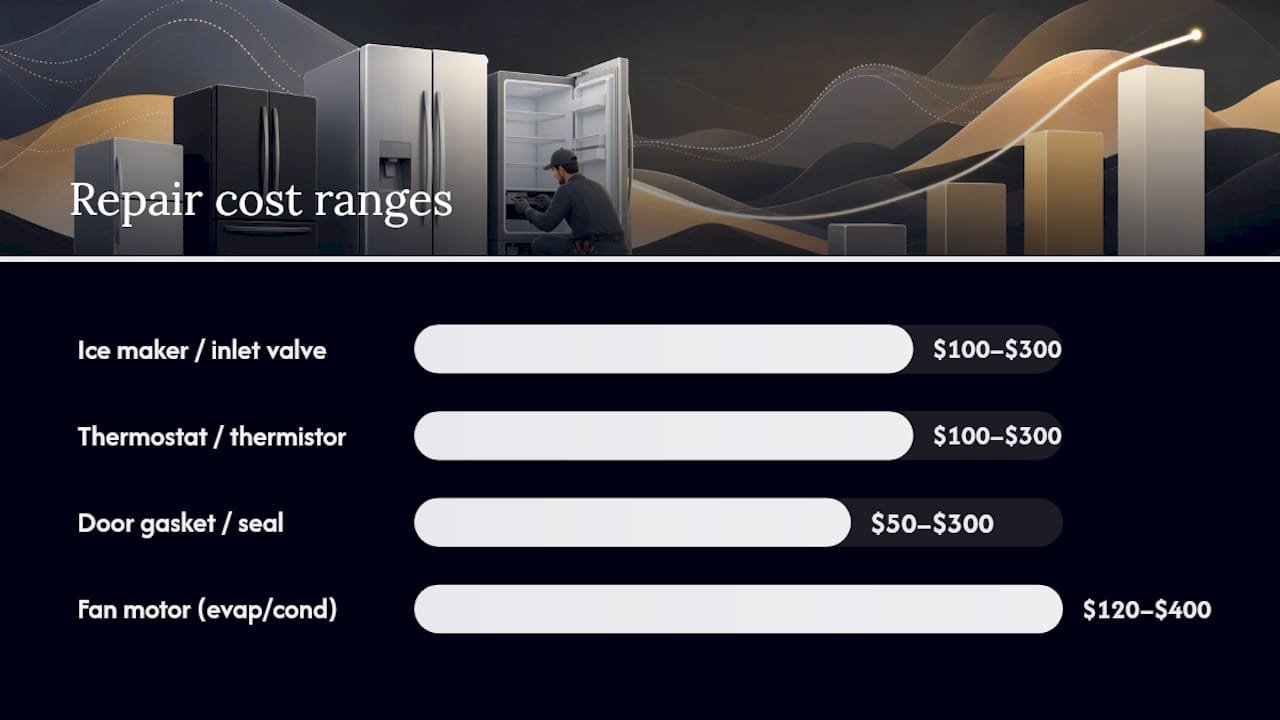
| Ice maker or water inlet valve | $100–$300 |
| Thermostat or thermistor | $100–$300 |
| Door gasket or seal | $50–$300 |
| Evaporator or condenser fan motor | $120–$400 |
| Defrost heater or defrost system | $100–$400 |
| Control board | $200–$500+ |
| Compressor or sealed system | $700–$1,250 |
A few things stand out from this list:
- The compressor is the clear outlier. Everything else clusters under $400.
- Control boards carry the widest range because smart-fridge electronics vary so much by model.
- Gasket replacement is often the cheapest fix that also lowers your energy bill.
What Determines the Cost of Each Repair Type?
Not every warning light means the same repair, and the price gap between fixes is bigger than most homeowners expect. Understanding what drives each cost helps you sanity-check a quote before you approve it.
Ice maker and inlet valve problems are among the most frequent service calls Mdtechservices gets. A warm fridge with a working freezer often points elsewhere, but a fridge that won’t produce ice usually traces to a stuck valve or a failed module. Expect $100 to $300 installed, and expect it to be a same-visit fix in most cases.
Thermostats and thermistors are cheap sensors that fail more often than people realize, given how many hours they cycle daily. Replacement runs $100 to $300 and is almost always worth doing rather than living with inconsistent temperatures that spoil food.
Door gaskets and seals cost $50 to $300 depending on the model, and a worn gasket is one of the sneakiest energy drains in your kitchen. A compressor that runs constantly to compensate for a leaky seal wears out faster, so fixing a $50 gasket can prevent a $1,000 problem down the road.
Fan motors, both evaporator and condenser, run $120 to $400. Watch for a fridge section that stays warm while the freezer works fine, or a rattling, buzzing noise from the back panel. That symptom pattern usually means a dying evaporator fan.
Defrost heaters and defrost systems cost $100 to $400 to repair. A blocked defrost drain or failed component typically shows up as ice buildup in the freezer or water pooling at the bottom of the fridge.
Control boards range from $200 to $500 or more. Newer refrigerators with touchscreens, Wi-Fi connectivity, or internal cameras carry pricier boards, and availability can add days to your timeline if the part has to be ordered.
Statistic Callout: Compressor and sealed-system repairs run $700 to $1,250, roughly three to five times the cost of any other single repair on this list. That gap exists because sealed-system work requires refrigerant recovery, brazing copper lines, and a vacuum-and-recharge process that demands specialized tools and, often, EPA certification.
Sealed-system failures deserve extra attention because non-sealed repairs are fundamentally different work than sealed-system repairs. A gasket or thermostat swap takes basic tools and an hour. A compressor job takes refrigerant handling equipment, welding skill, and a technician licensed to work with refrigerants. That technical gap is exactly why the price gap is so wide.
Does Fridge Type or Size Change the Repair Price?
Your refrigerator’s style has a real effect on what a technician will charge, mostly because of access and part cost.
- Compact and mini fridges: repairs often run on the lower end, sometimes $75 to $200, since parts are simpler and access is easy.
- Top-freezer models: usually the cheapest full-size fridges to service, often $100 to $300 for common repairs.
- Bottom-freezer and side-by-side models: comparable to top-freezers for most repairs, though ice maker and dispenser issues add cost.
- French-door refrigerators: more electronics and moving parts (dual doors, sometimes a middle drawer) push costs toward the higher end of every range above.
- Built-in and counter-depth units: tight cabinetry clearance adds labor time for removal and reinstallation, and parts tend to cost more.
Capacity matters too. A larger unit generally means a bigger compressor, more insulation to work around, and heavier doors, all of which add modest labor time even for a routine fix.
What Goes Into Your Refrigerator Repair Quote?
A written estimate should break down into a handful of predictable line items, and knowing what belongs on that list helps you catch anything that looks padded.
- Service call fee ($75–$125): usually credited toward the repair if you proceed with the work that day.
- Labor: some companies quote hourly rates, others use flat-rate pricing per repair type; flat rates tend to be more predictable for you.
- Parts: OEM parts cost more but typically fit better and hold up longer than generic aftermarket substitutes.
- Access difficulty: built-in units or fridges wedged into tight cabinetry add labor time that shows up as a surcharge.
- Emergency or after-hours service: expect a premium if you need same-day or weekend service.
- Add-ons: refrigerant recharge ($150–$300), coil cleaning ($60–$120), and water-line repairs ($75–$150) are common extra charges that show up alongside the main repair.
Pro Tip: Ask for the diagnostic fee policy in writing before the technician starts. A company that hesitates to confirm the credit-toward-repair practice up front is one to question later.
Is It Cheaper to Repair or Replace Your Refrigerator?
The 50% rule is the fastest gut check available: if a repair quote comes in above half the price of a comparable new refrigerator, replacement is usually the smarter long-term move. Here’s how to apply it.
- Get the repair quote. Say a technician quotes $450 for a control board replacement.
- Price a comparable new fridge. If a similar model costs $900, that $450 quote sits right at the 50% line, a genuine toss-up.
- Factor in age. A 4-year-old fridge with a $450 quote leans toward repair. A 12-year-old fridge with the same quote leans toward replacement.
- Check for override triggers. A failed compressor, a second major repair within two years, or a model with known reliability problems usually points to replacement regardless of the math above.
- Weigh energy savings. Newer refrigerators use meaningfully less energy than models from a decade ago, and that savings can tip a borderline decision toward buying new.
An 8 to 10-year-old fridge with a moderate repair bill is usually worth fixing. Past 10 to 12 years, especially with a big-ticket repair on the table, replacement tends to be the better value.
How Do You Get an Accurate Refrigerator Repair Quote?
A vague verbal estimate is a warning sign. Before you book a technician, gather the make, model, and serial number of your fridge, and write down exactly what it’s doing wrong, ideally with a short video or a couple of photos.
- Confirm whether the diagnostic fee applies toward the repair cost if you proceed.
- Ask what warranty covers the parts and the labor separately.
- Request a written estimate that itemizes parts and labor rather than a single bundled number.
- Ask for a realistic timeline if a part needs to be ordered.
- Walk away from anyone who quotes a price over the phone without testing the unit or who won’t share part numbers.
Pro Tip: Save the model and serial number in your phone’s notes app the first time you set up your fridge. You’ll need it again eventually, usually at the worst possible moment.
Which Refrigerator Repairs Are Safe to DIY?
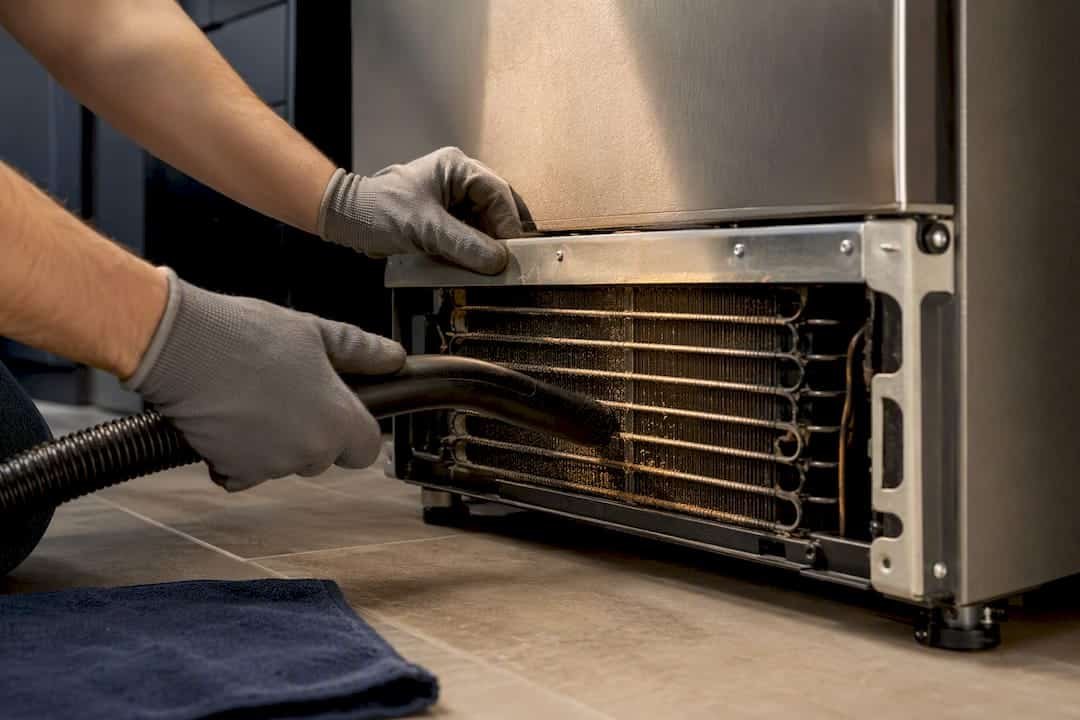
Some fixes are genuinely simple. Cleaning the condenser coils, swapping the water filter, or replacing a worn door gasket are all reasonable weekend projects, and they can save you the better part of a service call fee.
Refrigerant recovery, sealed-system repairs, and compressor replacement are different territory entirely. These involve pressurized refrigerant lines and high-voltage components, and attempting them yourself risks electric shock, chemical exposure, and a voided warranty if you’re still under coverage. When a fridge points toward a sealed-system issue, that’s the moment to call a licensed technician rather than open the back panel.
MDTech’s Take on Fair, Diagnosis-First Refrigerator Repair
Too many repair estimates get built on a guess. A technician hears “it’s not cooling” and quotes a compressor replacement before testing anything, and homeowners end up paying for a part they never needed. Mdtechservices runs the opposite way: our licensed technicians test the fan, defrost cycle, start relay, and coil condition before recommending a fix, because a proper diagnostic visit usually finds the real problem is smaller than the symptom suggests.
That approach means our service call fee gets credited toward your repair when you move forward, and every estimate we hand you breaks down parts, labor, and warranty coverage separately. No bundled guesswork, no upsell disguised as a diagnosis.
— MDTECH
Book a Transparent Refrigerator Repair Quote
Guessing at a repair bill is worse than not knowing at all. Mdtechservices gives Orange County and Los Angeles County homeowners something most guides can only describe: an actual on-site diagnosis before anyone talks price, with parts, labor, and warranty terms spelled out in writing.
A typical appointment starts with a technician testing your fridge’s compressor, fans, and defrost system, then walking you through exactly what’s wrong and what it costs to fix, part by part. Before your visit, jot down your fridge’s model number, snap a photo or two of the issue, and clear a path to the unit so the technician can access the back panel without moving furniture. If your fridge is closer to the replacement side of that 50% rule, our team will tell you plainly rather than push a repair that doesn’t make financial sense.
Ready to get a real number instead of a guess? Visit our appliance repair and replacement guide to book a diagnostic visit and get your written estimate started.
Sources
Cost ranges cited above come from Angi’s refrigerator repair cost data, the Neighborville repair cost database, and Texas Pros Network’s repair-versus-replace guidance. Energy-savings figures for the replacement decision come from Energy.gov’s appliance shopping guidance, with additional service workflow context from Another Cycle Appliance Repair.
- Neighborville – Refrigerator Repair Cost Database (2026)
- Angi — How Much Does Refrigerator Repair Cost? 2026 Data