
Most weak shower streams come from a mineral-clogged nozzle, a stuck flow restrictor, or a partially closed valve, and the fastest fix is pulling the showerhead and soaking it in equal parts white vinegar and water. If another faucet in the house also runs weak, or you notice a leak, the cause is likely bigger than the fixture and calls for a professional look.
TL;DR:
- Most weak shower streams are caused by mineral buildup, clogged nozzles, or partially closed valves, all of which homeowners can often fix with basic cleaning.
- Measuring home water pressure with a gauge helps determine if low pressure stems from supply issues or local fixture problems.
- A pressure reading below 45 psi indicates a supply problem or leak, while over 80 psi suggests the need for PRV adjustment to protect the plumbing system.
- If multiple fixtures suffer from low pressure or unusual symptoms persist after DIY fixes, a professional inspection is necessary.
- Routine maintenance, like cleaning showerheads and checking valves regularly, prevents future pressure drops caused by scale buildup or valve wear.
Table of Contents
- How shower water pressure actually works
- Common causes of low shower water pressure and how to spot them
- Step-by-step DIY fixes homeowners can try
- How to test and measure incoming water pressure
- Is it one shower or the whole house?
- When to call a professional plumber
- Prevention and maintenance to keep pressure steady
- What we see most often, and what usually fixes it
- How MDTech Services can help with pressure problems
- Where these recommendations come from
- Sources
- FAQ
How shower water pressure actually works
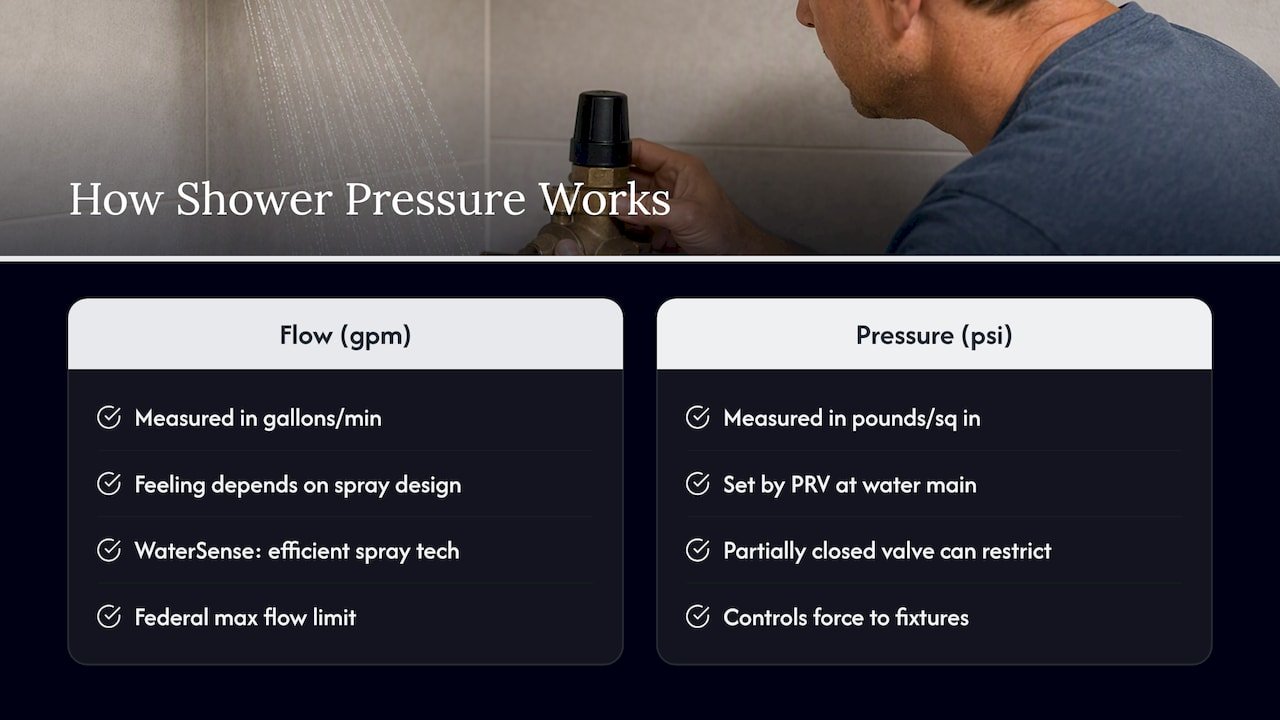
Two different measurements decide how a shower feels: flow, measured in gallons per minute (gpm), and pressure, measured in pounds per square inch (psi). A shower can have low flow and still feel strong if the spray is engineered well, which is the whole idea behind WaterSense certification.
Federal rules cap showerhead flow at a maximum allowed rate, and many efficient models run below that limit while still delivering a satisfying spray because they’re built to concentrate the stream or mix in air rather than just dump more water through the nozzle, according to federal testing guidelines. So a lower flow rating doesn’t automatically mean a weaker shower.
Pressure works differently. A pressure-reducing valve (PRV) sits where the water main enters your home and controls how much force reaches every fixture. A partially closed valve anywhere along the line, whether it’s the main shutoff or an isolation valve under a sink, can quietly choke pressure to a single fixture while leaving the rest of the house unaffected.
Common causes of low shower water pressure and how to spot them
Most low-pressure complaints trace back to one of a handful of usual suspects, and the symptoms usually point you toward the right one before you touch a tool.
- Mineral scale and clogged nozzles: hard water leaves calcium and lime deposits that narrow or block the tiny holes in a showerhead, often producing an uneven, sprinkler-like spray with visible white crust around the nozzles.
- Flow restrictors: many showerheads include a built-in restrictor disc that limits gpm; a poorly matched or damaged one can make the spray feel thin even when supply pressure is fine.
- Partially closed valves: a main shutoff or isolation valve that isn’t fully open reduces flow to specific fixtures without affecting the whole house.
- Sediment in the shower arm: debris can collect at the connection between the arm and the head, restricting flow before water even reaches the nozzle.
- Faulty shower cartridge or diverter: worn internal parts can misdirect or restrict water inside the valve body itself.
- Corroded pipes or a failing PRV: aging galvanized pipe narrows over time, and a PRV that’s wearing out can drop pressure throughout the home.
- Main-line leak: a hidden leak reduces pressure everywhere and often shows up as unexplained water use or damp ground near the supply line.
A problem confined to one shower usually points to something local, like the head, arm, or valve. A problem affecting every fixture in the house points toward the supply side.
Step-by-step DIY fixes homeowners can try
Work through these in order. Each step is quick, low-risk, and rules out one possible cause before you move to the next.
- Test another faucet. Turn on a sink or tub and note whether the problem is limited to the shower, one temperature setting, or the whole house.
- Remove and soak the showerhead. Unscrew it, submerge it in a bowl with equal parts white vinegar and water for about an hour, then scrub the nozzles with an old toothbrush before reattaching, a method that effectively dissolves mineral buildup.
- Check your valves. Confirm the main shutoff and any isolation valves near the shower are fully open, and inspect the shower arm for sediment buildup at the connection point.
- Inspect the flow restrictor. Locate the small disc inside the showerhead connection and note its condition before deciding whether to remove or replace it.
Pro Tip: Hand-tighten the showerhead onto the arm and give it a quarter turn with a wrench wrapped in cloth. Overtightening can crack the threads and cause a slow leak you won’t notice until it stains the ceiling below.
Removing a flow restrictor can make the spray feel stronger, but it also increases water use and can make temperature harder to control, and in some areas it may not meet local plumbing code, a tradeoff worth weighing before you remove one. Guides on safely removing calcium buildup cover product-safe cleaning options if you’d rather skip the vinegar soak.
How to test and measure incoming water pressure
If cleaning the head and checking valves didn’t solve it, the next step is measuring your home’s actual service pressure. This tells you whether the problem is at the fixture or coming from the supply itself.
- Attach a pressure gauge (sold at most hardware stores) to an outdoor hose bibb or the first cold-water tap on the ground floor.
- Turn off every other fixture in the house before taking the reading, so you get an accurate resting pressure.
- Compare the number to the range WaterSense recommends: roughly 45 to 60 psi for normal fixture performance.
A reading under 45 psi suggests low incoming supply or a leak somewhere in the system, while anything over 80 psi may call for a PRV adjustment to protect your plumbing. Our guide to testing water pressure walks through the process in more detail if you want a second reference before you start.
Is it one shower or the whole house?
Before calling anyone, run a few quick checks to figure out whether you’re dealing with a single fixture or a system-wide issue. Test every faucet and shower in the house at different times of day, since supply pressure can dip during peak hours in some neighborhoods.
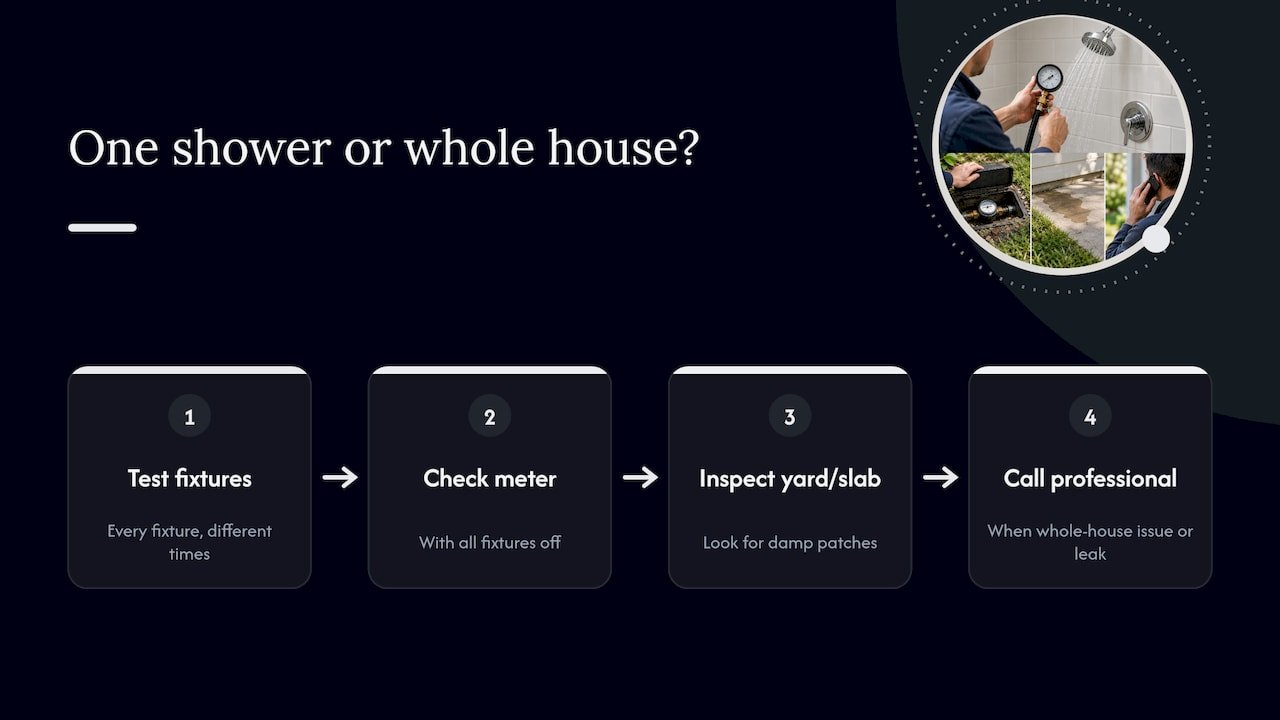
Check your water meter when every fixture in the house is off. If it’s still moving, that points to a hidden leak rather than a fixture problem. Watch for damp patches in the yard or near the slab, which often signal a line leak.
If every fixture runs weak, the meter shows phantom flow, or your home has older galvanized piping that’s due for inspection, it’s time to bring in a professional rather than keep troubleshooting piece by piece. Our page on regulating water pressure explains how a PRV factors into whole-house symptoms.
When to call a professional plumber
Call a plumber right away if you spot an active leak, if pressure hasn’t improved after the basic fixes, if the whole house is affected, or if you suspect a failing PRV or corroded piping. These aren’t jobs to keep guessing at.
A typical visit includes a pressure test, PRV inspection or adjustment, leak detection, and inspection of valves, cartridges, and pipe condition. From there you’ll get a diagnosis and a repair plan, whether that means a fixture swap, PRV service, or a recommendation for a pressure booster or water softener if scale keeps coming back. Our guide to common plumbing issues breaks down which problems are safe to DIY and which aren’t.
Prevention and maintenance to keep pressure steady
A little routine maintenance goes a long way toward avoiding another round of weak showers.
- Clean showerheads monthly with a vinegar soak, especially in hard water areas.
- Check shutoff and isolation valves quarterly to confirm they’re fully open.
- Choose WaterSense-certified showerheads when replacing a fixture, since they’re tested to perform well at lower flow.
- Install a water softener or inline filter if hard water causes frequent buildup.
- Schedule a professional inspection if your plumbing is aging or low pressure keeps coming back.
What we see most often, and what usually fixes it
In our service calls, mineral-clogged showerheads and partially closed valves account for the majority of low-pressure complaints, and both are fixes a homeowner can handle in under an hour. We recommend calling a professional once the problem shows up in more than one fixture, or when you suspect a PRV issue or a hidden leak, since those problems only get more expensive the longer they sit.
— MDTECH
How MDTech Services can help with pressure problems
If the vinegar soak and valve check didn’t bring your pressure back, a technician can run a full pressure test, inspect or adjust your PRV, check for leaks, and replace worn valves or cartridges as part of our plumbing repair services. Booking online gets you a scheduled inspection and a quote before any work starts.

Try the safe DIY steps first if you’re comfortable with a wrench and a bowl of vinegar. When the problem points to the supply line, a PRV, or anything involving your home’s main plumbing, book a visit through our appliance and plumbing services page and we’ll handle the diagnosis and repair.
Where these recommendations come from
Guidance in this article draws on EPA WaterSense recommendations for service pressure and fixture maintenance, Consumer Reports testing notes on showerhead performance, and federal flow-rate standards for showerheads. For PRV settings specifically, this homeowner guide offers additional detail.
Sources
- How to clean a shower head – EPM/Stanford
- Home maintenance tips – WaterSense / EPA
- Showerhead buying guide – Consumer Reports
- Energy
FAQ
What causes low water pressure in one shower but not the other?
A single weak shower usually points to a local problem: a clogged nozzle, mineral scale, a partially closed valve, or sediment stuck in the shower arm. If only one fixture is affected, the supply line itself is probably fine, and the fix is almost always at the fixture level.
Why does my shower suddenly lose pressure after only a few minutes?
This pattern often points to sediment shifting inside the pipes or a partially clogged showerhead that restricts flow once the initial burst clears. It can also signal a failing cartridge or diverter valve that can’t maintain consistent flow, which is worth checking if cleaning the head doesn’t help.
Will low water pressure affect my shower?
Yes, low pressure directly affects shower performance, producing a weak or uneven spray and sometimes inconsistent temperature. Measuring your home’s incoming pressure with a gauge on an outdoor hose bibb, and comparing it to the 45 to 60 psi range WaterSense recommends, tells you whether the supply itself is the issue.
How to increase the force of water in a shower?
Start by soaking the showerhead in equal parts white vinegar and water to dissolve mineral buildup, then check that all valves are fully open. If pressure is still weak, a high-performing WaterSense showerhead or, for whole-house issues, a PRV adjustment or pressure booster may be needed.