
A heat pump that stays iced over is not defrosting properly. A light frost that disappears on its own is normal. A thick layer of ice that stays after the unit has run for a while is a fault. The usual causes are restricted airflow, low refrigerant, or a failed defrost control board or sensor. This guide shows you how to tell the difference, what you can safely check yourself, and when to stop and call a licensed technician.
TL;DR
- Frost under about 1/4 inch that clears within 5 to 15 minutes is a normal defrost cycle. Heavy ice that stays is not.
- Common causes: dirty filters or blocked coils, low refrigerant, a bad defrost board or sensor, a loose sensor, or meltwater refreezing on the cabinet.
- Safe checks: filter, debris around the unit, gutters dripping onto it, and thermostat settings.
- Never chip ice with a tool. Refrigerant work, board replacement and sensor testing belong to a licensed technician.
- If ice returns after you thaw the unit, the cause is still there. Book a diagnosis before the compressor takes the strain.
Table of Contents
- What a normal defrost cycle looks like
- Signs your heat pump is not defrosting
- Why a heat pump stops defrosting
- Quick reference: symptom to likely cause
- What you can safely check yourself
- When to call a licensed technician
- Our perspective: diagnose the system, not the part
- Heat pump repair across Orange County and Los Angeles County
- How to prevent defrost problems
- FAQ
- Sources
What a normal defrost cycle looks like
In heating mode, the outdoor coil works as an evaporator. It runs colder than the air around it, so under certain temperature and humidity conditions, frost can form on the coil surface. That is expected. The system is built to remove it.
During a defrost cycle, the heat pump briefly switches from heating to cooling mode. The refrigerant flows in the opposite direction and sends heat to the outdoor coil. The cycle usually lasts between 5 and 15 minutes, depending on how much frost has built up.
What you may notice during a normal cycle:
- The outdoor fan stops.
- Steam or vapor rises from the unit as the ice melts.
- Water runs from the base.
- Cooler air may come from your vents for a short time, depending on the system.
The steam looks alarming, but it is usually just melting ice. Carrier notes that a thin layer of frost, generally under 1/4 inch, is normal and should be cleared automatically by the defrost cycle. You do not need an emergency call for that.
Signs your heat pump is not defrosting
The line between normal and faulty comes down to thickness, timing and pattern. Persistent ice thicker than 1/4 inch, or ice that does not melt after a normal defrost interval, points to a malfunction.
Watch for these signs:
- Ice covers most of the coil or the whole unit, including the fan guard and cabinet.
- Ice is still there hours after the last cycle. Frost that returns after each cycle and clears is fine. Ice that never clears is not.
- Your home is getting less warm. Ice blocks the airflow the coil needs, so heat transfer drops.
- The unit never seems to enter a defrost cycle. You do not hear the reversing sound, the fan never pauses, and there is no steam.
- The unit runs constantly and still cannot hold the thermostat setting.
Frost or ice: how to tell
Frost looks like a white, fuzzy coating on the fins, and you can still see the metal through it. Ice is clear or milky, solid, and fills the gaps between the fins. If you can’t see the fins at all, treat it as ice.
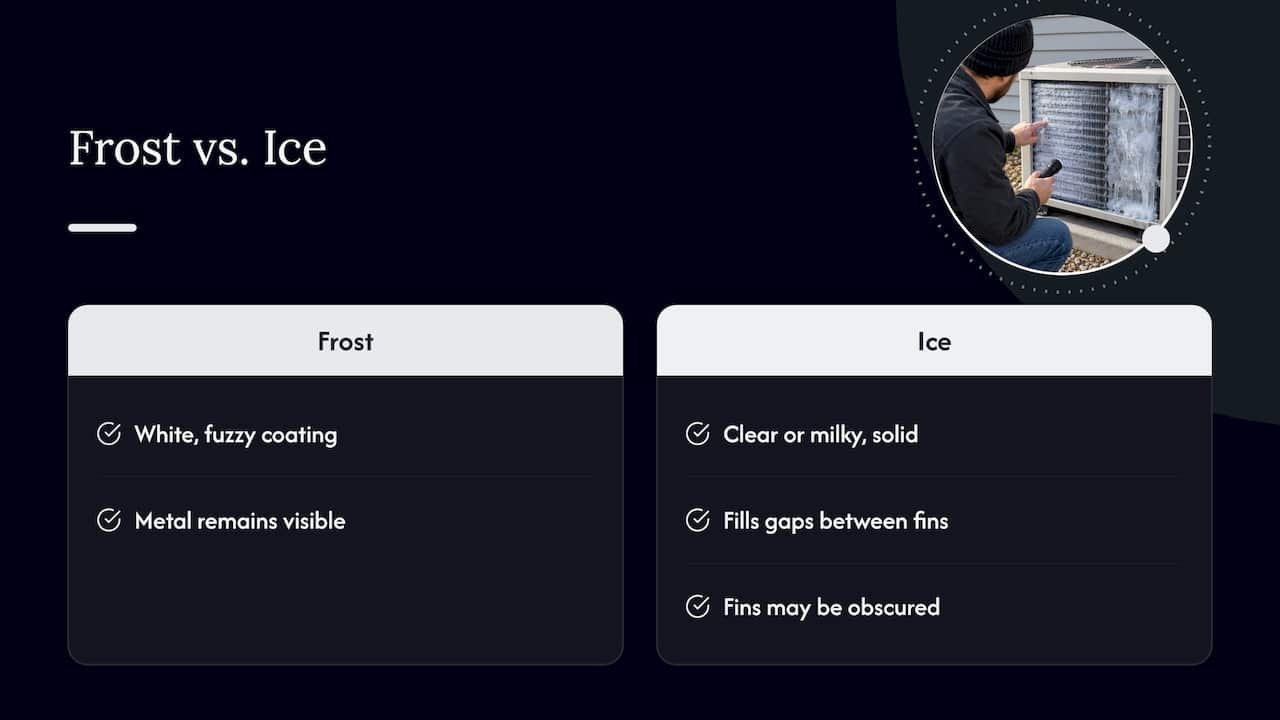
Also look at where the ice is. Ice only on the coil suggests a defrost or airflow problem. Ice on the frame, the base pan or the lower cabinet suggests a drainage or meltwater problem, which we cover below.
Why a heat pump stops defrosting
A failed defrost cycle has several possible causes. Some are cheap to fix and some are not, so the diagnosis matters more than the guess.
1. Restricted airflow
The indoor side matters too. When a heat pump heats, the indoor coil acts as a condenser, and the return air filter must be clean for enough air to pass through it. A clogged filter lowers heat transfer across the whole system, and that can contribute to icing outside. Outdoors, leaves, debris, or shrubs packed against the coil do the same.
2. A faulty defrost control board
The board decides when to start and stop a defrost cycle. If it fails, the unit may never enter defrost, or may exit too early. This is one of the most common reasons listed for a unit that will not defrost. Testing a board means working with line and low-voltage electrical components, so it is a job for a licensed technician.
3. A bad or loose defrost sensor
The sensor tells the board when the coil is frost-free. A loose sensor with poor thermal contact cannot read the coil accurately. The frost-free reading is usually around 57°F, so a sensor that never sees that temperature can end the cycle early and leave ice behind, even when the electrical parts technically work.
4. Low refrigerant
Low refrigerant disrupts the heat transfer the system needs, and it can cause icing and incomplete defrost. Refrigerant does not get used up, so low charge means a leak. Adding refrigerant without finding the leak only delays the next failure. Incorrect charging can also damage the compressor, which is why this repair should go to a licensed professional.
5. A reversing valve problem
The reversing valve switches the refrigerant direction. If it sticks or fails, the unit cannot reverse into defrost mode. A failed valve usually shows up as a unit that cannot change modes at all, and it needs a technician’s tools to confirm.
6. Thermostat or wiring issues
Incorrect thermostat configuration can make the system behave oddly, and aftermarket thermostats are not always set up for heat pumps. Wiring left from earlier work can also interfere. If the problem started right after a thermostat swap or other service, mention that when you call.
7. Outdoor fan or physical obstruction
A failing outdoor fan motor reduces airflow over the coil. A unit sitting too close to a wall, fence or landscaping can have the same effect.
8. Meltwater refreezing on the cabinet
This one is easy to miss. When defrost meltwater drips onto the cold metal frame, it can refreeze before it drains. Over several cycles, the buildup can block airflow through a large part of the coil. Because the ice is attached to the cabinet instead of the coil, a normal defrost cycle cannot clear it. Homeowners often read this as a total defrost failure.
A similar pattern appears when the water comes from outside. Leaky gutters dripping onto the unit can ice it over, and Carrier stresses diagnosing the whole system before blaming a single component.
Quick reference: symptom to likely cause
| What you see | Likely cause | Who fixes it |
|---|---|---|
| Ice on the whole coil, dirty filter indoors | Restricted airflow | You (filter), technician if it returns |
| Ice mostly on the frame and base | Drainage or meltwater refreezing | Technician, after you check gutters |
| Never enters defrost, no steam or fan pause | Defrost board, sensor or reversing valve | Licensed technician |
| Ice plus weak heat and hissing or oily residue | Possible refrigerant leak | Licensed technician |
| Ice after thermostat change | Setup or wiring | Technician |
| Ice with fan not turning | Outdoor fan or motor | Technician |
What you can safely check yourself
These steps cost nothing and rule out the simple causes. Carrier’s five-step troubleshooting checklist covers similar ground before it suggests calling a professional.
- Check the thermostat. Confirm it is in heat mode with a setpoint above room temperature, and that the batteries are fresh if it uses them.
- Check the air filter. Replace it if it is dirty. Filters that are overdue are a frequent contributor to icing.
- Look at the outdoor unit. Clear leaves, trash and plants from the sides. Keep clear space around it.
- Look up. If a gutter or downspout drips onto the unit, redirect it.
- Check drainage. Water should run away from the base. If it pools and refreezes, note that for the technician.
- Check the breaker. A tripped breaker can stop the unit or a component such as the outdoor fan.
If the unit is heavily iced, turn the system off, or switch to fan-only, so it can thaw. Pickhvac suggests fan-only for thawing in its guidance. Let the ice melt on its own while you wait for service.
What not to do
- Do not chip or scrape the ice with a screwdriver, ice pick or knife. The coil tubing is thin, and one puncture means a refrigerant leak and a costly repair.
- Do not pour boiling water on the unit.
- Do not open the electrical panel or touch the control board.
- Do not keep running a heavily iced unit. Ice reduces airflow, and the compressor works harder against it.
- Do not add refrigerant yourself. It requires licensed handling and leak diagnosis.
A thaw only treats the symptom. If the ice returns within a day or two, the cause is still in the system.
When to call a licensed technician
Call for service when any of these apply:
- Ice returns after you have thawed the unit and cleared the area.
- The unit never shows a defrost cycle.
- Ice is thicker than 1/4 inch and stays after a normal interval.
- You see oily residue, hear hissing, or the home heats poorly, which can point to a refrigerant leak.
- The outdoor fan is not turning.
- The problem began after a thermostat change or other work.
What a good diagnosis covers: airflow on both sides of the system, refrigerant charge and leak checks, the defrost board and sensor (including sensor placement and contact with the coil), the reversing valve, the outdoor fan, and the thermostat setup. A technician who tests the whole system can avoid replacing a board that was never the problem.
If you are comparing heat pump problems with other icing issues, our guide on why an AC freezes up explains the cooling-mode version. For a broader look at how we approach diagnosis, see our HVAC troubleshooting process for homeowners.
Our perspective: diagnose the system, not the part
When homeowners call about a heat pump that will not defrost, the first assumption is usually a bad control board. We understand why, since many guides list it first. But a clean diagnosis starts earlier. We check the filter, airflow, drainage and sensor contact before replacing anything, because an iced coil can come from the indoor side, the outdoor side, or the controls.

The approach that protects you is simple. Find the real cause, fix that, and explain it in plain words. A thawed unit that ices up again a week later has not been repaired. We would rather confirm why the unit iced than send you home with a temporary fix.
We also want you to avoid unnecessary calls. Steam from a unit in a normal defrost cycle is not an emergency, and we will tell you so. When the problem is real, such as a refrigerant leak, a failed board or a sensor that has lost contact, our licensed technicians handle it in a way that keeps the system safe and your warranty in mind.
— MDTECH
Heat pump repair across Orange County and Los Angeles County
If your heat pump is iced over, not entering defrost, or not keeping your home comfortable, we can diagnose it. MDTech Services provides HVAC repair for homeowners, landlords and property managers in Orange County and Los Angeles County, with online appointment booking.
Start with our heat pump service page or our HVAC repair service, or book through mdtechservices.com. If you want a technician close to you, see heat pump repair near you. We do not publish prices, so ask for the cost when you book.
How to prevent defrost problems
Most defrost trouble is easier to prevent than to repair.
- Replace or clean filters on schedule. Follow the filter’s recommended interval and check it more often in heavy-use months.
- Keep a clear zone around the outdoor unit. Trim plants and sweep leaves away from the coil.
- Fix drips from above. Repair or redirect gutters and downspouts that drain onto the cabinet.
- Keep the base area draining. Do not let water pool beneath the unit.
- Schedule seasonal maintenance before heating season, when a technician can test the defrost components, sensor contact and refrigerant charge. Our step by step HVAC maintenance guide lists what to look at.
- Act on early signs. A unit that ices a little more each cycle is telling you something. Waiting turns a minor repair into a bigger one.
Trane’s homeowner’s guide to heat pump repair also lists the signs that suggest service is due, including a unit that is not heating.
FAQ
How long should a heat pump take to defrost?
A normal defrost cycle typically lasts between 5 and 15 minutes, depending on how much frost has built up, according to Vaillant. If ice is still thick after that, or the unit has been iced for hours, something is stopping the cycle. Have it checked.
Is it normal for a heat pump to have ice on it?
A light frost or thin ice layer, generally under 1/4 inch, is normal and should clear automatically. Heavy ice that stays is a sign of a malfunction such as blocked airflow, low refrigerant, or a failed board or sensor. The thickness and how long it lasts are what matter.
Can I force my heat pump to defrost?
We do not recommend forcing it yourself. Online tips exist, but they depend on the model, and a unit that needs forcing already has a fault. Turn the system off or to fan-only, let the ice melt, and book a diagnosis if the ice returns.
How do I know if my defrost control board is bad?
The typical sign is a unit that never enters a defrost cycle even though frost keeps building. But a loose sensor, dirty coil, or low refrigerant can look the same. A technician should test the board and sensor together before replacing either.
Why is steam coming off my heat pump?
Steam in cold weather is often ice melting during a normal defrost cycle. It is not a reason for an emergency call. If the unit stays iced over afterward, or the steam never stops, schedule service.
Sources
- Heat Pump Not Heating? Troubleshooting Cold Air Issues, Carrier
- Heat Pump Repair Services and Troubleshooting Guide, Carrier
- Heat Pump Troubleshooting Guide, Carrier
- Defrost Cycle of a Heat Pump, InterNACHI
- Defrost cycle of a heat pump explained, Vaillant
- Measured Performance of a Low Temperature Air Source Heat Pump, U.S. Department of Energy
- Common Causes of Unsatisfactory Operation of Heat Pump, Goodman user manual
- Heat Pump Refrigerant Leak: Signs, Fixes, Costs, and Safety Guide, PICKHVAC
- Homeowner’s Guide to Heat Pump Repair, Trane