
When your dishwasher backs up into the sink, the water almost always has nowhere else to go. The cause is usually a clogged garbage disposal or sink drain, a drain hose without a proper high loop, a blocked air gap, or a pinched hose. Most of these can be checked in under an hour. If the sink itself will not drain, the problem is in your home’s plumbing and not in the dishwasher.
This guide walks you through the causes in the order we check them, shows the safe steps you can take first, and explains when it is time to call a licensed technician.
TL;DR
- Run water in the sink for about 30 seconds. If it does not drain, the blockage is in the plumbing, not the dishwasher.
- The most common causes are a clogged disposal, a missing high loop or air gap, a kinked hose, or a disposal knockout plug that was never removed.
- California generally follows the Universal Plumbing Code, which is why many homes here have an air gap on the countertop.
- Do not keep running cycles while water is rising. Stop, check the sink drain, then check the hose.
- Call a pro if the sink stays clogged, the backup returns, or you hear grinding or humming with no draining.
Table of Contents
- Why dishwasher water ends up in your sink
- Start here: the 30-second sink test
- The most common causes
- Do you need an air gap in California?
- Safe steps to take, in order
- What about vinegar, baking soda, and dish soap?
- When the drain is not clogged but water still backs up
- Appliance problem or plumbing problem?
- When to stop and call a professional
- Our perspective
- Get it fixed without guessing
- FAQ
- Sources
Why dishwasher water ends up in your sink
A dishwasher has one way out for dirty water. At the end of a wash or rinse, the control starts the drain pump, which pushes water through the drain hose to the sink drain, an air gap, or a garbage disposal. A proper high loop or a working air gap keeps wastewater from flowing back into the dishwasher.
That shared path is why a problem in one place shows up in another. If the sink drain, the disposal, or the hose is restricted, the pump still pushes water out, and the water takes the easiest route. Sometimes that is up through the sink. Sometimes it is back into the tub, leaving standing water and a smell.
The symptoms people describe usually fall into three patterns:
- Water appears in one or both sink basins while the dishwasher drains. The line downstream of the dishwasher connection is restricted.
- The sink fills when the dishwasher runs, and the dishwasher also holds water. A clog is shared by both, or the hose connection is blocked.
- Water backs up only when the sink is also in use. The drain is partly blocked and cannot handle both flows at once.
Start here: the 30-second sink test
Before you touch the dishwasher, test the sink. Run water in the sink connected to the dishwasher for about 30 seconds and watch whether it drains. If it does not, the issue is with the home’s plumbing, not the dishwasher, and a plumber should be contacted.
This one test saves a lot of time. It tells you whether to spend the next hour inside the dishwasher or under the sink.
If the sink drains slowly or gurgles, you are likely dealing with a clog in the disposal, the tailpiece, the trap, or the line beyond it. If the sink drains normally and the dishwasher is the only thing that causes trouble, move on to the disposal, hose, and air gap checks below.
The most common causes
A clogged garbage disposal
Many dishwashers drain into the disposal. Food particles from the dishwasher settle in the disposal’s drain port, and over time they pack in and block the flow. Run the sink and the disposal, then see whether the water clears. Whirlpool lists inspecting the disposal for obstructions among the steps for unclogging a dishwasher drain.
If the disposal hums but does not spin, or the sink stays full after you run it, stop and have it looked at. Forcing a jammed unit can make things worse.
A knockout plug left in a new disposal
This one catches people after a recent installation. If a disposal was recently installed or replaced, check that its knockout plug was removed, since a retained plug blocks drainage completely. The plug is a small disc inside the dishwasher inlet on the disposal. It is meant to be knocked out when a dishwasher is connected. If it stays, no water can leave the dishwasher at all.
If the problem began right after a new disposal or a new dishwasher went in, this is the first thing to rule out.
A drain hose with no high loop
The drain hose should rise high under the counter before it drops to the connection. This is called a high loop. It is not a device but a way of routing the hose. The hose is secured as high as possible under the sink, so gravity and the height difference help prevent backflow.
When the hose sags low or runs straight from the dishwasher to the drain, sink water can flow back toward the dishwasher, and dishwasher water can rise into the sink with little resistance. Samsung notes that after installation, one of the most common drain problems is a hose that is not connected to an air gap or has no high loop above the sink connection.
A pinched or kinked hose
Samsung also points out that the most common reason for a drain problem right after installation is that the dishwasher is sitting on its drain hose, pinching it shut. Hoses can also get crushed when a cabinet is reorganized or when the dishwasher is pushed back into place. A hose that is kinked, crushed, or sagging restricts flow and can send water the wrong way.
A blocked or dirty air gap
An air gap is a small fitting that sticks up off the kitchen sink or countertop, typically 4 to 5 inches tall, and it keeps sink drain water from backing up into the dishwasher. It works by creating an open break between the dishwasher’s drain line and the sink’s drain. If the sink drain gets clogged, water flows out of the air gap and onto the countertop rather than into the dishwasher hose.
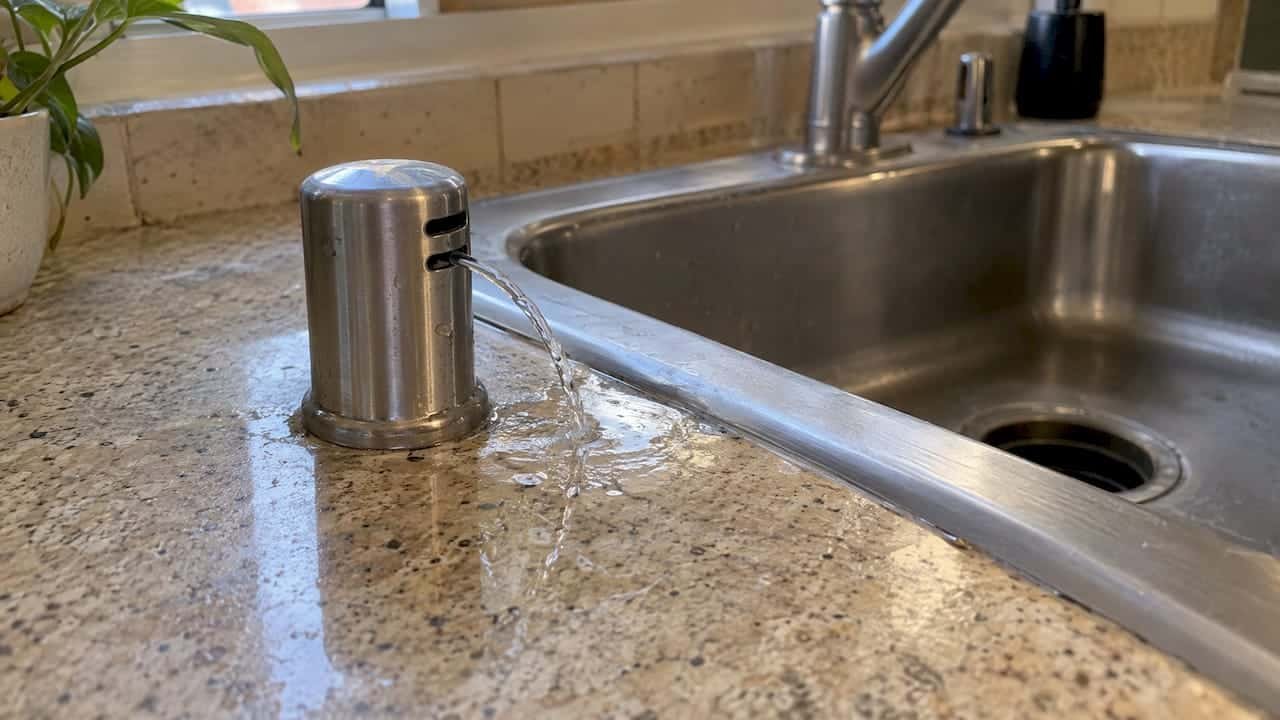
So if you see water spitting or leaking around the air gap cap, the air gap is doing its job and telling you something downstream is blocked. Either the air gap itself is clogged with debris, or the disposal or drain beyond it is.
A clogged dishwasher filter, sump, or drain pump
Sometimes the dishwasher is the source of the restriction. KitchenAid describes the signs this way: water slightly above the filter screen often points to a partial restriction in the filter, sump, or hose, while water near the door opening suggests a severe blockage or a pump that is not running. A steady hum with no water movement can mean a jammed impeller or an obstruction in the pump. Grinding can mean hard debris, such as glass, is in the pump area. These details come from KitchenAid’s drain troubleshooting page.
Do you need an air gap in California?
If you live in Orange County or Los Angeles County, this question comes up often, especially after a remodel or a new dishwasher install. States that require air gaps are generally those that follow the Universal Plumbing Code, including California, Washington, Hawaii and Minnesota, while states that follow the International Plumbing Code are more likely to permit the high loop. Requirements also vary by state and local rules.
A high loop and an air gap do the same job in different ways. The loop relies on the height of the hose. The air gap relies on a physical break in the line. Because the air gap is an open break, it is the more complete protection against backflow, and in California it is the arrangement local inspectors are used to seeing.
We cover the details in our guide on California dishwasher air gap rules, including what homeowners and contractors should know before an install or a remodel.
Safe steps to take, in order
Work from the simplest check to the more involved one. Stop at the first step that fixes the backup.
- Stop the dishwasher. Cancel the cycle and turn off power to the unit at the breaker or unplug it before reaching into the tub or under the sink.
- Run the sink and the disposal. Shut off the dishwasher and run the garbage disposal with water. If the sink clears, the disposal was the restriction.
- Do the 30-second sink test. If the sink still does not drain, the clog is in the plumbing and the dishwasher is not the cause.
- Clean the air gap. If you have one, lift the cap and clear out debris. Check the small hoses on both sides.
- Check the hose path. Look under the sink. The hose should rise high before dropping to the connection, with no kinks and no weight on it.
- Clean the filter. Remove the filter at the bottom of the tub, rinse it, and look for debris in the sump. Use caution, because there may be sharp debris. Some models have removable parts in the filter and drain area, and the user manual shows how to take them off.
- Inspect the hose connection. Place a towel and a shallow pan under the sink connection, loosen the clamp, and detach the hose from the disposal or sink tailpiece. Look for a clog at the end of the hose and at the disposal inlet. KitchenAid’s page gives the same sequence.
If you find the dishwasher itself will not drain after these steps, our article on why a dishwasher stops draining goes deeper into the pump and filter. Bosch owners can also read our guide to checking debris before a pump repair.
What about vinegar, baking soda, and dish soap?
Baking soda and vinegar are commonly used as a gentle drain cleaner for weaker clogs, and Whirlpool’s guide lists them among the options for a clogged dishwasher drain. They can help with light buildup of grease and soap in a drain. They are not a fix for a hose with no high loop, a retained knockout plug, a failed pump, or a solid blockage.
A good rule: if one round does not improve the drain, do not keep stacking products. Mixing chemical drain cleaners with other products in a drain you cannot see can also splash back at you or damage parts. Move on to the mechanical checks above, or bring in a technician.
When the drain is not clogged but water still backs up
This is the frustrating case. The sink drains fine on its own, yet water comes up when the dishwasher runs. Look at these causes:
- Hose routing. The hose may be too low, sagging, or missing the loop. Even a clear drain can back up through a hose that sits below the sink’s drain connection.
- Air gap or hose partly blocked. A partial restriction passes small flows from the sink but cannot take the dishwasher’s surge of water.
- Pump or sump problems. If the pump hums with no water moving, or grinds, the dishwasher may not be moving water out properly, as KitchenAid describes. Water near the door opening suggests a more serious blockage or a pump that is not running.
- Control or electrical faults. If the cycle pauses and the drain pump never engages, the cause may be electrical or control-related.
- A recent install. Check that the hose is not pinched under the unit and that the disposal plug is gone.
Check that the hose is not kinked, crushed, or sagging, and confirm a proper high loop or a clear, functioning air gap. If all of that looks right and the problem continues, it is time for a diagnostic visit.
Appliance problem or plumbing problem?
It helps to know which kind of professional you need. This table sorts the usual signs.
| What you see | Likely source | Best next step |
|---|---|---|
| Sink will not drain even without the dishwasher | Home plumbing, disposal, or drain line | Plumbing repair |
| Sink drains, but backs up only when the dishwasher runs | Hose routing, air gap, or disposal inlet | Check hose and air gap, then technician |
| Water at the air gap cap or countertop | Blockage downstream of the air gap | Clear the air gap, then check the disposal and drain |
| Hum with no draining | Pump or impeller obstruction | Appliance technician |
| Grinding noise | Hard debris in the pump area | Appliance technician |
| Backup started right after an install | Pinched hose, no loop, or retained knockout plug | Installer or technician |
| Cycle stops and the pump never starts | Control or electrical issue | Appliance technician |
When to stop and call a professional
DIY checks have a clear limit. Call a licensed pro when:
- The sink still does not drain after you run the disposal. Samsung says this means the issue is in the home’s plumbing and a plumber should be contacted.
- The backup comes back within days of clearing it.
- The pump hums, grinds, or stays silent while water stands in the tub.
- You find water under the cabinet, around the unit, or on the floor. Our guide on diagnosing leaks by where water appears can help you describe it, and our kitchen sink leak checklist covers the plumbing side.
- You are a landlord or property manager and a tenant reports water in the sink after a long period of disuse. Let a technician confirm the cause before anyone runs more cycles.
- You are unsure how the hose is routed, or you suspect it was installed without a high loop or air gap.
Standing wastewater can spread odors and bacteria through the tub. Once the cause is fixed, our guide on cleaning a dishwasher that smells shows how to freshen it.
Our perspective
We see dishwasher backups in Orange County and Los Angeles County homes every week, and most start with the same few things: a hose routed too low, a disposal inlet packed with food, or an install that skipped a step.
Our approach is to find where the water is actually getting stuck before replacing anything. That means testing the sink first, then checking the disposal, the air gap, the hose path, and the pump. We would rather fix the real cause once than swap parts and see the problem return.
Because we handle appliance repair, installation, and plumbing, one visit can cover both sides of a backup. If the sink drain is the problem, we can say so. If the dishwasher or its installation is the problem, we can correct it and set the hose or air gap up so it holds. Our technicians are licensed, and we aim to give you a clear explanation of what we found and what we recommend.
If you own or manage a property and want the work done in a way that stays safe and lasts, a proper diagnosis is the best first step.
MDTECH
Get it fixed without guessing
If you have run through the checks and the sink still fills when the dishwasher runs, we can diagnose it. Our team handles appliance repair for dishwashers and other kitchen appliances, and we can reset a poor installation so the drain hose, loop, or air gap does its job. You can book online, and we serve homeowners, landlords, and property managers across Orange County and Los Angeles County.
If the dishwasher was recently installed or moved, our appliance installation services cover correct drain routing from the start. For sink or drain line problems, see our plumbing repair services.
FAQ
Why is my dishwasher backing up into the kitchen sink?
The drain path is restricted somewhere past the dishwasher pump. Common causes are a clogged disposal, a blocked air gap, a sagging or kinked hose, or a knockout plug left in a new disposal. Run the sink for 30 seconds first. If the sink does not drain, the clog is in your plumbing.
Why does the sink fill up when the dishwasher runs?
The dishwasher pumps water into the same drain the sink uses. If that drain, the disposal, or the hose connection is partly blocked, the water has to rise somewhere, and it rises in the sink. A hose with no high loop can make the problem worse because backflow meets less resistance.
Can I pour vinegar down the drain to unclog it?
Baking soda and vinegar are commonly used on weaker clogs, and they can help with light grease and soap buildup. They will not clear a solid blockage or fix a hose routing problem. If the backup continues after one attempt, check the disposal, air gap, and hose, or call a technician.
Does a California home need an air gap?
California generally follows the Universal Plumbing Code, and states under that code are the ones that tend to require air gaps. Rules can vary by city and by project, so confirm with your local building department or a licensed installer before you remodel.
Should I keep running the dishwasher to see if it clears?
No. Each cycle sends more water into a blocked line, and it can overflow into the sink or the cabinet. Stop the cycle, test the sink, and check the disposal, air gap, and hose before running it again.
Sources
- Dishwasher Not Draining, Maytag
- Dishwasher Not Draining, KitchenAid
- Samsung dishwasher is not draining
- Dishwasher Air Gap Device FAQ, Sub-Zero, Wolf, and Cove
- What Is the Thing Next to My Kitchen Faucet? Air Gaps, Family Handyman
- How to Unclog a Dishwasher Drain in 5 Steps, Whirlpool