
A toilet that won’t flush almost always has one of four problems: not enough water in the tank, a flapper or chain that isn’t working, blocked rim or jet holes, or a clog in the trapway or drain line. You can check the first three in about 15 minutes with no special tools. A clog that plunging won’t clear, or one that backs up into other drains, is the point to call a licensed plumber.
This guide walks through the checks in the order that saves the most time, explains why a toilet can fail to flush even when it isn’t clogged, and covers what to do about a toilet that keeps clogging or flushes weakly.
TL;DR
- Start with the tank: lift the lid, press the handle and watch whether the flapper lifts and whether the water sits about 1 inch below the top of the overflow pipe.
- If the tank works, look at the bowl: mineral deposits can narrow the rim and jet holes, and a clog in the trapway or drain line stops the flush.
- Turn off the water before you plunge, use a flat-bottomed or flange plunger that fully covers the drain hole, and never use boiling water or Drano in a toilet.
- Several slow drains, gurgling, or water rising in a tub or sink when you flush point to a main line or vent problem that needs a professional.
- In Orange County and Los Angeles County, we handle toilet and drain repairs through our plumbing service.
Table of Contents
- Why a toilet stops flushing
- Step 1: Check the tank water level
- Step 2: Inspect the flapper and chain
- Step 3: Clear the rim holes and jet hole
- Step 4: Look for a clog
- Why is my toilet not clogged but still not flushing?
- Can you force a toilet to flush with water?
- Weak flush and water pressure
- Why does my toilet keep clogging?
- When to stop and call a plumber
- Our perspective on toilet problems
- Get help with a toilet that won’t flush
- FAQ
- Sources
Why a toilet stops flushing
A toilet uses gravity and a siphon. When you press the handle, the flapper lifts, tank water rushes into the bowl through the rim and the jet hole, and the sudden volume pulls the bowl’s contents through the trapway and into the drain. Anything that reduces the volume, slows the speed, or blocks the path weakens that siphon.
Kohler’s troubleshooting guide lists the usual suspects for a no-flush: a disconnected or very loose flapper chain, a dirty, worn or misaligned flapper, a closed supply valve, a blocked trapway, jet, rim, soil pipe or vent pipe, and an incorrectly adjusted water level. That list maps neatly onto a simple order of checks: water supply, tank parts, bowl holes, then the drain.
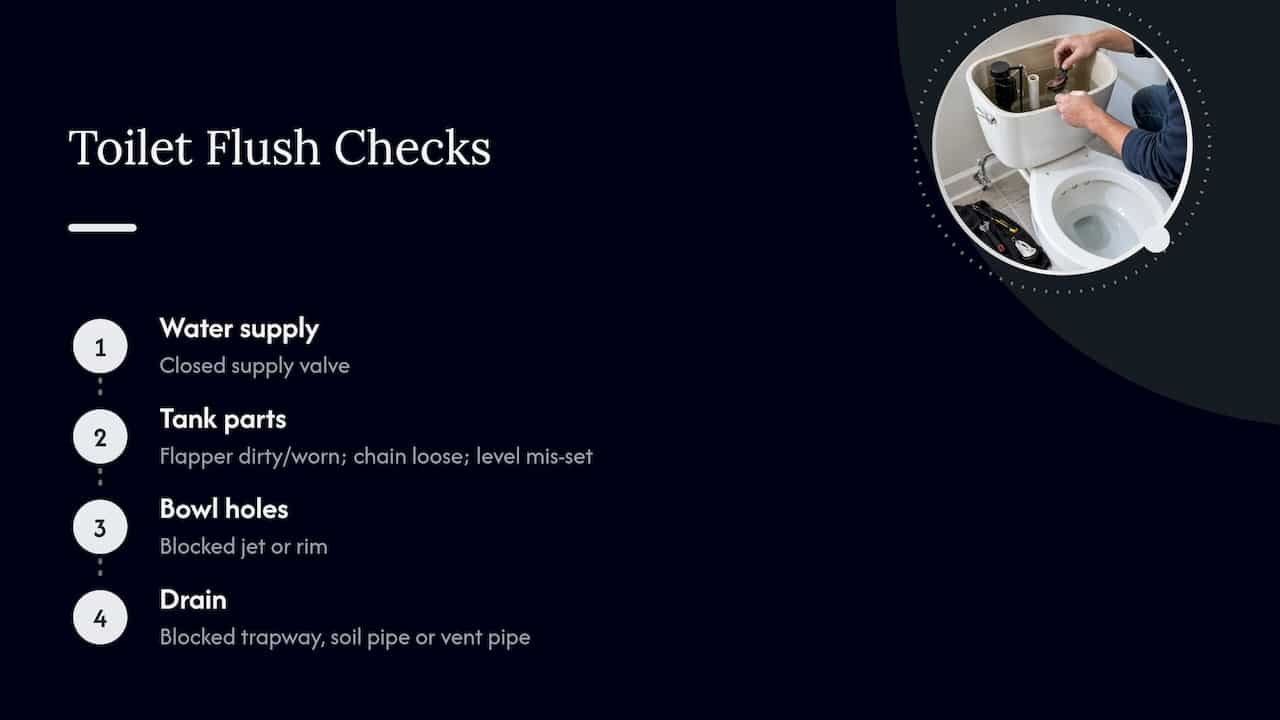
Step 1: Check the tank water level
This is the fastest check and the cause that gets missed most often.
- Take the lid off the tank and set it somewhere safe, since porcelain lids chip and crack easily.
- Look at the water line. Fluidmaster says the level should generally sit within 1 inch of the top of the overflow pipe.
- If the tank is nearly empty, check the shutoff valve on the wall or floor behind the toilet. A valve that was partly closed after a repair, or never fully reopened, is a common reason for a tank that refills slowly or not at all.
- If the valve is open and the tank still stays low, the fill valve may be worn or clogged with debris. Adjusting the fill level is possible on most models by following the manufacturer’s instructions for that fill valve.
A low tank means less water enters the bowl, and a weak or partial flush is the result. If you flush and the tank refills quickly to the right level, move on.
If the opposite is happening and the toilet runs after you flush, see our guide on diagnosing a running toilet, since the flapper and fill valve are the same parts.
Step 2: Inspect the flapper and chain
Press the handle and watch inside the tank.
- Handle moves but nothing happens: the chain may have come off the handle arm or the flapper. Reattach it.
- Handle feels loose or spins freely: the handle nut or arm may be loose. Flush handles are often reverse-threaded, so American Standard notes you turn the nut clockwise to loosen and counterclockwise to tighten.
- Flapper lifts, then drops too fast: the flush ends before enough water has left the tank. Fluidmaster lists a flapper that closes too soon as one reason for a weak flush.
- Flapper doesn’t lift at all: the chain may be too loose.
Chain slack matters in both directions. Korky explains that if the chain is too loose the flapper may not lift, and if it is too tight the flapper may not seal, and it recommends leaving one to two links of slack.
While you are there, check the flapper itself. A flapper that is warped, brittle, dirty or worn won’t seal well. Wipe it with a cloth. If it feels slimy, cracked or stiff, a replacement flapper is an inexpensive part, but make sure it matches your toilet model.
Step 3: Clear the rim holes and jet hole
If the tank fills and the flapper lifts but the flush is weak, slow or leaves the bowl dirty, look at the bowl itself. Water enters through small holes under the rim and through a larger jet hole at the bottom of the bowl. Southern California has hard water in many areas, and mineral deposits can build up in those holes over the years.
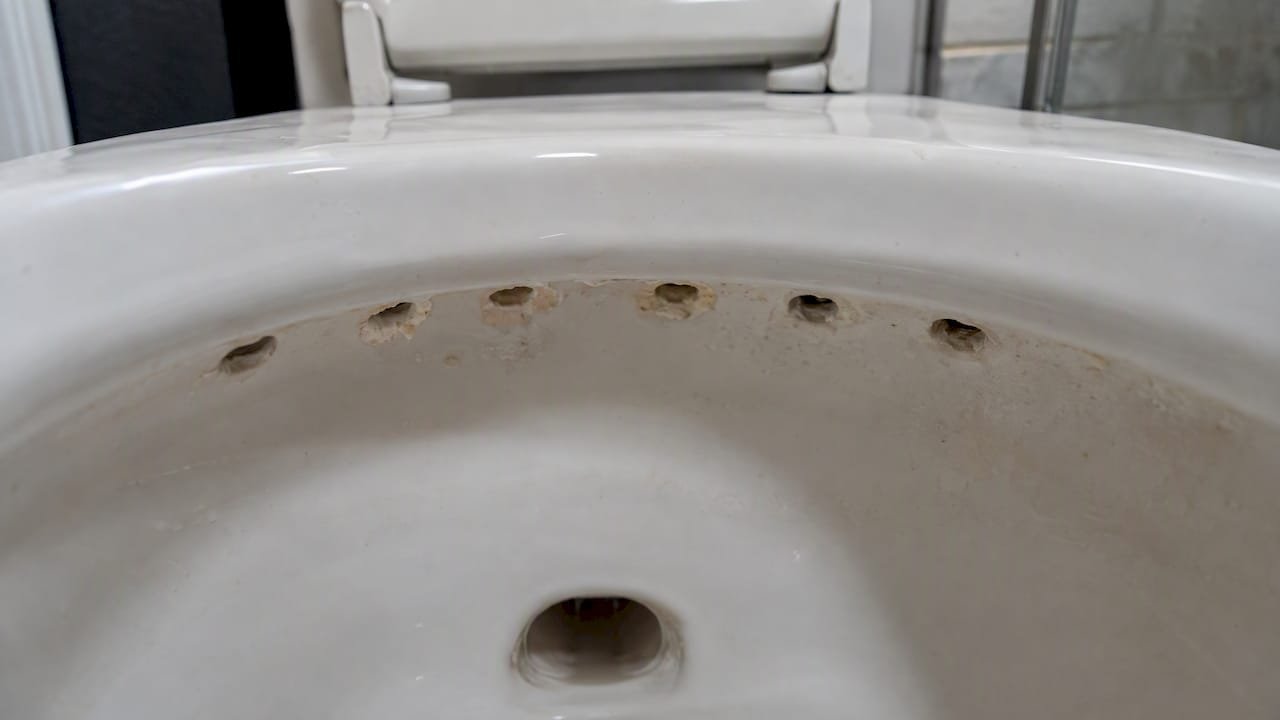
American Standard says mineral deposits may shrink the rim holes and jet hole and limit water flow, and suggests using a mirror and a coat hanger or nail to clean the holes under the rim. The same manufacturer says to check for obstructions in the outlet jets when a toilet does not flush consistently, and that vinegar can help clear hard-water deposits.
A practical way to do this:
- Turn off the water supply and flush once to empty the tank.
- Hold a small mirror under the rim and find the holes.
- Scrape each one gently with a bent wire or a nail, working out the grit. Use a stiff brush on the jet hole at the bottom of the bowl.
- Pour white vinegar into the overflow tube and let it sit for a while to soften deposits, then turn the water back on and flush a few times.
Mineral blockage tends to build slowly, so a toilet that has gradually gotten weaker over months often responds to this step more than a toilet that stopped flushing overnight.
Step 4: Look for a clog
If the tank and bowl holes are fine, a clog in the trapway or drain line is the likely cause. American Standard says that when a toilet is clogged and won’t flush out the bowl’s contents, the clog could be in the trapway or drain line.
Signs of a clog rather than a mechanical problem:
- The bowl fills high or overflows slowly when you flush.
- The water level in the bowl drops slowly or sits high.
- The tank works normally, but water doesn’t leave the bowl.
How to clear a clog safely
- Don’t keep flushing. Repeated flushes on a clogged toilet can overflow the bowl.
- Turn off the water at the shutoff valve and lay towels on the floor. Consumer Reports advises turning off the water before unclogging.
- Wear gloves and use a plunger whose cup completely covers the trapway hole, with a firm seal. American Standard describes the plunger and the seal as the key to success.
- Plunge with steady, firm strokes, starting gently to push out trapped air, and give it a number of cycles before you check.
- If plunging doesn’t work, American Standard suggests dish soap with hot, not boiling, water, or baking soda and vinegar.
Two cautions belong right at this step. Consumer Reports warns not to use boiling water because it can damage the toilet’s wax-ring seal, and not to pour Drano into a toilet because its corrosiveness can damage pipes. Hot tap water is enough.
Why is my toilet not clogged but still not flushing?
This is the question behind many searches. If the bowl isn’t clogged, the cause is usually one of these:
| Symptom | Likely cause | What to do |
|---|---|---|
| Tank nearly empty or refills slowly | Closed or partly closed supply valve, worn fill valve | Open the valve fully; adjust or replace the fill valve |
| Handle moves, no flush | Chain off or too loose | Reattach, leave 1 to 2 links of slack |
| Flush starts, then stops early | Flapper closing too soon or worn | Adjust chain, clean or replace flapper |
| Weak flush, dirty bowl | Mineral-blocked rim holes or jet hole | Clean holes with wire and vinegar |
| Slow drain, gurgling | Clog in trapway or drain, or vent problem | Plunge; call a plumber if it persists |
American Standard also lists clogged rim holes, faulty parts or water-pressure issues as reasons a toilet may not clean the bowl properly, and recommends checking the flapper, jet hole and tank water level.
Can you force a toilet to flush with water?
Yes, in the right situation. When a toilet won’t flush because the tank is empty or the water has been shut off, pouring water directly into the bowl can trigger the siphon. Mental Floss explains that a cup or two usually won’t start the siphon, while a couple of gallons can create enough rapid flow to flush the bowl.
OWASA, a North Carolina water utility, gives similar guidance for water-service interruptions: a tank toilet can be flushed once with the water already in its tank, and if the tank is empty, pour about 1 gallon of water into the bowl, using non-drinking water if possible.
One caution: if the bowl is already full because of a clog, don’t pour more water in. It will overflow. Pouring water is a workaround for an empty tank, not a fix for a blocked drain.
Weak flush and water pressure
If only one toilet flushes weakly, the problem is in that toilet. If low pressure shows up at the sinks and showers too, look at the whole house. American Standard notes that its EcoStrength toilet is designed for household water pressure of at least 20 psi, and that low pressure throughout the home may point to a whole-house pressure issue.
We have two guides that help here: why testing water pressure matters and how water pressure regulation works. If the shower is weak as well, our page on low shower water pressure covers the test and the usual fixes.
Why does my toilet keep clogging?
One clog is an event. Repeated clogs are a pattern, and the pattern usually has one of these roots:
- What goes down the toilet. American Standard says facial tissues, cotton swabs, tampons and dental floss can clog a toilet, and the advice is to flush only toilet paper. Wipes labeled flushable are the most common surprise in a homeowner’s call to a plumber.
- An older toilet. The same source notes that some older toilets have weaker flushing power.
- Reduced flow in the bowl. Mineral-narrowed rim holes or a low tank level cut the flush strength every time, so even normal use leaves waste behind.
- A partial blockage deeper in the line. If the toilet clears with a plunger but clogs again within days, the obstruction may be further down, and plunging only moves it temporarily.
Work through steps 1 to 3 above first. A toilet that flushes with full force is much less likely to clog on normal use. If it still clogs often after that, it is time for a professional look at the drain line.
When to stop and call a plumber
DIY checks are worth doing, but some signs mean the problem isn’t in the toilet.
- Plunging fails. Consumer Reports advises seeking professional help if plunging fails or if water backs up in another fixture, which can indicate a mainline stoppage.
- Gurgling, slow drains elsewhere or sewer odor. Multiple slow fixtures can point to a vent or main line problem. The vent on your roof can also be blocked by debris, and American Standard recommends that if the toilet still flushes poorly, you inspect the roof vent for debris and call a plumber to clear it. Roof work is not something to attempt on a ladder yourself.
- Water keeps rising. Shut off the supply valve behind the toilet, put down towels and stop flushing. Our plumbing emergency checklist lists what to do while you wait.
- Recurring clogs after the basic checks. A professional can inspect the line and clear it properly.
If water also collects around outside or roof drains during rain, a guide on clogged drain solutions explains how to respond safely before assuming the blockage is only in the toilet.
For a broader view of what homeowners can handle and what needs a licensed pro, see our guide to common household plumbing issues.
Our perspective on toilet problems
Most toilet calls we hear about start the same way: a homeowner has already plunged several times, tried a chemical cleaner and flushed again, and now the bathroom floor is wet. The simplest fixes, a reattached chain or a clean rim hole, often take minutes. The expensive mistakes come from repeating the wrong fix.
Our approach is to work from the symptom backward. A toilet that fails in the tank is a parts problem. A toilet that fails in the bowl is a clog or a flow problem. A toilet that fails along with other drains is a line problem. Treating each one as what it is keeps repairs short and keeps the fix lasting.
That is why we send licensed technicians who can check the whole drain path and not only the fixture, and why we quote pricing upfront before work begins. If you have water rising, a drain that backs up into a second fixture, or a toilet that keeps clogging after the basic checks, a professional visit is the faster and safer route, and we are available for emergencies around the clock in Orange County and Los Angeles County.
MDTECH
Get help with a toilet that won’t flush
If the checks above didn’t solve it, or you would rather not work around a clogged toilet, our team handles plumbing repair for homeowners, landlords and property managers in Orange County and Los Angeles County. We diagnose the toilet, the drain line and the connected fixtures, explain what we find, and give you the price before work starts.
See our plumbing repair services or book an appointment online. For pipe-level problems behind a backing-up toilet, our plumbing drain pipe repair page explains what we do.
FAQ
Why is my toilet not clogged but not flushing?
The cause is usually mechanical. Check for low tank water, a chain that is loose or disconnected, a worn or misaligned flapper, a closed supply valve, and rim or jet holes narrowed by mineral deposits. Kohler and American Standard both list these causes in their troubleshooting guidance. Start in the tank, since it is the quickest check.
How do I force a toilet to flush?
If the tank is empty or the water is off, pour roughly a gallon or more of water directly into the bowl, which can trigger the siphon. A cup or two usually won’t do it. Don’t try this if the bowl is already full from a clog, since it will overflow. In that case, turn off the supply and plunge instead.
Will pouring water in the toilet make it flush?
It can, if the bowl is not blocked. A larger volume poured quickly into the bowl creates the flow needed to start the siphon. If the bowl doesn’t drain after you pour, stop and look for a clog in the trapway or drain line.
Why does my toilet keep clogging?
Common reasons are flushing anything other than toilet paper, an older toilet with weaker flushing power, mineral-blocked rim holes that weaken each flush, or a partial blockage deeper in the drain. Clean the rim holes, check the tank level and flapper, and flush only toilet paper. If clogs continue, have a plumber inspect the line.
When should I call a plumber for a toilet that won’t flush?
Call if plunging doesn’t clear it, if water backs up in a sink, tub or another toilet, if several fixtures drain slowly or gurgle, or if the toilet still flushes poorly after you’ve checked the roof vent. Those signs point to a main line or vent problem beyond the toilet.
Sources
- Kohler troubleshooting guide (89863-6-C)
- American Standard: bowl doesn’t get clean when I flush
- American Standard: fixing a toilet with a poor flush
- American Standard: toilet doesn’t flush consistently
- American Standard: EcoStrength poor flush
- American Standard: how to unclog a toilet
- Fluidmaster: weak toilet flush
- Korky: slow flushing toilet
- Consumer Reports: how to unclog your toilet
- OWASA: be prepared
- Mental Floss: pouring water in the toilet bowl