
A gas orifice is a small brass fitting with a precisely drilled hole that meters gas into a burner. Its size is given as a drill number, and the right size depends on three things: the gas you burn, the pressure supplied to the appliance, and the BTU rating on the appliance’s data plate. Natural gas needs a larger hole than propane, but changing the orifice alone does not finish a conversion. The regulator, air shutter and a leak check all matter too.
This guide explains how orifice sizes are read, what the numbers mean, and where the safe line sits between understanding the system and working on it yourself.
TL;DR
- An orifice is sized by drill number. A smaller number means a larger hole, so a #50 drill hole is bigger than a #70.
- Natural gas needs a bigger orifice than propane because it carries less energy per cubic foot and is supplied at lower pressure.
- Capacity charts list BTU per hour for each drill size at a given pressure. Use the chart for your gas type, not a generic one.
- Changing the orifice without setting the regulator and air shutter is a common cause of incomplete combustion and carbon monoxide.
- Orifice work on a home appliance is a job for a licensed technician. We handle LP to natural gas conversions in Orange County and Los Angeles County.
Table of Contents
- What a gas orifice does
- How to read orifice sizes
- Why natural gas needs a larger orifice than propane
- A worked example
- Orifice sizing is only one part of a conversion
- What happens when the orifice is the wrong size
- Signs you should call a technician
- Why this is not a DIY job
- Industrial orifice plates are a different subject
- Our perspective: what we see in the field
- Appliance gas conversion with MDTech Services
- Getting the most from a conversion
- FAQ
- Sources
What a gas orifice does
On most gas cooktops, a threaded brass orifice, often called a spud, meters gas to each burner at the proper flow rate. The flow depends on two things working together: the supply pressure and the diameter of the hole. Change either one and the burner gets a different amount of gas.
Furnaces, water heaters, ovens, dryers and fireplaces use the same principle. Each burner or burner group has an orifice sized so the appliance delivers its rated heat output with a clean blue flame.
The orifice is not the only part of the system. Gas leaves it as a jet, pulls in air through the air shutter, mixes in the burner tube and burns at the ports. If the jet is wrong, the mixture is wrong, and everything downstream suffers.
How to read orifice sizes
Orifice size means the diameter of the drilled hole, and in the trade it is given using standard numbered drill bit sizes. Each drill size ties to a flow capacity in BTU per hour for a given gas and pressure.
The numbering runs backward from what most people expect. A higher drill number is a smaller hole. Some common sizes, using decimal diameters from a published gas orifice conversion chart:
| Drill size | Diameter (inches) |
|---|---|
| 80 | 0.0135 |
| 78 | 0.016 |
| 77 | 0.018 |
| 76 | 0.020 |
| 75 | 0.021 |
The differences look tiny, and that is the point. A change of a couple of thousandths of an inch moves the output by hundreds or thousands of BTU per hour. That is why guessing a size, or enlarging a hole with a bit, is a poor idea.
What the markings mean
Many orifices are stamped with a number. That number may be the drill size, or it may be the hole diameter in thousandths or hundredths of an inch, depending on the manufacturer. Two stamped numbers that look similar can mean different things, so check the appliance’s conversion kit instructions or the manufacturer’s specifications before assuming what a stamp represents.
Why natural gas needs a larger orifice than propane
Two differences drive the sizing.
Energy content. The chart referenced above assumes about 1,050 BTU per cubic foot for natural gas and 2,500 BTU per cubic foot for LP gas. Propane delivers more than twice the heat in each cubic foot, so the burner needs far less volume of it.
Supply pressure. The same chart lists natural gas at pressures such as 3.5 and 7 inches of water column and LP at 11 inches. Higher pressure pushes more gas through the same hole.
Together, these mean a propane orifice is much smaller than a natural gas orifice for the same appliance. You can see it in the chart’s numbers for one drill size. A #76 hole (0.020 inch) passes about 1,016 BTU per hour of natural gas at 3.5 inches of water column, but about 2,794 BTU per hour of propane at 11 inches. To get the same heat from propane, you would use a smaller hole, and to get it from natural gas, a larger one.

A capacity chart from an HVAC supplier uses the same basis: natural gas at 3.5 inches of water column and propane at 11 inches, each with its own specific gravity and orifice coefficient.
A worked example
Say a cooktop burner is rated for roughly 9,000 BTU per hour on propane. You would look at the propane column, at 11 inches of water column, and find the drill size that comes closest to that figure without exceeding it. For natural gas, you would use the natural gas column at the pressure your utility delivers, and the chosen drill size would be noticeably larger.
This example shows the logic, not the answer for your appliance. The correct size comes from the manufacturer’s data plate and conversion kit, because burners differ in their port design, air mixing and rated input. Charts give theoretical capacity. The manufacturer’s kit gives the tested, approved combination.
Orifice sizing is only one part of a conversion
Homeowners often assume that swapping the orifice finishes the job. It does not. A conversion usually involves:
- Replacing the orifices with the size specified for the new gas.
- Adjusting or converting the pressure regulator, which often means changing the spring or flipping a cap so it holds the right manifold pressure. Natural gas is typically in the 3.5 to 7 inch water column range, while propane is about 11.
- Setting the primary air shutter so the flame draws the right amount of air.
- Checking the flame for a steady blue cone, with no yellow tipping or soot.
- Testing every joint for leaks and confirming the appliance’s input rate.
Forgetting the regulator step is a common cause of incomplete combustion and dangerous carbon monoxide. An EPA guide on adjusting atmospheric gas burners describes checking the input rate with the gas meter after the unit has run for several minutes, with all other gas appliances off. That kind of verification is what separates a finished conversion from a guess.
What happens when the orifice is the wrong size
Too large. The appliance receives more gas than it was designed for. That can mean incomplete combustion, excess heat, stress on components such as a heat exchanger, and higher carbon monoxide risk.
Too small. The appliance underfires. It may never reach its rated output, may heat slowly, and can ignite erratically or have flames that lift or go out.
Both cases can look like an ordinary appliance fault at first. A yellow, lazy flame, soot on cookware or walls, a burner that is slow to light, or a pilot that keeps going out are all reasons to stop and have a technician look at the appliance.
Signs you should call a technician
Call a licensed technician right away if you notice any of the following:
- A smell of gas near the appliance. Leave the home and call your gas utility or 911 from outside.
- Yellow or orange flames where you expect blue.
- Soot or discoloration around a burner, oven or flue.
- Burners that are noticeably weaker or stronger after a move, a new installation or a fuel change.
- A new appliance that was built for propane being hooked up to natural gas, or the reverse.
- Headaches, nausea or a carbon monoxide alarm sounding.
For more on household gas safety, see our guide to gas safety at home.
Why this is not a DIY job
It is fair to want to understand the numbers. Reading a chart and knowing why your range has a certain spud is useful. Doing the work yourself is where the risk sits.
The margins are small. A difference of a few thousandths of an inch changes the output. The right size depends on pressure, which you cannot see without a manometer. The regulator must also be set correctly, and the result has to be checked with a flame inspection and leak test. Gas appliance work is also affected by local codes and the manufacturer’s instructions, and a conversion done outside those instructions can create problems with the appliance warranty.
If you own the home and want an appliance converted, use a technician who does gas conversions routinely and uses the manufacturer’s kit.
Industrial orifice plates are a different subject
Search results for this topic often mix two things. In a pipeline, an orifice plate is a flow measurement device. Engineers size it using a beta ratio, which compares the bore of the plate to the internal diameter of the pipe. Even small changes in edge condition or surface roughness can shift its accuracy, and the sizing follows standards such as ISO 5167 and API 14.3.
That is not what sits in your range or furnace. A household appliance orifice is a fixed, drilled brass fitting that sets burner input. The two share a name and some physics, but not a method.
Our perspective: what we see in the field
Most of the gas calls we respond to in Orange County and Los Angeles County do not start with an orifice problem. They start with a homeowner who bought or inherited an appliance built for the other fuel, or who moved into a home on natural gas with a range set up for propane. The appliance lights, so it seems fine. It is not fine until the orifices, regulator and air settings match the fuel.
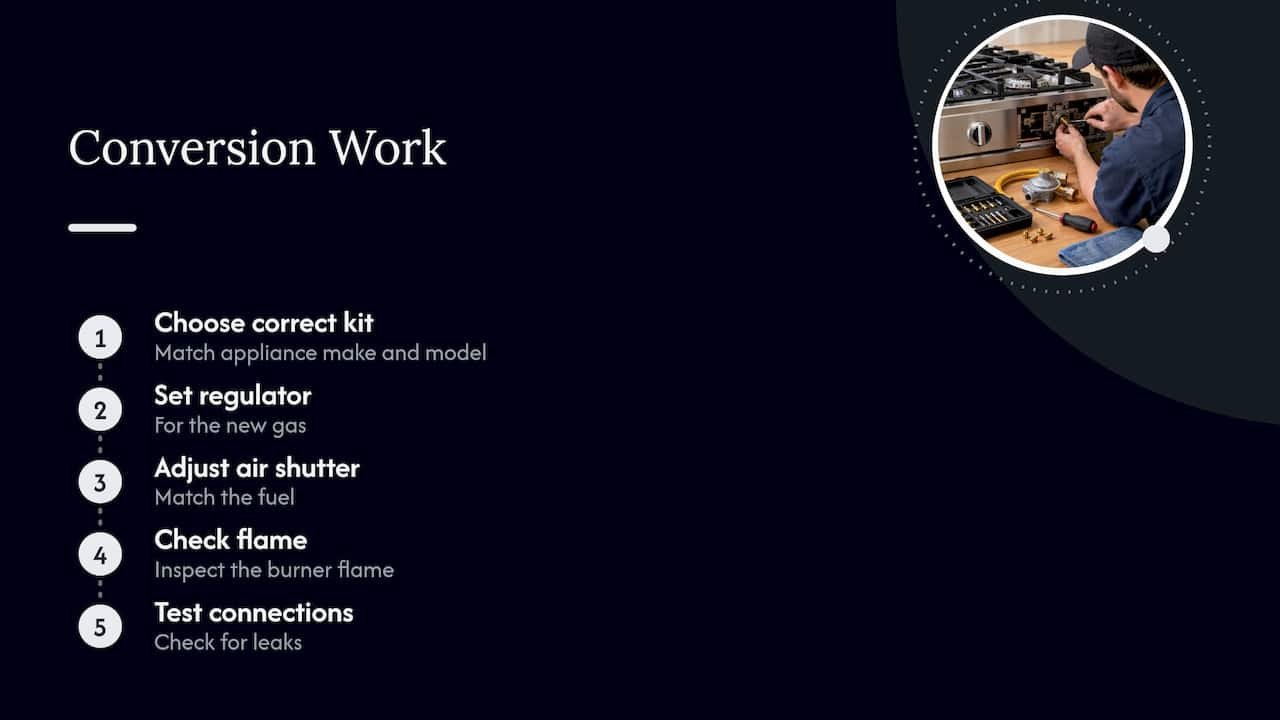
We approach conversions as a complete job. That means the correct kit for the make and model, the regulator set for the new gas, the air shutter adjusted, the flame checked and the connections tested for leaks. We would rather take the extra time than leave a burner that only appears to work.
Our advice to homeowners is simple. Learn how the system works, keep the conversion kit paperwork, and let a licensed technician do the work. If an appliance has been running on the wrong orifice, a technician can tell you what it was doing and fix it safely.
— MDTECH
Appliance gas conversion with MDTech Services
If you need a range, cooktop, oven or dryer converted, we handle LP to natural gas conversions for homeowners, landlords and property managers in Orange County and Los Angeles County. Our licensed technicians also repair gas appliances and install new ones, and you can book online.
Start with our gas appliance conversion service in California, or go straight to gas appliance repairs if something is already running poorly. For your specific appliance, see our pages on cooktop, oven and stove conversions, or converting a propane dryer to natural gas. To book, visit mdtechservices.com.
Getting the most from a conversion
Before the visit
- Write down the make, model and serial number from the data plate.
- Confirm which gas your home has. Check with your utility if you are not sure.
- Locate the original owner’s manual, and any conversion kit that shipped with the appliance.
- Clear access to the appliance and the gas shutoff valve.
After the visit
- Ask the technician what pressure the regulator is set to and keep the note.
- Watch the flame for a few days. It should be steady and blue.
- Keep the old orifices if you might switch fuels again, and label them.
- Test your carbon monoxide alarms.
If you are weighing the cost and benefit of switching fuels, our article on whether converting LP to natural gas is worth it walks through the main points. For a broader walk-through of the process, see our homeowner guide to gas conversion.
FAQ
Are natural gas orifices bigger or smaller than propane?
Natural gas orifices are bigger. Natural gas holds less energy per cubic foot and is delivered at lower pressure than propane, so the burner needs a larger opening to reach the same heat. A propane orifice for the same burner has a smaller hole.
What does orifice size mean?
It is the diameter of the drilled hole in the orifice fitting, usually given as a numbered drill size. The numbers run backward, so a lower number is a larger hole. Each size passes a certain number of BTU per hour at a given gas and pressure.
What natural gas pressure do home appliances use?
Research and published charts commonly list natural gas appliances at about 3.5 inches of water column, with some systems up to 7 inches. Propane appliances typically use 11 inches. Your regulator and the appliance data plate set the exact figure, and a technician should confirm it with a manometer.
Can I just drill out a propane orifice for natural gas?
We do not recommend it. A few thousandths of an inch change the output substantially, and hand drilling is hard to control. The regulator and air settings also have to change. Use the manufacturer’s conversion kit installed by a licensed technician.
What happens if the orifice is oversized?
The appliance gets more gas than it was designed for. That can cause incomplete combustion, excess heat and carbon monoxide. If you see yellow flames or soot, turn the appliance off and call a technician.
Sources
- How to Convert Gas Appliance Spuds or Orifices from LP to Natural Gas or Propane (InspectApedia)
- Gas Orifice Conversion Chart (LicensedNC)
- Orifice Gas Flow Chart (Century HVAC)
- Guidelines for Adjustment of Atmospheric Gas Burners (EPA)
- Orifice Plate Flow Measurement, Beta Ratio and DP Checks (Atlas of Engineering)