
A humming garbage disposal almost always means the motor is getting power but the flywheel underneath is jammed and can’t turn. Cut the power, use a hex wrench or a wooden broom handle to free the flywheel by hand, then press the reset button and run cold water to test it. If the flywheel spins freely by hand but the unit still hums when you flip the switch, the problem has moved past a simple jam and points to a failed capacitor, worn bearings, or a motor on its way out.
TL;DR:
- Most humming disposals are jammed by foreign objects like silverware or fruit pits, which is usually quick and easy to fix with a hex wrench or broom handle.
- If the flywheel spins freely but the disposal still hums, the issue likely stems from a failed start capacitor, seized bearings, or electrical faults rather than a jam.
- Continuous humming after attempting to clear a jam or the reset button repeatedly popping out indicates a likely motor failure or internal component damage, requiring professional repair or replacement.
- Safety precautions include completely disconnecting power before inspection, avoiding metal tools inside the chamber, and not running water with your hand or tools inside.
- Disposals older than 10 years or showing leaks, burning smells, or persistent electrical faults are generally better replaced than repaired to avoid ongoing issues.
Table of Contents
- Why Your Garbage Disposal Is Humming Instead of Grinding
- Safety Steps Before You Touch the Disposal
- The 5 to 10 Minute Fix for a Humming Disposal
- When the Flywheel Turns Freely but It Still Hums
- Repair or Replace: How to Decide
- Preventing the Next Jam
- What a Licensed Technician Checks During a Service Call
- The Real Lesson in a Humming Disposal
- Book a Disposal Repair With MDTech Services
- Sources
- FAQ
Why Your Garbage Disposal Is Humming Instead of Grinding
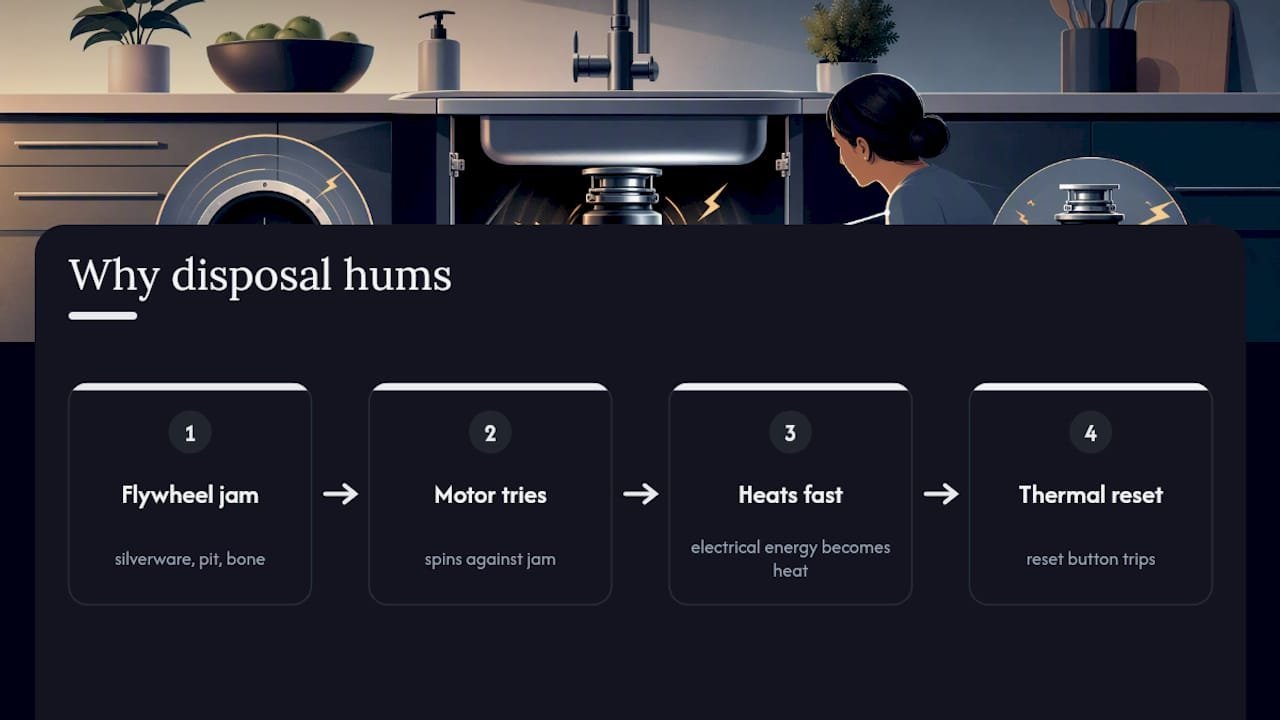
That hum you’re hearing isn’t the motor struggling to grind something. It’s the motor trying to spin against a flywheel that physically can’t move. Something has wedged itself between the impellers and the grind ring, usually a piece of silverware, a fruit pit, or a chunk of bone, and the motor keeps drawing current without anywhere for that energy to go.
This matters for a practical reason: a locked motor at standard household current heats up fast, sometimes within seconds, because all that electrical energy turns into heat in the windings instead of mechanical motion. That’s exactly why disposals have a thermal overload switch, better known as the reset button. It’s designed to trip before the motor cooks itself. If you hear humming and do nothing, you’re racing a clock you can’t see.
The good news is that a jammed flywheel is by far the most common cause of a humming disposal that won’t spin, and it’s also the easiest to fix yourself. The hum itself is useful information. It tells you the motor and the electrical supply are working, which narrows the problem down to a mechanical obstruction or a failing start component rather than a wiring issue.
Safety Steps Before You Touch the Disposal
Before any tool or finger goes near that unit, cut the power completely. Flip the wall switch off, unplug the unit if it’s plugged into an outlet under the sink, or trip the breaker, and confirm the switch truly has no effect before you start.
- Never put your hand inside the disposal chamber, even with the power off. Use tongs, needle-nose pliers, or the hex wrench designed for the job.
- Wear work gloves and eye protection when clearing debris, since broken glass and sharp metal fragments are common culprits.
- Skip metal tools you don’t recognize as disposal-safe. A butter knife or screwdriver jammed into the chamber can slip and damage the grind ring.
- Don’t run water into the chamber while your hand or a tool is inside it.
Pro Tip: If the disposal has been humming for more than a few seconds, shut it off immediately rather than letting it “work through” the jam. A locked motor overheats quickly, and repeated overheating shortens the motor’s life even when the reset button keeps saving it.
The 5 to 10 Minute Fix for a Humming Disposal
Most jammed disposals can be freed in less time than it takes to load the dishwasher. Work through these steps in order.
- Confirm the power is off. Flip the switch and listen. If it still hums, unplug the unit or shut off the breaker before continuing.
- Bail out standing water if the sink basin is full, using a cup or small bowl, so you can see into the chamber.
- Shine a flashlight down the drain and look for anything visible. Remove it with tongs or pliers. Never reach in by hand.
- Insert a 1/4-inch hex (Allen) wrench into the small hex socket on the bottom center of the disposal unit, underneath the sink. Rock it back and forth firmly until you feel the flywheel start to turn freely in both directions.
- No bottom socket on your model? Insert a wooden broom handle or a long wooden spoon down through the drain opening from above and lever the impeller blades until they rotate freely.
- Extract any loosened debris with tongs, then press the red reset button on the bottom or side of the unit.
- Restore power, run cold water, and switch the disposal on to test it.
This sequence matches what InSinkErator’s own support documentation recommends for jammed units, and it’s the same fix most appliance techs try first. Most humming disposal problems turn out to be exactly this kind of quick DIY repair, and freeing the jam with a hex wrench resolves the issue for the majority of homeowners without any tools beyond what’s in a kitchen drawer.
If the reset button won’t stay pushed in, don’t force it repeatedly. Wait about 10 minutes for the motor to cool and try again once. A reset that keeps popping back out after cooling usually means either the jam wasn’t fully cleared or the motor itself has failed.
When the Flywheel Turns Freely but It Still Hums
Here’s where the diagnosis gets more serious. If you can spin the flywheel smoothly by hand with the hex wrench, but flipping the switch still produces nothing but a hum, the jam isn’t the problem anymore.
A failed start capacitor or seized motor bearings are the two most likely causes at this stage. Here’s how to tell them apart, at least roughly:
- Failed start capacitor: the motor hums because it’s getting power but can’t generate the initial torque to start spinning under load. This component sits inside a sealed housing on many models.
- Worn or seized bearings: turning the hex wrench feels gritty, notchy, or stiff instead of smooth, even after the jam is cleared. That resistance means the bearings themselves are damaged.
- Electrical faults: before assuming a mechanical failure, check whether the disposal is on a GFCI-protected circuit that’s tripped, confirm the outlet has power with another appliance, and check that the breaker hasn’t partially failed.
Replacing a capacitor is technically possible, but it carries real risk. These components can hold a stored electrical charge even when unplugged, and most disposal motors are sealed units that aren’t designed for a home mechanic to open. In many cases, replacing the whole disposer ends up being the safer and cheaper option compared to sourcing and installing a replacement capacitor yourself. If your unit trips the GFCI outlet it’s plugged into every time you try to run it, that’s a signal worth investigating before you touch the motor at all.
Repair or Replace: How to Decide
Certain symptoms mean it’s time to stop troubleshooting and call a professional, no matter how confident you feel with a hex wrench.
- Water leaking from underneath the unit or around the sink flange.
- Any smell of burning plastic or wiring, or visible smoke.
- The reset button won’t hold even after a full cooling period.
- The disposal has tripped the breaker or reset more than once in the same week.
- Humming continues after you’ve confirmed the flywheel spins freely.
Age matters too. A disposal older than roughly 10 years has usually absorbed years of wear on its bearings and seals, and a capacitor or bearing failure at that point is often the first sign of a motor that’s simply worn out. Sinking money into a repair on a unit that old rarely pays off compared to installing a new one, and our garbage disposal replacement cost breakdown walks through what factors into that decision.
Pro Tip: Leaks and burning smells warrant an emergency call the same day. A persistent hum with no leak or odor can usually wait for a scheduled appointment within a day or two.
Preventing the Next Jam
A little discipline at the sink prevents most of the calls we get about humming disposals. Run cold water for a few seconds before, during, and after every use, since cold water keeps grease solid enough to grind and flush through rather than coating the chamber.
- Never pour grease, oil, or fat down the drain, and skip large bones, fruit pits, and shells entirely.
- Feed fibrous foods like celery and potato peels in small amounts, not handfuls, and cut large scraps into smaller pieces first.
- Clean the chamber occasionally with ice cubes, a handful of coarse salt, and citrus peels run through together to scrub the blades and freshen the smell.
- Glance at the reset button and chamber every few months, especially after any jam, to catch small problems early.
If jams keep coming back despite good habits, that’s usually a sign of a deeper mechanical issue worth having inspected rather than something you should keep clearing yourself.
What a Licensed Technician Checks During a Service Call
A professional visit follows a specific sequence: verifying power reaches the unit, testing the outlet and any GFCI protection, inspecting the sink flange and mounting for leaks, manually checking the flywheel for resistance, and listening for bearing noise under load. Technicians recommend replacement over repair when a unit shows recurring electrical faults, has crossed the decade mark in age, or shows internal bearing failure that makes repair cost-prohibitive against a new unit.

The Real Lesson in a Humming Disposal
Most advice online treats a humming disposal like a mystery that needs troubleshooting. It usually isn’t. The hum is the motor telling you exactly what’s wrong: it has power, it wants to spin, and something mechanical is stopping it. That’s actually reassuring information, because it rules out the more expensive possibilities before you’ve spent a dime.
Where conventional advice falls short is in what happens after the hex wrench trick. A lot of guides treat “try the reset button” as the end of the conversation, when a reset that won’t hold is really the beginning of a different one. That’s the moment homeowners either waste money chasing a capacitor repair that’s riskier than it looks, or replace a unit that only needed a five-minute unjam.
Our take: try the DIY fix once, safely, and give it a fair shot. If the flywheel spins free and the hum persists, or the reset won’t hold after cooling, stop treating it as a puzzle to solve yourself. That’s the line between a Saturday-morning fix and a job for someone who deals with failed capacitors and seized bearings every week.
— MDTECH
Book a Disposal Repair With MDTech Services
If the hex wrench trick didn’t clear it, or you’d rather skip the crawl under the sink altogether, Professional repair services are available locally to diagnose and fix the problem correctly the first time, with licensed technicians who identify the actual cause rather than guessing.

Many service providers offer online booking options and upfront estimates prior to starting any work, so customers have clarity on costs before a technician arrives. If you’re dealing with a leak, a burning smell, or smoke, request emergency service right away rather than waiting. For a persistent hum with no leak or odor, a standard scheduled visit works fine. Head to our kitchen appliance repair page to book a time that works for your household and get your disposal running quietly again.
Sources
- Garbage disposal hums but won’t spin? Here’s how to fix it in 10 minutes – HomeNestor
- Fixing a jammed garbage disposal – InSinkErator support
- Garbage disposal troubleshooting – ServiceMag guide
- Garbage disposal hums but doesn’t work: Common Causes & Solutions – AppliancePartsPros
- Garbage disposal humming but not spinning: what to do – FixitReal
FAQ
My Disposal Is Humming and I Pressed Reset. What Now?
If the button won’t stay pushed in, the motor is likely still hot or something is still jammed. Wait about 10 minutes for it to cool, clear any remaining debris with tongs, then try the reset button once more before assuming motor failure.
Why Is My Disposal Humming When It Isn’t Clogged With Food?
Even without a food clog, small hard objects like silverware, bottle caps, or fruit pits can wedge the flywheel just as effectively. Use a flashlight to check the chamber and a hex wrench in the bottom socket to free the flywheel manually.
What Can I Put Down a Garbage Disposal to Help Unclog It?
Ice cubes with coarse salt run through the chamber help scrub debris off the blades, and citrus peels freshen odors afterward. Avoid pouring grease, drain chemicals, or anything abrasive down the drain, since those tend to create the jams that cause humming in the first place.
Why Does My Disposal Hum but Not Actually Grind Anything?
The motor is receiving power but the flywheel can’t rotate, either from a physical jam or, if the flywheel spins freely by hand, from a failed capacitor or worn bearings. If clearing the jam doesn’t stop the humming, the unit likely needs a professional inspection or replacement.