
If your outdoor AC unit hums but the fan won’t start, the fan spins slowly or not at all, or you’re getting warm air even though the system sounds like it’s running, you’re likely looking at a failing capacitor. These three symptoms overlap with other electrical problems, so a proper diagnosis needs testing and not guessing. Don’t touch the capacitor yourself. Turn off the thermostat and call a licensed HVAC technician.
TL;DR:
- Capacitors store electrical energy to start and support the compressor and fan, and their failure often mimics compressor or wiring problems.
- Common signs of failure include humming with no start, slow or no fan, warm air from vents, and visible capacitor damage like swelling or leaks.
- Heat, power surges, age, and exposure accelerate capacitor deterioration, making regular maintenance and surge protection essential.
- DIY checks are limited to visual inspections and safely spinning the fan; testing and discharge must be performed by licensed technicians to avoid hazards.
- Immediate professional diagnosis is advised for symptoms like burning smells or no-start conditions, with typical replacements costing $100 to $400.
Table of Contents
- What Does an AC Capacitor Do?
- What Are the Types of AC Capacitors?
- What Are the Signs of AC Capacitor Failure?
- What Causes AC Capacitor Failure?
- How Can You Safely Check an AC Capacitor Yourself?
- When Should You Call an HVAC Professional?
- What Preventive Maintenance Reduces Capacitor Failures?
- Why Early Capacitor Detection Matters More Than People Think
- Get Your AC Capacitor Checked by a Licensed Technician
- Sources
- FAQ
What Does an AC Capacitor Do?
An AC capacitor stores electrical energy and releases it in a concentrated burst to start your compressor and fan motors, then it helps keep them running smoothly. Think of it as a small battery that gives your motors the jolt they need to overcome resistance at startup, then settles into a steady supporting role.
When a capacitor weakens, it can no longer deliver enough of a charge. The motor struggles to start, hesitates, or draws extra current trying to compensate. That’s why a bad capacitor produces symptoms that look a lot like compressor failure at first glance. Homeowners (and sometimes technicians working off a hunch) sink money into compressor diagnostics when the real problem is a $20 to $30 part. A failing capacitor also puts extra strain on the compressor every time it forces a hard start, which can shorten the compressor’s life if it goes unaddressed.
What Are the Types of AC Capacitors?
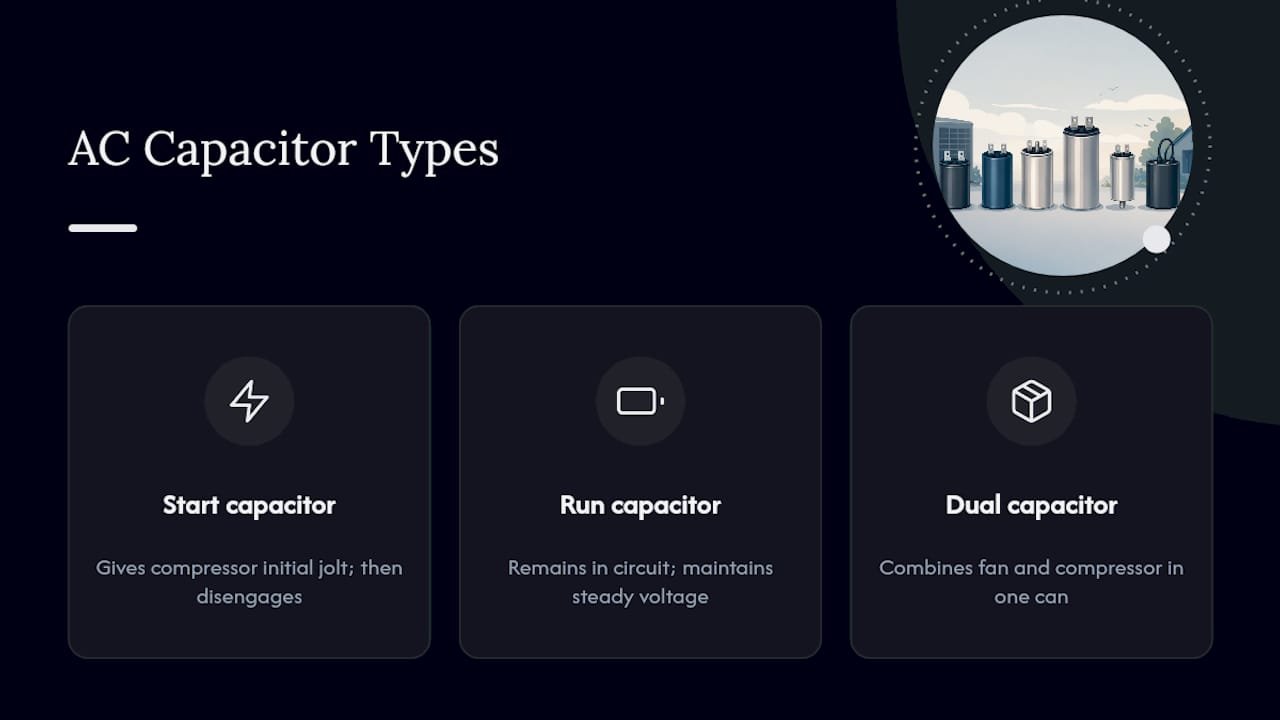
Central AC systems typically use two or three capacitor types, and matching the symptom to the type narrows down the problem. A start capacitor gives the compressor its initial jolt and disengages once the motor is running. A run capacitor stays in the circuit the whole time the motor operates, maintaining steady voltage. Many residential systems use a dual capacitor that combines both fan and compressor functions in one canister with two or three terminals.
Capacitors are usually mounted inside the outdoor condenser unit, near the fan motor or compressor, tucked behind an access panel. Each one is labeled with a microfarad (µF) rating and voltage rating stamped on the side. Replacement capacitors must match those specs exactly. A wrong-sized capacitor can cause the same symptoms as a failing one, or damage the motor outright.
What Are the Signs of AC Capacitor Failure?
Symptoms of AC capacitor issues range from a minor annoyance to a full system shutdown, and the severity usually tells you how much time you have before you need help. Here’s how to read them, ranked roughly by how often they show up and how urgent they are.
- Humming with no start. The outdoor unit hums but the compressor or fan won’t kick on. This is the single most common bad AC capacitor symptom, and it usually means the capacitor can’t deliver the starting charge the motor needs.
- Fan not spinning, or spinning slowly. If the condenser fan is sluggish or dead while the compressor runs, that points to a failing run capacitor specifically, since it’s the fan side of the dual capacitor that’s usually first to weaken.
- Warm air from the vents. If the outdoor unit is running or humming but your indoor air stays warm, the compressor likely isn’t building pressure the way it should, which often traces back to a capacitor that can’t sustain the compressor motor.
- Hard starting. The system takes several attempts to turn on, sometimes with a delay of several seconds after the thermostat calls for cooling. This is an early warning sign worth acting on before it becomes a no-start situation.
- Breaker trips or lights dim on startup. A capacitor forcing the motor to draw excess current can trip a breaker or cause a visible dim in your house lights the moment the AC kicks on.
- Intermittent cooling or short cycling. The system turns on and off repeatedly without completing a normal cooling cycle, a pattern consistent with a capacitor that’s degrading but not yet fully dead.
- Burning smell. A burning or acrid odor near the outdoor unit signals overheating components and should be treated as high urgency. Shut the system down.
- Visible bulge, oil leakage, or cracked casing. A swollen top, oily residue, or a cracked capacitor housing is a clear sign the part has failed internally and needs immediate replacement.
A quick reality check: the absence of visible damage doesn’t mean the capacitor is fine. Many capacitors fail electrically while looking completely normal on the outside, which is exactly why professional testing under load matters more than a visual once-over.
One important caveat runs through this entire list: a bad contactor, a failing compressor, or a loose wiring connection can produce nearly identical symptoms. Humming with no start, for instance, can come from a stuck contactor just as easily as a dead capacitor. That overlap is precisely why guessing is risky, and why the next two sections matter as much as the symptom list itself.
What Causes AC Capacitor Failure?
Heat is the leading cause of capacitor failure, and it’s not close. Capacitors sit inside a hot metal cabinet baking in direct sun for months at a time, and prolonged high ambient temperatures degrade the internal dielectric material faster than almost anything else. That’s part of why AC capacitor problems spike during the hottest stretches of summer, right when you need the system most.
Power surges and unstable voltage are the second major culprit. A lightning strike, a grid fluctuation, or even a neighborhood brownout can push more current through a capacitor than it’s rated for, weakening it instantly or over repeated events.
Age plays a role too. Capacitors commonly last somewhere in the 5 to 20 year range depending on climate, usage, and build quality, with units in hot coastal or desert regions typically landing on the shorter end. Salt air, humidity, and dust or debris buildup around the outdoor unit accelerate corrosion and shorten that window further. If a capacitor fails repeatedly within a short span, that’s rarely bad luck. It usually signals a deeper electrical issue, like voltage imbalance or loose terminals, and it’s worth having an electrician check the home’s supply.
How Can You Safely Check an AC Capacitor Yourself?
You can do a limited, no-contact inspection before calling for help, and it gives your technician useful information up front. The key word is limited. This is triage, not repair.
Start with power off completely: switch the thermostat to “off,” then flip the outdoor disconnect switch (usually a gray box mounted near the condenser) to cut power at the unit itself. Give it a minute before doing anything else.
From there, a homeowner can safely check:
- Look at the capacitor through the access panel for a bulging or swollen top, oily residue, or a cracked housing.
- Check for obvious burn marks or discoloration on the capacitor or nearby wiring.
- Look for any wiring that’s come loose from its terminal.
- Listen for humming, clicking, or repeated start attempts before you shut the system down, since that sound pattern is useful information for the technician.
- With power confirmed off, you can gently spin the fan blade with a non-conductive stick (never your hand) to check for stiffness or a locked-up bearing.
Pro Tip: Take a photo of the capacitor and note the exact symptom timeline (when it started, what you heard, whether it’s worse in the afternoon heat) before you call. That single detail can cut a diagnostic visit down by ten or fifteen minutes.
Here’s what you should never do, no exceptions: never touch the capacitor terminals, never attempt to discharge the capacitor yourself, and never try to test it with a meter. Capacitors retain a lethal electrical charge even after the power is switched off, and that charge doesn’t disappear just because the unit stopped running. Professionals discharge capacitors with insulated tools built for exactly that purpose. That step alone is worth the price of a service call.
When Should You Call an HVAC Professional?
Match your symptom to the right level of urgency instead of guessing. Here’s a practical breakdown:
- Same-day service: visible bulging, oil leakage, a burning smell, or a total no-start on a hot day. These situations risk further damage or a safety hazard the longer they sit.
- Within 24 to 48 hours: intermittent hard starting, occasional humming with delayed start, or short cycling that hasn’t gotten worse. You have some room, but the window is shrinking.
- Immediate emergency: a tripped breaker paired with a burning smell, or any situation where you smell smoke. Shut the system down and call right away.
A technician’s diagnostic process follows a set sequence: confirm power is off, discharge the capacitor with insulated tools, measure its actual capacitance against the rated µF on the label, then test it under load, since a capacitor can measure fine at rest and still fail the moment the motor demands its full inrush current. They’ll also inspect the contactor and compressor wiring while they’re in there, because those components fail in similar ways and sometimes fail together.
After a replacement, a good technician doesn’t just walk away. They’ll run an amp check on the compressor and fan motor and verify the system starts cleanly on the first attempt, confirming the new part is actually solving the problem rather than masking a different one.
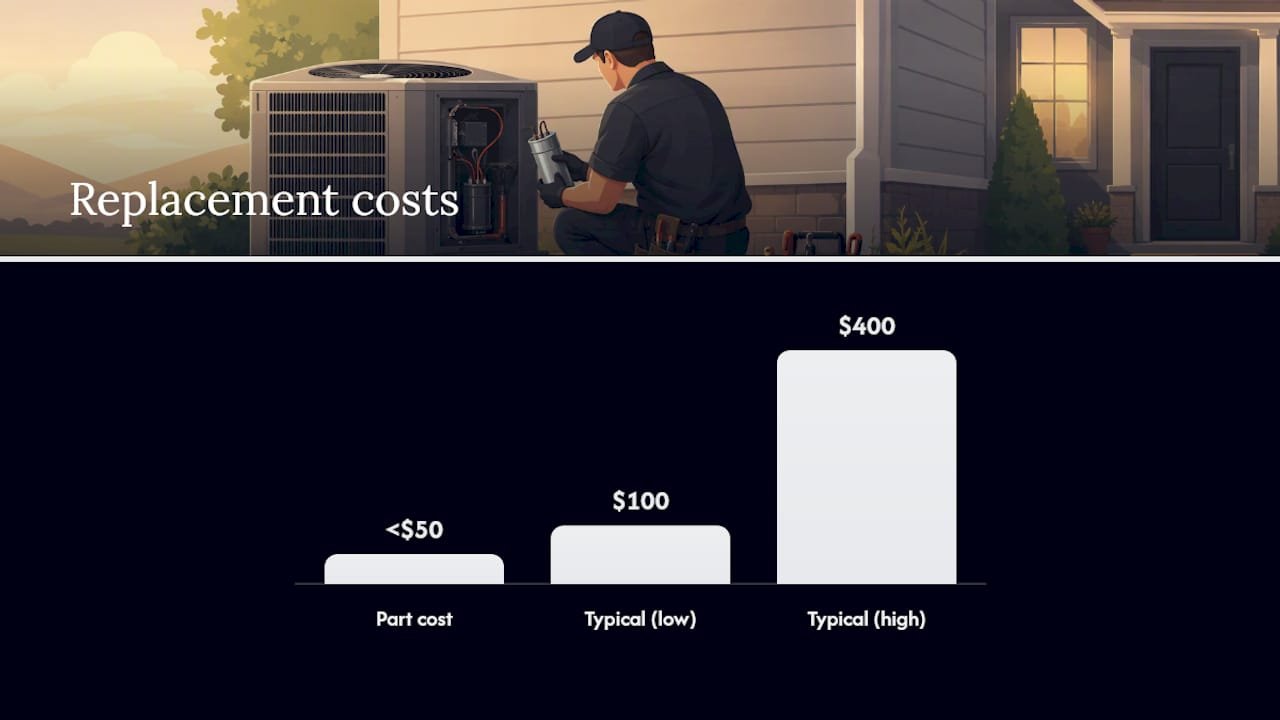
On cost: typical capacitor replacement runs $100 to $400 for parts and labor combined, with the part itself often costing well under $50. What pushes you toward the higher end is an after-hours emergency call, a longer drive for the technician, or additional repairs discovered during the visit, like a worn contactor. Before your appointment, have your unit’s model and serial number ready, a rough timeline of when symptoms started, and any photos you safely took. It speeds up the visit considerably.
What Preventive Maintenance Reduces Capacitor Failures?
A little upkeep goes a long way toward avoiding a mid-July breakdown. Consider these steps, either on your own or as part of a scheduled visit:
- Book a professional tune-up every spring, before peak cooling season hits, so a weak capacitor gets caught before it fails outright.
- Keep the area around your outdoor unit clear of leaves, grass clippings, and debris, and provide shade where possible to reduce the heat load on internal components.
- Install a whole-home surge protector, since voltage spikes are a leading cause of premature capacitor failure and a protector is cheap insurance against them.
- If your system is older or has already gone through one or two capacitor replacements, ask your technician whether proactive replacement makes sense before it fails on the hottest day of the year.
- Keep a simple log of service visits. If capacitors keep failing in the same unit, that pattern is worth escalating to an electrician to check for upstream voltage issues.
A shaded, clean, surge-protected system with a yearly checkup rarely surprises you with a dead capacitor in August.
Why Early Capacitor Detection Matters More Than People Think
Most homeowners treat a humming AC unit as background noise until the house stops cooling entirely. That’s backwards. The hum, the slow fan, the hesitant start, those are the system telling you something is wrong days or weeks before it fails completely.
It is common across many calls in Orange County and Los Angeles County that a customer describes a “weird sound” that’s been going on for a week, and it turns out to be a capacitor already well into failure. Catching it at that stage is a quick, affordable fix. Catching it after the compressor has taken repeated hard starts is a much bigger bill.
Licensed technicians typically run electrical testing under load, not just a quick visual check, and document findings along with clear, upfront pricing before any work starts. If your system is humming, hesitating, or blowing warm air, some service providers offer same-day diagnostics in the area.
— MDTECH
Get Your AC Capacitor Checked by a Licensed Technician
AC capacitors should be tested by safely discharging with insulated tools, measuring against the rated µF, and checking under actual operating load rather than a quick meter glance that can miss a capacitor about to fail. That’s the difference between a diagnosis you can trust and a guess that costs you a second service call.

If your outdoor unit is humming, the fan is sluggish, or you’re getting warm air on a hot afternoon, book a visit through our Air Conditioning Repair page, where you can schedule online and see coverage across our Orange County and Los Angeles County service area. Before your technician arrives, jot down your unit’s model and serial number, when the symptoms started, and any photos you safely captured from outside the access panel. It helps us diagnose faster and get your cooling back on track the same day whenever possible.
Sources
- AC Capacitor Replacement: Signs, Costs & Repair Steps — Bryant
- AC capacitor troubleshooting guide — Imperial AC Supply
- AC Capacitor leaking oil: top 5 warning signs — SML Capacitor (industry resource)
FAQ
What Happens if My AC Capacitor Goes Bad?
Your compressor or fan motor won’t get the electrical jolt it needs to start, so you’ll typically notice humming with no startup, a sluggish fan, or warm air from the vents. Left unaddressed, the repeated hard starts can eventually strain and damage the compressor, turning a cheap part replacement into a much bigger repair.
How Expensive Is It to Replace an AC Capacitor?
Replacement typically runs $100 to $400 for parts and labor combined, with the part itself often costing far less than the labor. Emergency after-hours calls or additional repairs found during the visit, like a worn contactor, can push the price toward the higher end.
What Is the Average Lifespan of an AC Capacitor?
Capacitors commonly last roughly 5 to 20 years depending on climate, usage, and heat exposure. Units in hot, humid, or salty coastal air tend to fail on the shorter end of that range.
How Long Will the AC Run With a Bad Capacitor?
It depends on how far the capacitor has degraded. Some systems limp along for days with intermittent cooling and hard starts, while others stop running entirely the moment the capacitor can no longer deliver enough charge to start the compressor or fan.
Can Mdtechservices Diagnose a Capacitor Problem the Same Day?
Yes. Mdtechservices offers same-day diagnostics across Orange County and Los Angeles County, and licensed technicians test capacitance and performance under load rather than relying on a quick visual check. You can book directly through the Air Conditioning Repair page.