
If your air conditioner is under 10 years old with one isolated failure, repair it. If it’s older, has a major component failure, uses R-22 refrigerant, or has needed repeated repairs, replacement usually pays off faster. Weigh age, repair cost, and repair frequency together, and use the $5,000 rule and ENERGY STAR’s age guidance as your starting filters.
TL;DR:
- Repair is usually worthwhile for units under 10 years old with isolated, inexpensive failures, especially if still under warranty.
- Major issues like compressor failure, rusted coils, or obsolete refrigerant generally justify replacement regardless of age.
- The $5,000 rule suggests replacing if the product of system age and repair cost exceeds that amount, or if repairs cost 50% or more of new system price.
- Proper installation and matching components are crucial; poor setup can negate energy savings from a new, efficient system.
- Disposing of old units responsibly involves refrigerant recovery and recycling, with environmental benefits favoring replacement when the system is inefficient or environmentally risky.
Table of Contents
- Repair or Replace an Air Conditioner: When Fixing It Makes Sense
- When Is It Time to Replace Your Air Conditioner?
- What Is the $5,000 Rule for HVAC Repair Decisions?
- Does a New AC Save Money on Energy Bills?
- How to Compare Repair and Replacement Quotes
- MDTech Services: What Our On-Site Assessment Covers
- How Long Does AC Replacement Take From Decision to Installation?
- Are There Rebates or Tax Credits for a New Air Conditioner?
- Will a New AC Improve Indoor Air Quality?
- Do New Air Conditioners Work With Smart Thermostats?
- What Happens to Your Old AC Unit When You Replace It?
- Our Take: Weigh the Whole Picture, Not Just One Number
- Schedule an MDTech On-Site Assessment
- Sources
Repair or Replace an Air Conditioner: When Fixing It Makes Sense
Repair almost always wins when the system is under 10 years old, the failure is isolated, and the fix is inexpensive relative to what a new unit would cost. Warranty coverage tips the scale further toward repair, since parts and sometimes labor are already paid for.
Certain failures are low risk and cheap to fix, which makes repair the obvious call:
- Capacitor replacement — often the culprit behind a unit that hums but won’t start, and one of the least expensive fixes available.
- Contactor issues — a worn contactor can cause a system to run intermittently or not at all, but the part itself is inexpensive.
- Thermostat problems — sometimes the “AC” isn’t broken at all; the control is.
- Fan motor replacement — a moderate cost repair that’s still far cheaper than a full system swap.
Repair frequency matters as much as repair cost. One service call in five years is a different story than three calls in eighteen months. A pattern of repeated breakdowns signals a system that’s wearing out system wide, not just a single failed part.
Before you approve any repair, run through a short checklist: confirm whether the unit is still under manufacturer or parts warranty, ask the technician how much life the failing part typically has left once replaced, and request a written diagnosis that names the actual defect rather than a vague “it needs service” note. Routine upkeep, like smart HVAC efficiency habits and seasonal filter changes, also extends the window where repair remains the smarter option.
When Is It Time to Replace Your Air Conditioner?
Age is the first flag. ENERGY STAR advises homeowners to consider replacement when a heat pump or air conditioner is more than 10 years old, and many industry guides put the practical replacement window at 10 to 15 years depending on usage and maintenance history. That said, lifetime modeling using national survey data found a median central AC lifespan closer to 18 years, which means age alone shouldn’t be the only trigger. Treat 10 to 15 years as a decision zone, not a hard deadline.
Certain failures point toward replacement regardless of age:
- Compressor failure — often the single most expensive component to replace, and frequently not worth fixing on an older unit.
- Rusted or corroded coils — a sign of long-term moisture damage that tends to recur even after a repair.
- Repeated major repairs — if you’ve paid for two significant fixes in three years, a third is likely coming.
- Obsolete refrigerant (R-22) — systems still running R-22 face rising service costs and shrinking refrigerant supply, since production has been phased out.
Watch performance too. Steadily climbing utility bills, along with cooling that stays weak even after a repair visit, both suggest the system has lost efficiency it won’t get back. Our guide to signs of a failing HVAC system walks through these warning signs in more detail.
What Is the $5,000 Rule for HVAC Repair Decisions?
Homeowners need fast math when a technician is standing in the driveway with a repair estimate. Two rules of thumb cover most situations.
- The $5,000 rule. Multiply the system’s age in years by the estimated repair cost. If the result exceeds $5,000, replacement is usually worth serious consideration. A 12-year-old unit with a $500 repair estimate lands at 6,000, which nudges you toward replacement, even though the repair itself sounds cheap.
- Percent-of-new rules. If a repair estimate runs 50% or more of the cost of a new system, replacement almost always makes more financial sense. Some contractors use a tighter 30 to 40% threshold for older units nearing the end of their expected service life.
Statistic Callout: A repair that crosses the $5,000 rule’s threshold, or that quotes at 50% or more of replacement cost, is the clearest numeric signal most homeowners will get that repair is no longer the economical choice.
These heuristics have limits. They don’t account for active warranty coverage, whether the failing part is minor or a compressor, refrigerant availability, or regional labor rates that swing repair estimates significantly from one market to another.
Does a New AC Save Money on Energy Bills?
SEER (Seasonal Energy Efficiency Ratio) and EER (Energy Efficiency Ratio) measure how much cooling a system delivers per unit of energy consumed. Higher numbers mean lower operating costs for the same square footage cooled. Correctly installed ENERGY STAR certified equipment can cut heating and cooling costs by up to about 20% compared with older, lower-efficiency systems.
That savings depends entirely on installation quality, not just the equipment label:
- Replace the indoor coil along with the outdoor condenser; mismatched components rarely hit their rated efficiency.
- Have ducts inspected and sealed, since leaky ductwork bleeds cooling capacity before it ever reaches a room.
- Confirm the contractor sized the system for your home’s actual square footage and insulation, not just the unit that was on the truck.
Pro Tip: Ask your technician for the system’s rated SEER2 number in writing, then ask what efficiency you’ll actually get after installation. A gap between the two is a red flag on workmanship, not equipment.
Skipping these steps carries a real cost. Improper installation can reduce efficiency by as much as 30%, which erases much of the savings a new unit was supposed to deliver, and it can shorten the equipment’s working life. Our HVAC efficiency checklist covers the specific items worth confirming before a new system goes in.
How to Compare Repair and Replacement Quotes
A repair estimate and a replacement quote should each spell out the same categories of information, which makes them easy to compare side by side once you know what to look for.
Ask every contractor for these items in writing:
- Full scope of work, not a one-line summary
- Parts and labor broken out separately, not bundled into a flat fee
- Warranty terms, including whether coverage transfers if you sell the home
- Exact equipment model numbers and system sizing calculations
- Refrigerant type used in the new or repaired system
- A realistic timeline from approval to completion
Watch for red flags that suggest you’re dealing with the wrong contractor. A vague scope of work, no proof of license or insurance, pressure to replace before a diagnosis is even finished, or a warranty explanation that changes depending on who answers the phone all warrant walking away. Our piece on choosing licensed technicians breaks down exactly what credentials to verify, and Axenia Construction’s guide to hiring licensed contractors explains why licensing and insurance protect you financially, not just legally.
- Get a second opinion any time a single contractor recommends full replacement without first attempting a diagnosis.
- Consider financing or a phased upgrade, such as replacing the outdoor unit now and the indoor coil within the same season, when a full system swap doesn’t fit your budget yet.
MDTech Services: What Our On-Site Assessment Covers
Mdtechservices sends licensed technicians who know Orange County and Los Angeles County homes, from older R-22 systems to newer variable-speed equipment. Every assessment includes online booking so you’re not waiting on hold to get a technician scheduled.
A typical on-site visit covers:
- Diagnostic checks on the compressor, capacitor, and electrical components
- Refrigerant type verification and a leak check
- Coil and ductwork inspection for corrosion or airflow loss
- A written estimate that separates parts, labor, and warranty terms
That written estimate becomes your baseline for comparing any other repair or replace air conditioner quote you collect.
How Long Does AC Replacement Take From Decision to Installation?
Most straightforward replacements move from decision to a running system within one to three days once you’ve signed off, assuming the new unit matches your home’s existing ductwork and electrical setup. A same-day emergency swap is possible when a compressor fails in the middle of summer and a technician has comparable equipment in stock, but that’s the exception, not the rule.
The timeline stretches when the job involves more than a straight swap. Upsizing or downsizing the system, adding new ductwork, upgrading electrical panels to support a higher-efficiency unit, or waiting on a specific model number can add anywhere from a few days to two or three weeks. Permitting requirements in some cities add another layer, since inspections typically happen after installation rather than before.
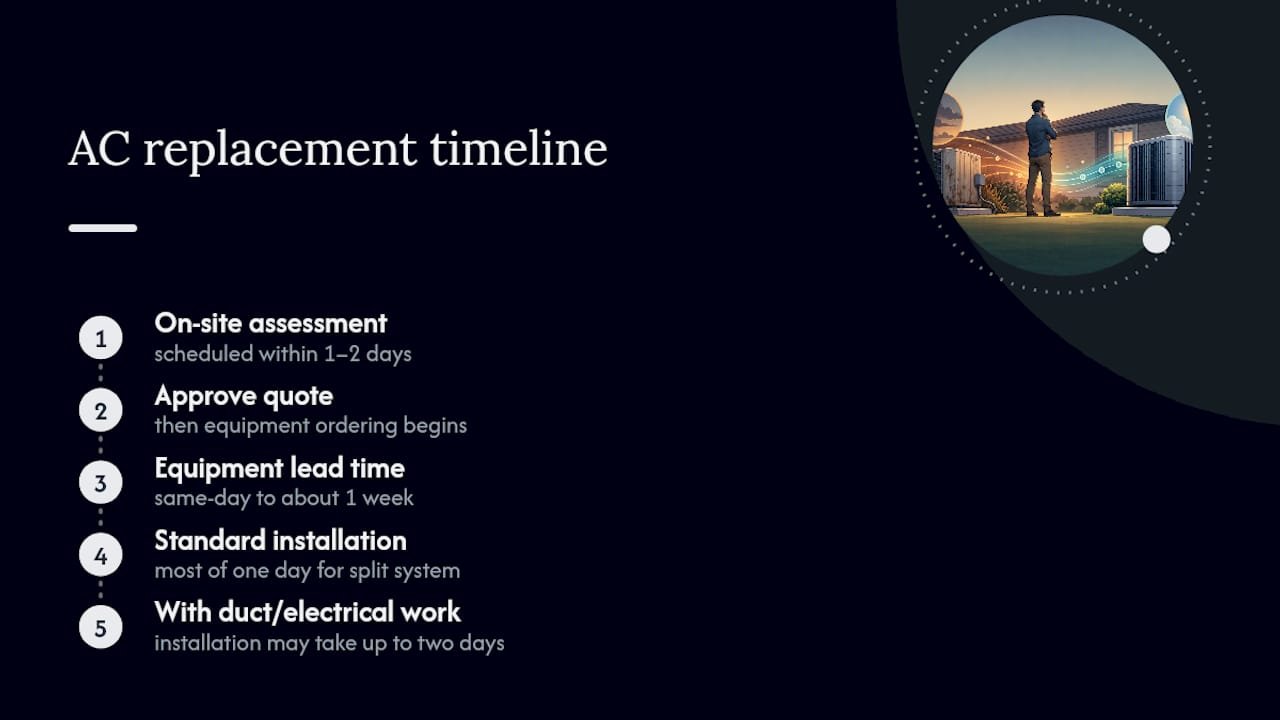
The practical sequence looks like this: an on-site assessment and written estimate come first, usually scheduled within a day or two of your call. Once you approve the quote, equipment ordering takes anywhere from same-day (for common sizes) to about a week for less common configurations. Installation itself for a standard split system usually takes a single technician crew most of one day. Homes needing duct modifications or electrical upgrades should expect installation day to stretch into two.
Ask your contractor for a specific date range in writing rather than a general “a few days” estimate, particularly during peak summer months when demand for replacement units and technician availability both tighten.
Are There Rebates or Tax Credits for a New Air Conditioner?
Replacing an older air conditioner with a higher-efficiency model often qualifies for financial incentives that reduce the effective cost of upgrading. Utility companies frequently run seasonal rebate programs for ENERGY STAR certified equipment, and the amount varies by region and by the efficiency tier of the unit installed.
Federal tax credits have also applied to qualifying high-efficiency HVAC equipment in recent years, though the specific credit amount, eligible equipment list, and expiration dates change based on current tax law. Because these programs shift from year to year, confirm current eligibility directly with the IRS or your utility provider rather than relying on a number quoted in an older article or a contractor’s sales sheet.
Manufacturer promotions add another layer worth checking. Some equipment brands run seasonal rebates on qualifying systems, and manufacturer financing offers can lower the upfront cost even when no rebate applies. Stacking a utility rebate with a manufacturer promotion and any applicable tax credit can meaningfully close the price gap between the cheapest repair and a full replacement, which is worth factoring into the percent-of-new math discussed earlier.
Ask any contractor you’re considering whether they handle rebate paperwork on your behalf, since some utility programs require documentation submitted by a licensed installer rather than the homeowner directly.
Will a New AC Improve Indoor Air Quality?
A new air conditioner can improve indoor air quality, though the improvement comes from specific upgrades rather than the new equipment alone. Modern systems typically pair with higher MERV-rated filtration than what many older units were designed to handle, which captures more dust, pollen, and particulate matter as air circulates.
Newer systems also tend to run more consistent airflow cycles, which reduces the humidity swings that let mold and dust mites thrive in ductwork. An aging system that short cycles or struggles to reach set temperature often leaves a home more humid than a properly sized replacement running at rated capacity.
That said, air quality gains depend heavily on what else happens during installation. A new unit connected to old, leaky, or contaminated ductwork won’t deliver much improvement, since the air still travels through the same compromised path before reaching your living space. If air quality is a priority, ask your technician to inspect ductwork condition as part of the replacement, and consider whether a whole-home air purifier or UV filtration add-on makes sense for your household, particularly if allergies or asthma are a factor.
Do New Air Conditioners Work With Smart Thermostats?
Most air conditioners installed within the last several years work with smart thermostats, though compatibility depends on your system’s wiring and control type. Standard single-stage systems typically pair easily with popular smart thermostat models. Variable-speed or multi-stage systems sometimes need a compatible thermostat specifically designed to communicate with that equipment’s control board.
Replacing an older system creates a natural opportunity to add smart thermostat control if you don’t already have it. The combination can meaningfully improve efficiency, since a smart thermostat that learns your schedule and adjusts setpoints automatically avoids the energy waste of cooling an empty house all day. Some models also flag unusual runtime patterns, which can serve as an early warning sign of a developing mechanical problem.
If you’re replacing an aging system that used a simple mercury or dial thermostat, confirm with your technician during installation that the new equipment’s control wiring supports whatever smart thermostat you’re planning to add. Mismatched wiring is a common and easily avoided installation oversight.
What Happens to Your Old AC Unit When You Replace It?
Disposal is a legitimate consideration in the repair or replace air conditioner decision, and it cuts in a specific direction: repair generally has a smaller environmental footprint than replacement, at least in the short term, since it keeps existing materials in service rather than sending them to a landfill or recycling stream.
That calculation shifts once a system is old enough or inefficient enough that its ongoing energy use outweighs the manufacturing impact of a new unit. A system still running R-22 refrigerant carries its own environmental cost, since R-22 is an ozone-depleting substance, and proper recovery during disposal matters as much as the decision to replace.
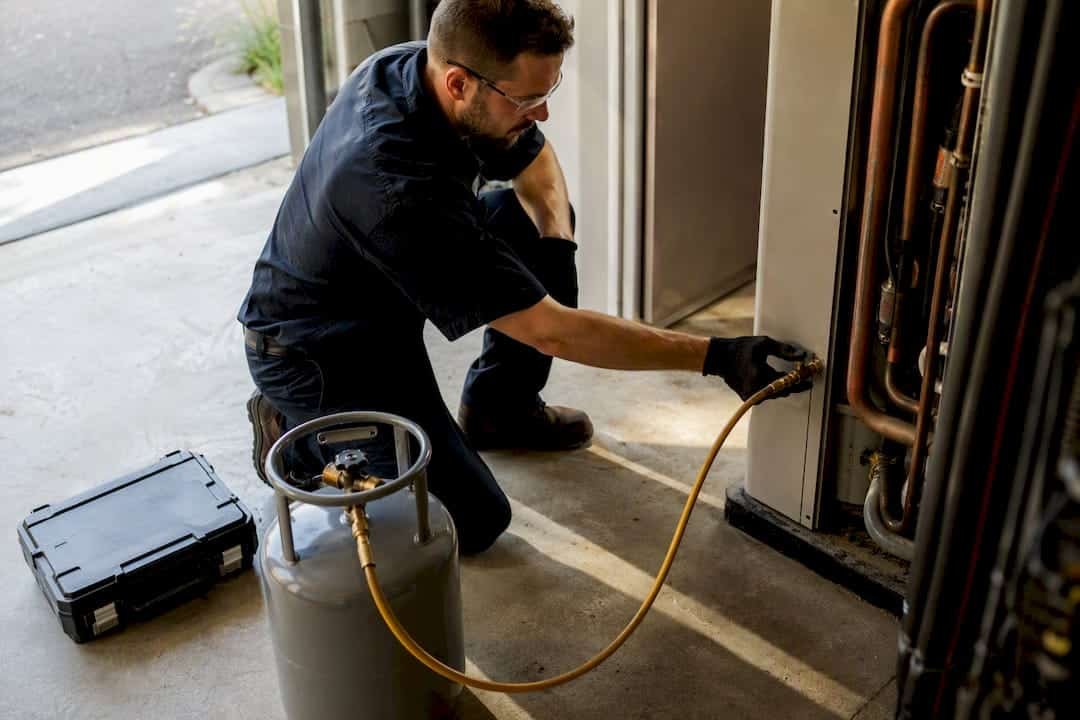
Licensed contractors are required to recover refrigerant before disposing of old equipment rather than releasing it into the atmosphere, and many components in a decommissioned system, including copper coils and aluminum housing, are recyclable through appliance recycling programs. Ask whichever contractor you hire how they handle refrigerant recovery and unit disposal specifically, since practices vary and not every company follows recovery requirements consistently.
The environmental math ultimately favors extending the life of a system that’s still efficient and repairable, while favoring replacement once a unit’s energy waste and refrigerant risk outweigh the cost of manufacturing something new.
Our Take: Weigh the Whole Picture, Not Just One Number
Repair newer units when the fault is inexpensive and isolated. Replace units that are aging, failing repeatedly, or running obsolete refrigerant, especially once efficiency losses stack up. Installation quality matters as much as the equipment you choose. Work through the checklist above, then get a licensed on-site assessment before committing either way.
— MDTECH
Schedule an MDTech On-Site Assessment
Mdtechservices gives you a real alternative to guessing at a repair or replace air conditioner decision on your own: a licensed technician who inspects your actual system, not a generic age chart, and hands you a written estimate the same visit.
That written estimate breaks down parts, labor, warranty terms, and refrigerant status, so you can run the $5,000 rule or the percent-of-new math with real numbers instead of guesses. Our technicians are licensed and familiar with the specific installation issues that erase efficiency gains, from mismatched coils to unsealed ductwork, so the fix you pay for actually performs the way it’s supposed to. If you’re ready to find out whether your system is worth repairing, visit our appliance repair versus replacement service page to book an on-site visit and request your detailed written estimate.
Sources
- When is it time to replace? | ENERGY STAR
- What is the $5,000 rule for HVAC systems? – CBS News
- HVAC Repair or HVAC Replacement – Make the Right Choice – Trane®
- Using national survey data to estimate lifetimes of residential appliances (OSTI)