
Most homeowners pay between $170 and $735 for furnace repair, with the national average landing around $352. That single number won’t tell you whether your specific quote is fair, but it gives you a benchmark before the technician walks in the door.
Here’s the rule that matters more than any price chart: if the repair costs 50% or more of a new furnace’s price, and your unit is past 10 years old, replacement usually makes better financial sense than repair. Your invoice typically breaks down into a few predictable pieces:
- Diagnostic or service call fee — the cost to have a technician inspect and identify the problem
- Labor — billed hourly, often with a minimum charge
- Parts — priced individually, sometimes marked up
- After-hours or emergency surcharge — added if you call outside normal business hours
Key Takeaways
Furnace repair cost typically falls between $170 and $735, and the 50% rule against a new furnace’s price is the fastest way to decide between fixing and replacing.
| Point | Details |
|---|---|
| Know your baseline | Most repairs cost $170 to $735 nationally, with a typical bill near $352. |
| Apply the 50% rule | If repair costs approach or exceed half the price of replacement, especially for units older than 10 years, replacement is usually more cost-effective. |
| Watch component costs | Ignitors and flame sensors run $80 to $300; a cracked heat exchanger often means replacement, not repair. |
| Avoid emergency premiums | After-hours calls typically add $100 to $300, so book during business hours when you can. |
| Get help from MDTech Services | Licensed technicians provide itemized diagnostics and quotes across Orange County and Los Angeles County. |
Table of Contents
- Furnace Repair Cost Breakdown: Service Calls, Labor, and Parts
- What Specific Furnace Components Cost to Repair
- Why Two Furnace Repair Quotes Can Differ by Hundreds of Dollars
- When to Repair vs. Replace Your Furnace
- How to Lower Your Furnace Repair Bill
- How MDTech Services Handles Furnace Diagnostics and Repair Quotes
- Our Take on Furnace Repair Pricing
- Get an Honest Furnace Repair Quote From MDTech Services
- Frequently Asked Questions
- Sources
Furnace Repair Cost Breakdown: Service Calls, Labor, and Parts
A furnace repair estimate is really three numbers stacked together: what it costs to show up, what it costs to fix, and what the part itself costs. Understanding each piece is what separates a homeowner who can evaluate a quote from one who just has to trust it.
The diagnostic fee, sometimes called a service call fee, averages around $69 nationally, though some guides put diagnostics between $75 and $150. Most reputable companies credit that fee toward the repair if you move forward with the work, so ask about this upfront. It’s a fair question, not an awkward one.
Hourly labor for HVAC work typically runs $60 to $70 an hour, though total labor time depends on how accessible your furnace is and how straightforward the diagnosis turns out to be.
| Cost Component | Typical Range |
|---|---|
| Diagnostic/service call | $69–$150 |
| Hourly labor rate | $60–$70 |
| Routine repair (parts + labor) | $150–$600 |
| Emergency/after-hours surcharge | $100–$300 |
| Full repair range (low to high) | $170–$735 |
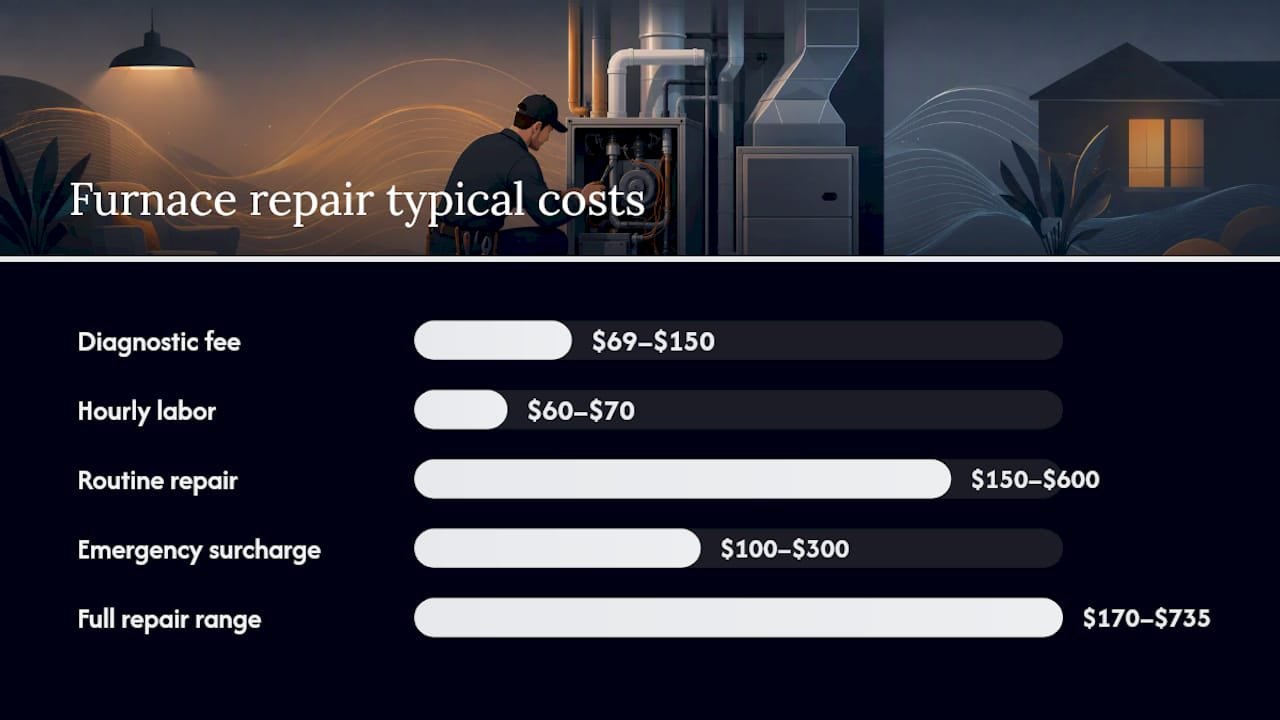
If your furnace dies at 9 p.m. on a Saturday, expect the bill to climb. Emergency and after-hours calls typically add $100 to $300 on top of standard pricing, since technicians charge a premium for working outside scheduled hours. That’s the cost of convenience, and it’s usually avoidable with a little planning.
What Specific Furnace Components Cost to Repair
Furnace repair quotes generally depend on the specific failing part, and awareness of typical pricing per component can aid in evaluating estimates.
- Ignitor: Often $150 to $300 installed. This is one of the most frequently replaced parts, since ignitors wear out from repeated heating and cooling cycles.
- Flame sensor: Usually $80 to $250. A dirty or failing sensor is a common culprit behind a furnace that starts, then shuts off within seconds.
- Capacitor: Generally $120 to $250. Worth confirming before you agree to a blower motor replacement, since a bad capacitor sometimes mimics motor failure.
- Blower motor: This is where costs swing widely, from a few hundred dollars to over $1,200 depending on whether it’s a PSC or ECM motor and whether the part is OEM or aftermarket.
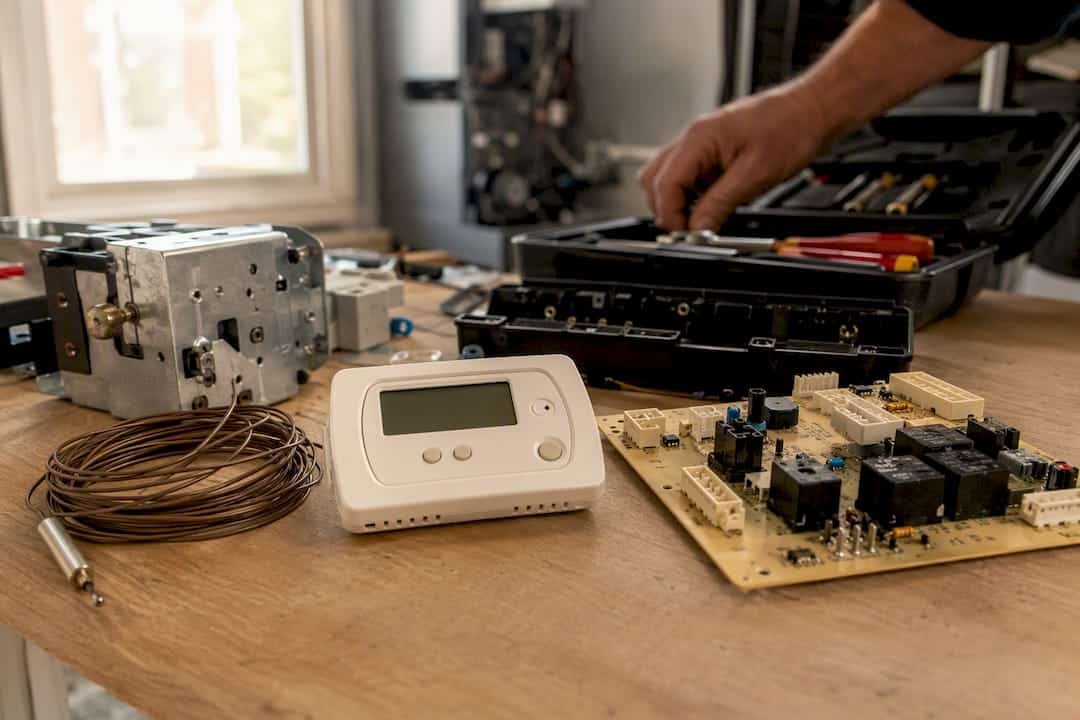
- Control board: Typically $200 to $600, sometimes higher on newer, computerized systems with more sensors to coordinate.
- Heat exchanger: Often $500 to $1,500 or more when the part itself is even available, and a cracked heat exchanger is usually the point where replacement becomes the smarter call.
Statistic to remember: most routine furnace repairs land in the $150 to $600 range, which means a quote of $900 or more for something other than a heat exchanger or blower motor deserves a second opinion.
OEM parts cost more than aftermarket alternatives, but they usually preserve your manufacturer component warranty, which can matter more than the sticker price if the part fails again within a year or two.
Why Two Furnace Repair Quotes Can Differ by Hundreds of Dollars
Two technicians can look at the same broken furnace and hand you two very different numbers, and it’s rarely because one of them is padding the bill. A handful of variables routinely swing furnace repair cost estimates:
- Unit age and repair history: An older furnace with a string of recent repairs behind it often costs more to keep alive, since technicians frequently find a second problem while fixing the first.
- Accessibility: A furnace tucked in an attic or crawlspace adds 30% to 60% more labor time than one sitting in an open basement, often tacking on an extra $50 to $200.
- Warranty coverage: If your furnace is still under a manufacturer parts warranty, you may only pay for labor, which can cut your bill substantially.
- Fuel type and parts sourcing: Older systems, especially those tied to phased-out refrigerants like R-22, face parts scarcity that drives up cost and stretches out scheduling.
Pro Tip: Before you approve a blower motor replacement, ask the technician to test the capacitor first. A failing capacitor is a common, much cheaper fix that sometimes gets misdiagnosed as full motor failure.
When to Repair vs. Replace Your Furnace
The 50% rule gives you a clean way to decide without guessing: if a repair costs 50% or more of what a new furnace installation would run, lean toward replacement.
- Run the math on a specific quote. If a new furnace installation runs about $4,000 and your repair quote comes in at $2,200, you’re past the 50% threshold, and replacement likely wins on long-term value.
- Weigh age against the quote. Furnaces under 10 years old are usually worth repairing almost regardless of cost. Between 10 and 15 years, the 50% rule should decide it. Past 15 years, most HVAC guidance leans toward replacement even for moderate repair costs, since efficiency losses and future failures start adding up.
- Factor in what you’ve already spent. If you’ve paid for two or three repairs in the last two years, add those totals to the current quote before deciding. The real cost of “just fixing it again” is often higher than it looks in isolation.
- Watch for safety dealbreakers. A cracked heat exchanger, which risks carbon monoxide leaking into your home, is one of the few situations where replacement is the only responsible choice regardless of age or price.
- Ask the technician three questions before you sign anything: What’s likely to fail next? Is any part still under manufacturer warranty? Can I get an itemized quote broken down by part and labor?
How to Lower Your Furnace Repair Bill
A little planning saves real money here, mostly by avoiding the premiums that come with surprise breakdowns.
- Schedule a pre-season tune-up before the first cold snap. A typical tune-up checks the ignitor, flame sensor, filters, and airflow, catching small problems before they become expensive ones.
- Ask upfront whether the diagnostic fee gets credited toward the repair.
- Request an itemized quote broken down by parts and labor, not a single lump number.
- Book service during regular business hours whenever the problem allows it, since after-hours calls add $100 to $300 that a same-week appointment avoids entirely.
- If you’re leaning toward replacement, ask about financing options rather than assuming it’s out of reach.
Pro Tip: Set a calendar reminder for early fall every year. Furnaces that get annual preventative maintenance tend to catch failing parts during a scheduled visit instead of during the first freeze of the season, when everyone else is calling too.
How MDTech Services Handles Furnace Diagnostics and Repair Quotes
MDTech Services sends licensed technicians who diagnose the actual problem before quoting a fix, not the other way around. Homeowners across Orange County and Los Angeles County get:
- Online appointment booking without waiting on hold
- Itemized quotes that separate diagnostic fees, labor, and parts
- Technicians trained across major brands and both gas furnace types
- A transparent HVAC repair process that explains what’s wrong before any work begins
Our Take on Furnace Repair Pricing
The conventional advice on furnace repair cost stops at “get three quotes,” which is fine but incomplete. The real gap is that most homeowners never ask what happens after the diagnostic fee, or whether the technician tested a cheaper part before recommending an expensive one. That single question, asked before a capacitor gets blamed on a $700 blower motor, probably saves more homeowners money than comparison shopping does.
The 50% rule is useful, but it works best paired with age. A five-year-old furnace with a $600 repair quote is still worth fixing even if that number sounds high in isolation. A 16-year-old furnace with the same quote usually isn’t. Age changes what the rule means, and too many guides treat it as a flat threshold instead of a sliding scale.
Where replacement looks likely, the smartest first move isn’t shopping for a new unit. It’s getting a technician to confirm the diagnosis in person, since a wrong first guess costs more than the second opinion ever would.
Get an Honest Furnace Repair Quote From MDTech Services
Mdtechservices gives you what most furnace repair calls don’t: a technician who diagnoses the actual failure first, then quotes it in writing, broken down by parts and labor, before any work starts.
That matters most exactly when you’re staring down a repair-versus-replace decision. Instead of guessing whether a $700 quote is fair or padded, you get a licensed technician’s read on what’s actually failing, what it costs to fix, and whether that cost gets you close enough to a full furnace installation that replacement is the smarter move. Homeowners across Orange County and Los Angeles County use this to skip the guesswork that usually comes with emergency calls.
If your furnace is acting up, book a diagnostic appointment with MDTech Services online and get an itemized quote before winter forces the decision for you.
Frequently Asked Questions
How much is furnace repair on average?
Most homeowners pay between $170 and $735, with a typical bill landing around $352. The exact number depends on which component failed and whether the call happens during business hours.
What is a typical furnace repair estimate for a diagnostic visit?
Diagnostic or service call fees average around $69 to $150, and most companies credit that amount toward the repair if you proceed with the work.
Is furnace service pricing different for emergency calls?
Yes. After-hours and emergency furnace repair cost typically runs $100 to $300 higher than a scheduled daytime appointment, since technicians charge a premium for off-hours work.
How do I get an accurate furnace repair estimate without overpaying?
Ask for an itemized quote that separates diagnostic fees, labor, and parts, and confirm whether the part is OEM or aftermarket, since that affects both price and manufacturer warranty coverage.
When does furnace repair cost make replacement the better option?
When the repair quote reaches 50% or more of a new furnace’s installed price, especially on a unit over 10 to 15 years old, or when the problem involves a cracked heat exchanger that poses a carbon monoxide risk.
Sources
- Furnace repair cost — Thumbtack
- R-22 refrigerant — Carrier
- Hvac
- Furnace repair cost — United HVAC Motors