
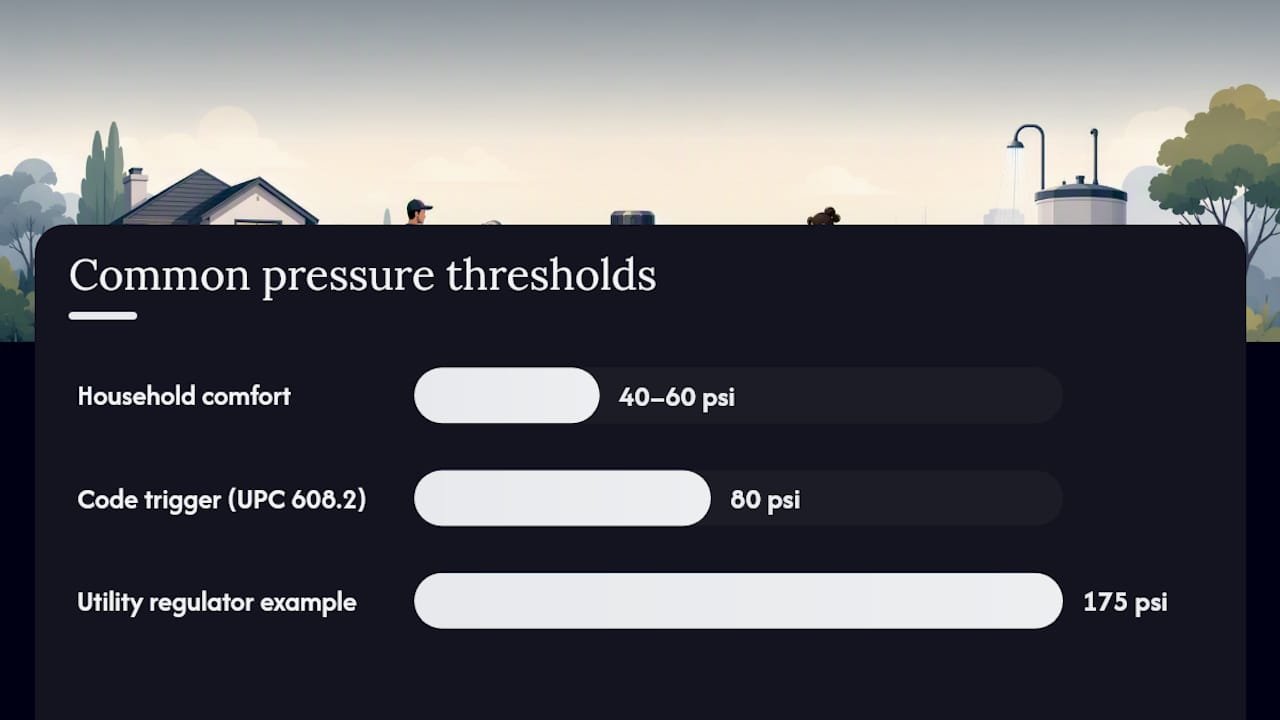
A water pressure regulator, also called a pressure-reducing valve or PRV, is the device on your main water line that lowers and stabilizes incoming water pressure to a safe, steady level for your home. Most homes run best around 50 psi, with a comfortable working range of 40 to 60 psi. If your static pressure climbs above 80 psi, the Uniform Plumbing Code Section 608.2 requires a regulator on the property. If you’ve noticed banging pipes when a faucet shuts off, or a toilet that seems to drip or run more than it should, those are two of the clearest early signs that your pressure is running too high.
That’s the short answer. The rest of this guide walks through how a regulator actually does its job, what happens if you skip one, and how to know whether you need to adjust, repair, or replace the one you’ve got.
Table of Contents
- What Is Water Pressure Regulation and How Does the Valve Work?
- Why Does Regulating Water Pressure Matter for Your Home?
- What Does the Plumbing Code Require, and Who’s Responsible?
- Where Is the Regulator Installed and What’s Around It?
- How Do You Test Your Home’s Water Pressure?
- Adjusting, Repairing, or Replacing Your PRV
- How Do You Choose the Right Pressure Regulator?
- When Should You Call a Licensed Plumber?
- Get Your Water Pressure Checked by MDTech Services
- Sources
What Is Water Pressure Regulation and How Does the Valve Work?
Water pressure regulation is the process of controlling how much force the water in your pipes carries, so it stays within a range your fixtures and appliances can handle without stress. The tool that does this work is the PRV, and its mechanism is simpler than most homeowners expect.
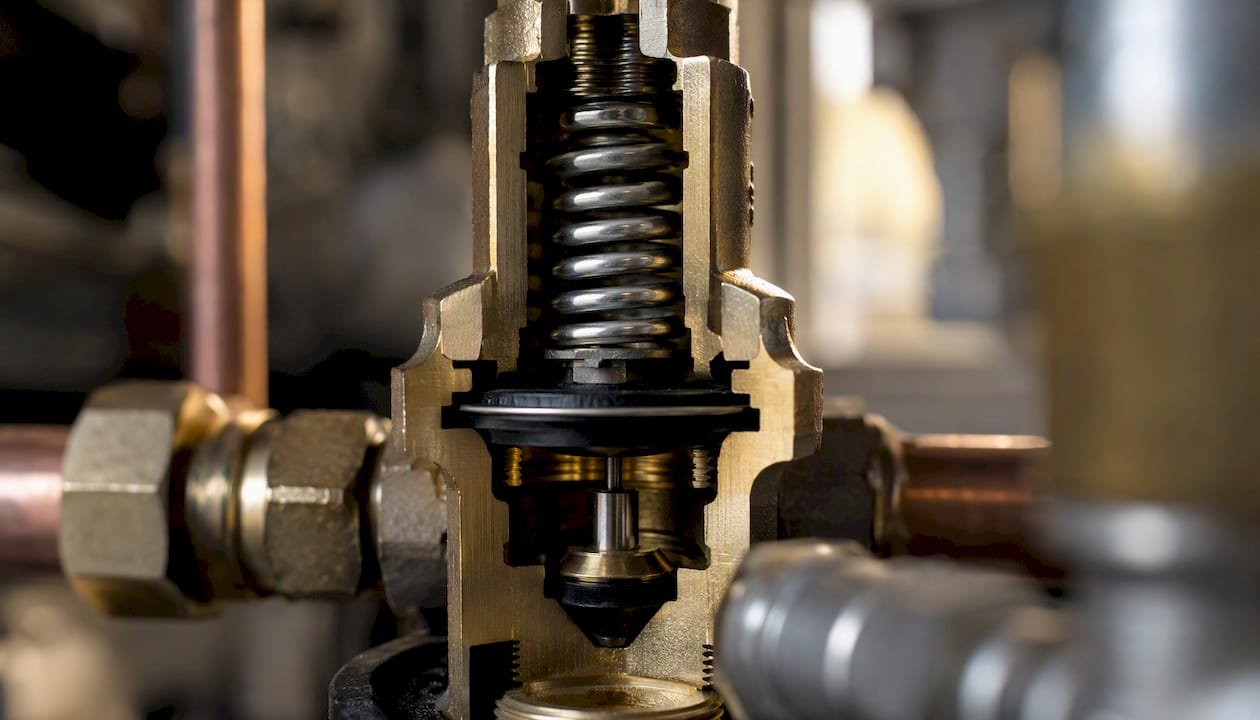
Inside the valve sits a spring-loaded diaphragm. Water enters the valve at whatever pressure the utility is delivering, sometimes 100 psi or higher depending on your elevation and how close you are to the pumping station. The spring pushes against the diaphragm, narrowing or widening the internal flow path until the pressure on the outlet side settles at a target number. A PRV is essentially a mechanical throttle: it doesn’t add pressure, it only reduces and steadies what’s already there.
Two pressure readings matter here, and mixing them up is a common source of confusion:
- Upstream pressure is whatever the utility sends down the main line before it reaches your regulator. This number can swing throughout the day based on neighborhood demand, elevation, and system maintenance.
- Downstream pressure is what comes out the other side of the valve, headed into your house. This is the number you actually control, and it should stay consistent even when upstream pressure fluctuates.
Most regulators have an adjustment screw on top. Turning it clockwise typically compresses the spring further and raises downstream pressure. Turning it counter-clockwise loosens the spring and lowers it. When that screw seizes up from corrosion, or the internal spring weakens with age, you’ll start seeing symptoms: pressure spikes at odd hours, banging noises in the walls, or a showerhead that surges and drops instead of running steady.
Why Does Regulating Water Pressure Matter for Your Home?
High water pressure feels great in the shower until you realize what it’s doing to everything behind the walls. Pipes, fittings, and appliances are engineered around a specific pressure range, and pushing past it accelerates wear in ways you won’t notice until something fails.
Here’s what unregulated pressure typically costs homeowners over time:
- Burst pipe fittings, particularly at joints and older solder connections that weren’t built for sustained high pressure.
- Shortened appliance life in dishwashers, washing machines, and water heaters, all of which have internal valves and hoses rated for a maximum psi.
- Running or leaking toilets caused by fill valves that can’t fully seal against excess pressure.
- Water hammer, the loud banging you hear when a valve closes suddenly and the pressure wave has nowhere to go.
- Inconsistent shower temperature, since pressure swings throw off the mixing valve’s balance between hot and cold lines.
A properly regulated system fixes all of that at once. Fixtures last longer, seals wear more slowly, and you avoid the slow leaks that run up your water bill without anyone noticing. If you’re already dealing with drips or damp spots, our complete leak-prevention checklist walks through the early warning signs worth catching before they become a repair call. Homeowners who’ve dealt with a mid-cycle dishwasher leak or a water heater that failed years early usually trace it back to pressure that was never checked in the first place.
What Does the Plumbing Code Require, and Who’s Responsible?
The rules here aren’t arbitrary. Uniform Plumbing Code Section 608.2 sets the trigger point: when static water pressure from the utility exceeds 80 psi, a pressure regulator becomes a code requirement, typically installed with a strainer to catch sediment before it reaches the valve.
Where the confusion usually starts is the split between what the utility protects and what you’re responsible for. Many water districts install a regulator at or near the meter, but that device exists to protect the meter and the utility’s infrastructure, not your household plumbing. As one water district explains, a district-owned regulator is not a substitute for a customer-owned PRV, since the two devices serve different purposes and are often set at different thresholds. Some districts only require their own regulator at pressures far above the household code trigger, such as 175 psi, which means a customer-side PRV is often the only thing keeping your home in the 40 to 60 psi comfort zone.
Local rules vary enough that it’s worth a quick call to your municipal water provider to confirm their specific policy before you assume you’re covered either way.
| Documentation to Gather | Why It Helps |
|---|---|
| Static pressure reading (no fixtures running) | Establishes your baseline against the 80 psi code threshold |
| Working pressure reading (fixtures running) | Shows how pressure behaves under normal household demand |
| Photos of the existing regulator and its label | Helps a plumber identify model, age, and orientation before a visit |
| Utility account or service address | Speeds up confirming whether your area has known pressure issues |
Pro Tip: Call your water utility before your plumber. Ask them directly what static pressure your street typically runs, since that single number tells you whether you’re dealing with a nuisance or a code issue.
Where Is the Regulator Installed and What’s Around It?
A PRV is almost always installed on the house side of the water meter, just after the main shutoff valve. That placement is intentional. It lets the regulator manage everything flowing into your home while leaving the utility’s meter and supply line untouched by any adjustment you make.
Around the regulator, you’ll usually find a small cluster of related parts:
- A main shutoff valve immediately upstream, so the whole system can be isolated for service.
- A strainer or mesh screen that catches sediment and mineral debris before it reaches the diaphragm.
- Isolation valves on either side of the PRV in newer installations, which let a plumber service or replace the valve without shutting off water to the entire house.
- A pressure gauge, sometimes built into the assembly, sometimes added separately for quick spot checks.
For potable water lines, look for lead-free brass or approved plastic components. Most modern regulators carry NSF certification marks confirming they’re rated for drinking water use, which matters more than people assume given how much water passes through that single valve every day.
Pro Tip: Check the arrow stamped on the regulator body before you touch anything. It shows flow direction, and if the valve was ever installed backward during a remodel, no amount of adjusting the screw will get your pressure right.
How Do You Test Your Home’s Water Pressure?
Testing takes about ten minutes and requires only a hose-end pressure gauge, which costs less than a service call and tells you almost everything you need to know.
- Buy a hose-end pressure gauge. These screw onto any outdoor spigot and cost relatively little at most hardware stores.
- Turn off all fixtures inside the house, including ice makers, sprinklers, and anything that draws water automatically.
- Attach the gauge to an outdoor faucet located close to where your main line enters the house, then turn the faucet fully open.
- Read the static pressure, the number the gauge shows with nothing else running. This is your baseline.
- Run a fixture inside (a sink or shower) while keeping the gauge attached, then note the dynamic pressure. A drop of more than a few psi under load can point to a restriction elsewhere in the system.
- Compare both readings against the safe range. Pressure below 40 psi usually means weak flow at multiple fixtures, 40 to 60 psi is the target zone most homes should sit in, and anything above roughly 65 to 75 psi starts putting real strain on pipes and appliances even before you hit the 80 psi code threshold.
Our guide on why testing water pressure matters covers a few additional troubleshooting steps if your readings come back inconsistent between tests.
Adjusting, Repairing, or Replacing Your PRV
If your static reading is high but your regulator still holds steady under flow, a small adjustment is often all you need. Loosen the lock nut, turn the adjustment screw in quarter-turn increments, then wait a minute and re-measure before turning again. Small, incremental changes produce far more predictable results than one big twist, which can overshoot the target and stress fixtures on the other end.
Adjustment has limits, though. Mineral deposits build up inside the valve body over years of use, and once the internal seals or spring degrade, turning the screw only offers a temporary fix. Rebuild kits exist for some models and can extend the life of an otherwise sound valve, but corrosion on the housing itself is usually the sign that replacement, not repair, is the better investment. Homes with irrigation systems sometimes benefit from a second, dedicated PRV tuned separately from the one serving household fixtures, since sprinkler demand and indoor demand rarely call for the same pressure setting.
Pro Tip: If the adjustment bolt won’t turn, or you see any moisture around the valve body while adjusting it, stop. A stripped bolt or a hairline crack under pressure is exactly the kind of failure that turns a five-minute fix into a flooded utility closet.
How Do You Choose the Right Pressure Regulator?
Not every PRV fits every house, and picking one based on size alone is a common mistake. A few criteria matter more than price:
- Inlet and outlet size should match your existing supply line, typically 3/4 inch or 1 inch in most residential setups.
- Flow capacity (GPM) at your expected working pressure needs to cover peak demand, meaning multiple fixtures running at once, not just a single tap.
- Maximum inlet pressure rating should comfortably exceed what your utility delivers upstream, with margin for occasional surges.
- Lead-free certification under NSF/ANSI standards is non-negotiable for any valve touching potable water.
- Serviceable versus cartridge-style design is worth considering upfront. Serviceable models accept rebuild kits and last longer with maintenance, while cartridge units are simpler to swap but usually get replaced outright rather than repaired.
Homes with high simultaneous demand, larger households, multiple bathrooms, irrigation systems, benefit from looking at the regulator’s flow curve rather than just its size, since an undersized unit restricts flow while an oversized one can create pressure instability of its own.
When Should You Call a Licensed Plumber?
Some situations are squarely DIY territory: a quarter-turn adjustment, a basic pressure test, a visual check of the strainer. Others call for a professional, and knowing the difference saves you from turning a small problem into a bigger one.
Watch for these warning signs:
- Pressure readings that won’t stabilize even after you’ve made adjustments.
- Visible leaks or corrosion on the regulator body itself.
- Banging pipes (water hammer) that persist after you’ve ruled out simple causes.
- Sudden drops or spikes in pressure that seem to happen without a clear trigger.
- Inconsistent fill times on appliances like washing machines or dishwashers.
When a licensed plumber comes out, expect them to measure both upstream and downstream pressure, isolate the PRV to test it independently from the rest of the system, and document their readings before recommending repair or replacement. Bring your own static and dynamic pressure readings, a few photos of the regulator, and notes on when the symptoms show up, since that context often shortens the visit considerably. Costs vary based on accessibility of the valve, whether isolation valves already exist, and whether any additional plumbing upgrades come up during the inspection. For a broader sense of which plumbing problems are worth a DIY attempt versus a service call, our guide on common household plumbing issues breaks down that decision in more detail. Municipal water pressure also shifts with terrain and elevation in ways no amount of home adjustment can fully control, which is exactly why a dedicated, homeowner-owned PRV tends to be the more reliable long-term fix.
A Simple Habit Worth Adopting
I’d recommend one habit to every homeowner who’s just learned they have a PRV: take a pressure reading once a year, snap a photo of the regulator and its label, and keep both somewhere you can find them. It sounds minor, but it turns a future service call into a five-minute conversation instead of a guessing game, especially if the person handling that call isn’t you.
One more thing worth doing while you’re at it: check your water heater and any high-value appliance manuals for their maximum rated pressure, then set your PRV a few psi below that number rather than right at the edge. It costs nothing and buys you a real margin of safety.
Get Your Water Pressure Checked by MDTech Services
If everything above has you fairly sure your home is running high, or you’d rather have a professional confirm it than guess, that’s exactly the kind of visit Mdtechservices handles regularly across Orange County and Los Angeles County. Instead of piecing together a DIY test and hoping you read the gauge right, you get a licensed technician who measures upstream and downstream pressure directly, isolates your PRV to test it properly, and documents every reading before recommending a fix.
Booking one of our plumbing safety checks gets you a technician who photographs the setup, records baseline numbers for future reference, and tells you plainly whether you’re looking at a simple adjustment or a regulator that’s reached the end of its service life. If your pressure issues have already led to appliance strain, our team also handles the appliance repair side of the equation, so one visit can cover both the cause and the damage. Schedule a pressure check with Mdtechservices and get a documented answer instead of a guess.
Quick Summary: What to Remember and Do Next
The single most important fact here: household water pressure should sit between 40 and 60 psi, and anything above 80 psi triggers a code requirement for a regulator under UPC Section 608.2.
| Point | Details |
|---|---|
| Test before you assume | Use a hose-end gauge at an outdoor faucet to check both static and working pressure. |
| Know your safe range | Aim for 40 to 60 psi; readings above 65 to 75 psi warrant attention before hitting 80 psi. |
| Adjust in small steps | Turn the screw in quarter turns and re-measure before adjusting again. |
| Replace when signs point that way | Corrosion, seal failure, or a stuck adjustment bolt means replacement, not repair. |
| Keep records for future visits | Save annual pressure readings and photos of your regulator setup. |
| Call Mdtechservices for confirmation | Licensed technicians measure, document, and resolve PRV issues across Orange County and Los Angeles County. |
Primary Sources and Further Reading
The sources below cover three different angles worth understanding: the code language itself, how a utility frames its own responsibilities, and the practical mechanics of testing and adjusting a regulator at home.
- IAPMO Code Spotlight on UPC Section 608.2, for the exact code threshold and requirement language.
- Valley Water District’s pressure regulator guidance, for how one utility explains the split between meter protection and household responsibility.
- The Spruce’s water pressure regulator overview, for a clear explanation of the spring-loaded mechanism.
- ATAS Plumbing’s DIY testing guide, for the step-by-step gauge test and reading interpretation.
- Black Mountain Plumbing’s failure signs guide, for a rundown of the warning signs that point to a failing PRV.
Sources
- IAPMO Code Spotlight
- VWD pressure regulator information
- Water pressure regulator overview — The Spruce
- How to test and adjust your water pressure regulator — ATAS Plumbing
- Water pressure regulator is failing? — Black Mountain Plumbing