
TL;DR:
- Retrofitting old homes involves upgrading building systems to enhance energy efficiency, comfort, and safety while preserving character.
- A whole-building approach, sequencing improvements, and professional management are critical to successful, sustainable retrofits.
Retrofit is defined as the process of upgrading an existing building’s fabric, systems, and services to improve energy performance, comfort, and safety without demolishing or replacing the structure. For older homes, the role of retrofit goes far beyond swapping out a boiler or adding loft insulation. It is a whole-building strategy that addresses how heat moves through walls, how air circulates through rooms, and how moisture behaves inside aging materials. Deep retrofits deliver 30% to 50% energy savings and up to 75% reductions in whole-life carbon emissions, figures that make a compelling case for any homeowner sitting on a drafty Victorian terrace or a mid-century ranch house.
What are the main benefits of retrofitting old houses?
Retrofitting old houses produces measurable gains across energy costs, health, property value, and environmental impact. These benefits are not theoretical. They show up on utility bills, in air quality readings, and in real estate appraisals.
Energy and cost savings are the most immediate wins. Standard retrofits reduce energy use by 8% to 20%, while high-performing projects reach up to 59% reduction. That range reflects the difference between adding weatherstripping and executing a full fabric-first overhaul with insulation, airtightness work, and a heat pump.
Health and comfort improvements follow directly from better building performance. Deep retrofit reduces drafts, stabilizes indoor temperatures, improves air quality, and cuts noise transmission. Older homes with solid walls and single-glazed windows are notorious for cold spots and condensation. Addressing these issues reduces respiratory risks linked to damp and mold.
The additional benefits worth knowing:
- Property value: Energy-efficient homes command higher prices and attract more buyers in competitive markets like Orange County and Los Angeles.
- Environmental impact: Retrofitting an existing structure avoids the carbon cost of demolition and new construction, making it one of the most sustainable renovation choices available.
- Heritage preservation: Upgrading performance does not require stripping character. Lime plaster, original timber frames, and period windows can all be retained with the right approach.
- Extended building lifespan: Addressing moisture, structural weaknesses, and outdated systems during a retrofit adds decades to a home’s functional life.
Pro Tip: When calculating the return on investment for a retrofit project, factor in avoided maintenance costs alongside energy savings. Older homes with deferred repairs often see compounding benefits once moisture and thermal issues are resolved.
How does a whole-building approach guide successful retrofit projects?
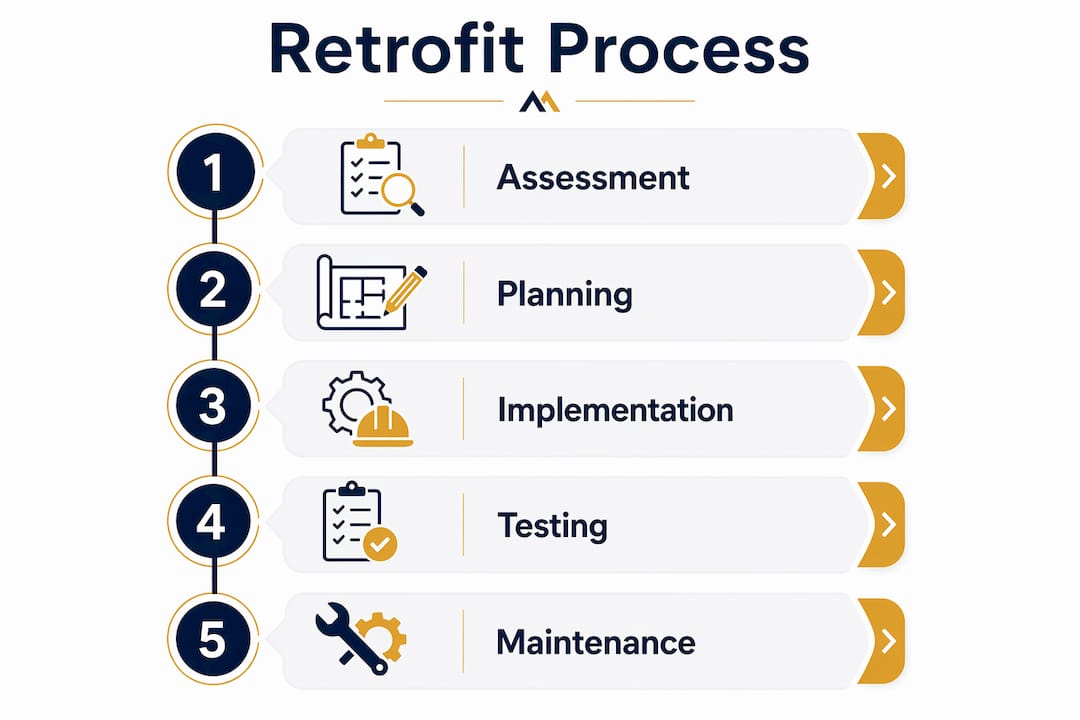
A whole-building approach treats the home as a single interconnected system rather than a collection of independent components. This distinction separates successful retrofits from expensive mistakes.

Every element of an old home interacts with every other. Insulation affects how moisture moves through walls. Airtightness affects how ventilation performs. Heating system sizing depends on how much heat the building fabric loses. Failing to consider whole-building interactions is the primary cause of retrofit failures, according to the Energy Saving Trust. That finding explains why so many homeowners who add insulation without addressing ventilation end up with mold problems they did not have before.
The sequencing of work matters as much as the work itself. Fabric improvements come first: insulation, air sealing, and window upgrades reduce heat demand before any heating system is selected. Installing a heat pump in a poorly insulated home is a common and costly error. The system ends up oversized for the building’s eventual heat demand once the fabric is improved, and the homeowner pays for equipment they did not need.
“Retrofitting is best understood as a sequence of interrelated decisions rather than isolated upgrades.” — Energy Saving Trust
Improving airtightness without upgrading ventilation causes moisture to accumulate inside wall cavities and living spaces, creating conditions for mold growth and structural decay. The solution is pairing airtightness work with a mechanical ventilation system, specifically an Energy Recovery Ventilator (ERV), which exchanges stale indoor air for fresh outdoor air while retaining most of the heat. This combination delivers both performance and healthy indoor air quality without compromise.
Modeling the building before work begins, measuring performance after each phase, and adjusting the plan based on results are the practices that separate professional retrofit coordinators from general contractors working on instinct.
What are key challenges and pitfalls when retrofitting vintage homes?
Retrofitting vintage homes presents a specific set of technical and regulatory challenges that do not apply to newer construction. Understanding them before you start saves money and avoids damage to irreplaceable features.
Moisture and breathability top the list of technical risks. Many pre-1920s homes were built with solid masonry walls designed to absorb and release moisture naturally. Applying modern vapor-barrier insulation to these walls traps moisture inside the masonry, accelerating decay and causing internal dampness. The fix is using breathable insulation materials, such as wood fiber or cork, that allow the wall to continue managing moisture the way it was designed to.
Thermal bridging is another persistent problem. A thermal bridge is any point in the building envelope where heat escapes faster than through the surrounding insulated area. Window frames, floor joists penetrating external walls, and structural steel elements are common culprits in older homes. Ignoring them undermines the performance of otherwise well-executed insulation work.
Heritage and conservation rules add a regulatory layer. Homes in historic districts or with listed status face restrictions on external alterations, window replacements, and visible changes to facades. Conservation and energy performance are complementary when a fabric-first approach is applied, but achieving that balance requires professionals who understand both building science and preservation requirements.
| Challenge | Risk if ignored | Recommended approach |
|---|---|---|
| Solid wall moisture management | Trapped damp, structural decay | Use breathable insulation (wood fiber, cork) |
| Thermal bridging | Reduced insulation effectiveness | Continuous insulation detailing at junctions |
| Heritage restrictions | Permit violations, forced removal | Consult a preservation-aware retrofit designer |
| Airtightness without ventilation | Mold, poor air quality | Install ERV alongside air sealing work |
Phased, planned long-term retrofit aligned with regular maintenance cycles is the most practical way to manage these challenges without overwhelming your budget or your household. Tackling one system at a time, in the correct sequence, reduces risk and keeps the project manageable.
How do retrofit roles and expert involvement impact project outcomes?
The quality of a retrofit depends heavily on who is involved and what their specific responsibilities are. The PAS 2035 framework defines five key roles that every well-managed retrofit project should include:
- Retrofit Advisor: Provides initial guidance on what is possible, what funding is available, and what the homeowner’s priorities should be.
- Retrofit Assessor: Conducts a detailed survey of the existing building, documenting its construction, condition, and current performance.
- Retrofit Coordinator: Manages the overall project, sequences the interventions, and ensures all trades work toward the same performance targets.
- Retrofit Designer: Produces technical specifications for each measure, accounting for the building’s specific characteristics and heritage constraints.
- Retrofit Evaluator: Reviews the completed work against the original targets and documents lessons for future phases.
Each role addresses a different failure point. Without a coordinator, individual contractors optimize for their own scope rather than the building as a whole. Without an evaluator, there is no feedback loop to confirm the work performed as expected. For older homes with complex construction histories, skipping any of these roles increases the risk of expensive remedial work later.
Pro Tip: Ask any retrofit contractor whether they work within the PAS 2035 framework before signing a contract. Those who do are accountable to a documented standard. Those who do not are working without a quality assurance structure.
Working with licensed, experienced professionals also matters for energy efficiency outcomes in systems like HVAC, where sizing, installation quality, and commissioning directly determine whether the system performs as designed.
Which retrofit upgrades are most effective for energy efficiency in old homes?
Prioritizing retrofit measures correctly determines whether you get a 10% improvement or a 59% one. The order of operations is not optional.
Fabric-first interventions always come before system upgrades:
- Loft and roof insulation: The highest-return measure in most older homes, where heat loss through the roof accounts for a significant share of total energy demand.
- Wall insulation: Internal wall insulation using breathable materials for solid-wall homes; cavity fill for homes with cavity walls built after the 1920s.
- Air sealing: Sealing gaps around pipes, floorboards, window frames, and loft hatches reduces uncontrolled air leakage without requiring a full airtightness membrane.
- Window and door upgrades: Secondary glazing preserves original window frames while dramatically improving thermal performance, a practical solution for heritage properties.
Heating system modernization follows fabric work. A right-sized heat pump installed after insulation and air sealing is in place will operate efficiently and meet the building’s actual heat demand. Installing one before fabric improvements means the system runs harder than necessary and costs more to operate. Review your HVAC upgrade options once the fabric work is complete.
Ventilation systems are non-negotiable once airtightness improves. An ERV or Heat Recovery Ventilator (HRV) maintains fresh air supply while recovering heat from exhaust air, keeping humidity control within safe ranges.
Smart controls add a final layer of efficiency. Programmable thermostats, zone controls, and energy monitoring systems allow you to track performance and catch inefficiencies before they become problems.
Key takeaways
Retrofit succeeds in old homes when fabric improvements come first, ventilation is upgraded alongside airtightness, and qualified professionals manage each phase within a whole-building framework.
| Point | Details |
|---|---|
| Fabric first, always | Insulate and air-seal before selecting or replacing any heating system. |
| Ventilation is mandatory | Pair every airtightness improvement with an ERV or HRV to prevent moisture damage. |
| Sequence determines outcomes | Retrofit is a series of interrelated decisions; wrong order creates costly failures. |
| Expert roles matter | PAS 2035 defines five roles that protect quality and accountability on every project. |
| Heritage and performance align | Breathable materials and fabric-first strategies preserve character while improving efficiency. |
Retrofit in old homes: what experience actually teaches
Working with older homes long enough, you learn that the biggest mistakes rarely come from bad intentions. They come from treating retrofit as a checklist rather than a system. A homeowner installs cavity wall insulation without checking whether the cavity is clean and dry. Another replaces a boiler with a heat pump before addressing the single-glazed windows. The results are predictable: higher bills, new damp problems, and a loss of confidence in the whole process.
What I have found genuinely useful is slowing down at the assessment stage. The more time spent understanding how a specific building was constructed and how it currently performs, the fewer surprises appear during installation. Old homes are not uniform. A 1910 craftsman bungalow in Pasadena behaves differently from a 1940s stucco ranch in Anaheim, even if both need insulation and HVAC work.
The misconception I encounter most often is that heritage restrictions make meaningful retrofit impossible. They do not. They require more careful detailing and more creative solutions, but conservation and carbon reduction are genuinely compatible goals. The homes that come out of a well-executed retrofit are more comfortable, more valuable, and more durable than they were before. That outcome is worth the patience the process demands.
— MDTECH
How Mdtechservices supports your retrofit and upgrade projects
When your retrofit plan reaches the systems phase, having a reliable local partner for HVAC repair, appliance installation, and plumbing makes a real difference. Mdtechservices serves homeowners across Orange County and Los Angeles County with licensed technicians who understand the demands of upgrading aging residential systems.

Whether you need a post-retrofit HVAC system inspection, appliance installation after a kitchen upgrade, or a plumbing assessment as part of a broader renovation, Mdtechservices brings the responsiveness and technical expertise your project requires. Our team works around your schedule and backs every service with a commitment to quality. Contact Mdtechservices today to book an appointment and keep your retrofit on track.
FAQ
What is the role of retrofit in old homes?
Retrofit improves an old home’s energy performance, comfort, and safety by upgrading insulation, ventilation, heating systems, and airtightness without demolishing the existing structure. The goal is to reduce energy consumption and carbon emissions while preserving the building’s character.
How much energy can retrofitting an old house save?
Standard retrofits lower energy use by 8% to 20%, while deep retrofit projects achieve up to 59% reduction. The actual savings depend on the starting condition of the home and the scope of measures installed.
Does retrofitting damage heritage features in old homes?
Not when done correctly. Breathable insulation materials, secondary glazing, and internal wall insulation systems are all designed to work with historic construction rather than against it. Conservation and performance goals are compatible with a fabric-first approach.
Why is ventilation so important in a retrofit project?
Airtightness improvements without ventilation upgrades cause moisture to accumulate inside the building, leading to mold growth and structural damage. Installing an ERV or HRV alongside air sealing work maintains healthy air quality and prevents moisture-related problems.
What financial support is available for home retrofits?
Programs like the UK’s Warm Homes Plan offer up to £30,000 for whole-house retrofits, and the Boiler Upgrade Scheme provides £7,500 toward heat pump installation. Homeowners in the US should check state-level energy efficiency incentive programs and federal tax credits available through the Inflation Reduction Act.