
Most American homeowners in Orange and Los Angeles County are surprised to learn that nearly 45 percent of warranty claims are denied due to documentation errors or misunderstandings about coverage. When an appliance breaks down, the true cost often depends on knowing exactly what your warranty protects. This article reveals practical strategies every homeowner can use to avoid common pitfalls, maximize benefits, and reduce expensive repair bills.
Table of Contents
- Defining Appliance Warranties And Misconceptions
- Types Of Appliance Warranties Explained
- How Warranty Coverage And Claims Work
- Financial Impacts Of Warranty Status
- Common Warranty Pitfalls To Avoid
Key Takeaways
| Point | Details |
|---|---|
| Understanding Warranties | Appliance warranties protect consumers but vary significantly in coverage and conditions. Reading the warranty terms is essential to know what is included and excluded. |
| Types of Warranties | There are full and limited manufacturer warranties, as well as extended warranties and service contracts, each providing different levels of protection. Choose based on your appliance’s reliability and repair cost. |
| Claims Process | Warranty claims require documentation, timely communication, and adherence to specific procedures set out by the manufacturer. Keep accurate records to avoid pitfalls in the claims process. |
| Financial Considerations | Evaluate the cost of extended warranties against potential repair expenses and appliance reliability. A thorough financial analysis helps in making informed decisions regarding additional coverage. |
Defining Appliance Warranties and Misconceptions
Appliance warranties represent legal agreements that protect consumers against potential product defects and malfunctions. Understanding these agreements requires recognizing their complex legal framework, which is governed by specific federal regulations like the Magnuson–Moss Warranty Act. These warranties are not mandatory for manufacturers, but when provided, they must meet minimum standards of transparency and consumer protection.
Contrary to common misconceptions, warranties are not blanket guarantees covering every possible repair scenario. They typically define specific conditions under which repairs or replacements are eligible. Some homeowners mistakenly believe that warranties will cover all mechanical failures, when in reality, most have precise limitations. For instance, warranties often exclude damage from improper use, accidental damage, or normal wear and tear. The Federal Trade Commission’s comprehensive guide clarifies that warranties must explicitly outline what is and is not covered, helping consumers understand their exact protections.
Manufacturers categorize warranties into two primary types: full and limited warranties. Full warranties typically provide more comprehensive coverage, promising free repairs or replacements if a product fails within a specified timeframe. Limited warranties, which are more common, offer more restricted protections and may require the consumer to cover certain repair costs. Homeowners should carefully read warranty documentation, paying close attention to duration, specific coverage areas, and any requirements for maintaining warranty validity, such as using authorized repair services.
Pro tip: Always retain original purchase receipts and warranty documentation, and photograph the appliance’s serial number and condition upon purchase to strengthen your potential warranty claims.
Types of Appliance Warranties Explained
Appliance warranties are complex legal protections that come in multiple forms, each offering different levels of coverage and consumer safeguards. The National Council of Insurance Legislators outlines several critical warranty categories that consumers should understand before making purchasing decisions. The primary warranty types include manufacturer warranties, extended warranties, and service contracts, each with unique characteristics and legal implications.
Manufacturer warranties are typically divided into two primary classifications: full warranties and limited warranties. Full warranties provide comprehensive protection, often promising free repairs or product replacements if specific defects occur within a designated timeframe. Limited warranties, which are more common, offer more restricted protections and may require consumers to bear partial repair or replacement costs. These distinctions are critical, as they determine the extent of protection consumers can expect when equipment malfunctions.
Extended warranties and service contracts represent additional layers of protection beyond standard manufacturer warranties. These agreements are typically purchased separately and can provide extended coverage periods or more comprehensive repair services. Some service contracts function similarly to insurance policies, offering protection against mechanical failures or unexpected breakdowns. Consumers should carefully examine the specific terms of these contracts, paying close attention to coverage limits, deductibles, and any exclusions that might impact their ability to receive repairs.
Pro tip: Always compare the total cost of an extended warranty against the appliance’s value and potential repair expenses to determine whether the additional coverage makes financial sense for your specific situation.
Here’s a concise comparison of common appliance warranty types and their key characteristics:
| Warranty Type | Coverage Level | Consumer Cost Considerations |
|---|---|---|
| Full Manufacturer | Comprehensive, free repair | No extra cost during warranty period |
| Limited Manufacturer | Basic, partial coverage | Some repairs may require payment |
| Extended Warranty | Extra years, optional terms | Upfront fee, may duplicate coverage |
| Service Contract | Broad, contract-specific | Annual fee, possible deductibles |
How Warranty Coverage and Claims Work
Navigating warranty claims requires understanding the specific legal framework that governs consumer protections. The Federal Trade Commission’s detailed guide outlines the precise steps consumers must take when pursuing warranty claims, highlighting the rights and responsibilities of both manufacturers and consumers. The process typically involves documenting the defect, contacting the manufacturer, and following their established claim submission procedures.
Warranty claims are governed by specific federal regulations that mandate manufacturers provide clear, accessible remedies. Under the Magnuson-Moss Warranty Act, manufacturers must offer prompt repair, product replacement, or refund when a covered defect occurs. Consumers should be prepared to provide proof of purchase, detailed documentation of the issue, and potentially allow the manufacturer to inspect the defective appliance. Some warranties require using authorized repair services, and failing to follow these guidelines can potentially void the claim.
The claims process varies depending on the type of warranty. Manufacturer warranties often have more straightforward claim procedures, while extended warranties and service contracts may involve more complex requirements. Consumers must carefully review their specific warranty documentation, paying close attention to exclusions, time limitations, and required documentation. Some warranties require immediate notification of issues, and delays can potentially invalidate a claim. Additionally, consumers should keep detailed records of all communications, repair attempts, and correspondence related to their warranty claim.
Pro tip: Photograph and document any appliance issues immediately, and always keep original purchase receipts and warranty documentation in a secure, easily accessible location to streamline the claims process.
Financial Impacts of Warranty Status
Consumer Reports reveals that understanding warranty status can significantly impact household repair expenses, highlighting the critical financial considerations homeowners must navigate. Warranty coverage directly influences potential out-of-pocket repair costs, with different warranty types offering varying levels of financial protection. The economic implications extend beyond simple repair coverage, affecting long-term appliance maintenance budgeting and potential replacement strategies.
The financial landscape of warranties involves complex cost-benefit calculations. Manufacturer warranties typically provide initial protection without additional expense, covering manufacturing defects during a specific period. Extended warranties, while offering additional coverage, often come with their own price tag that requires careful evaluation. Many consumers overestimate the value of these additional protection plans, with actual repair costs sometimes being comparable to or less than the warranty’s price. Some extended warranties duplicate existing coverage, potentially representing an unnecessary financial investment.

Homeowners must conduct a detailed financial analysis when considering warranty options. This involves calculating the appliance’s original cost, potential repair expenses, and the warranty’s price. Some high-end appliances might benefit from extended coverage, while budget models may not justify the additional expense. Factors such as the appliance’s reliability, manufacturer reputation, and typical repair costs should inform these financial decisions. Understanding the specific terms, exclusions, and claim processes can prevent unexpected financial burdens and help homeowners make informed protection investments.
The following table highlights key financial factors to review before purchasing extra appliance protection:
| Factor to Evaluate | Why It Matters | Common Pitfall |
|---|---|---|
| Appliance Value | Ensures coverage fits investment | Overpaying for low-cost items |
| Repair Cost Estimate | Helps weigh warranty vs. repair | Ignoring real repair costs |
| Reliability Ratings | Guides need for additional coverage | Assuming all brands are equal |
| Coverage Exclusions | Prevents claim denials | Missing hidden policy exceptions |
Pro tip: Create a spreadsheet comparing the cost of the extended warranty against the appliance’s value and typical repair costs to make a data-driven financial decision.
Common Warranty Pitfalls to Avoid
The Federal Trade Commission’s consumer guide reveals critical warranty mistakes that can invalidate consumer protections, highlighting the importance of understanding warranty terms and documentation. Homeowners frequently encounter numerous pitfalls that can compromise their ability to receive repairs or replacements. These mistakes often stem from misunderstandings about coverage, improper documentation, or failing to follow specific warranty requirements.
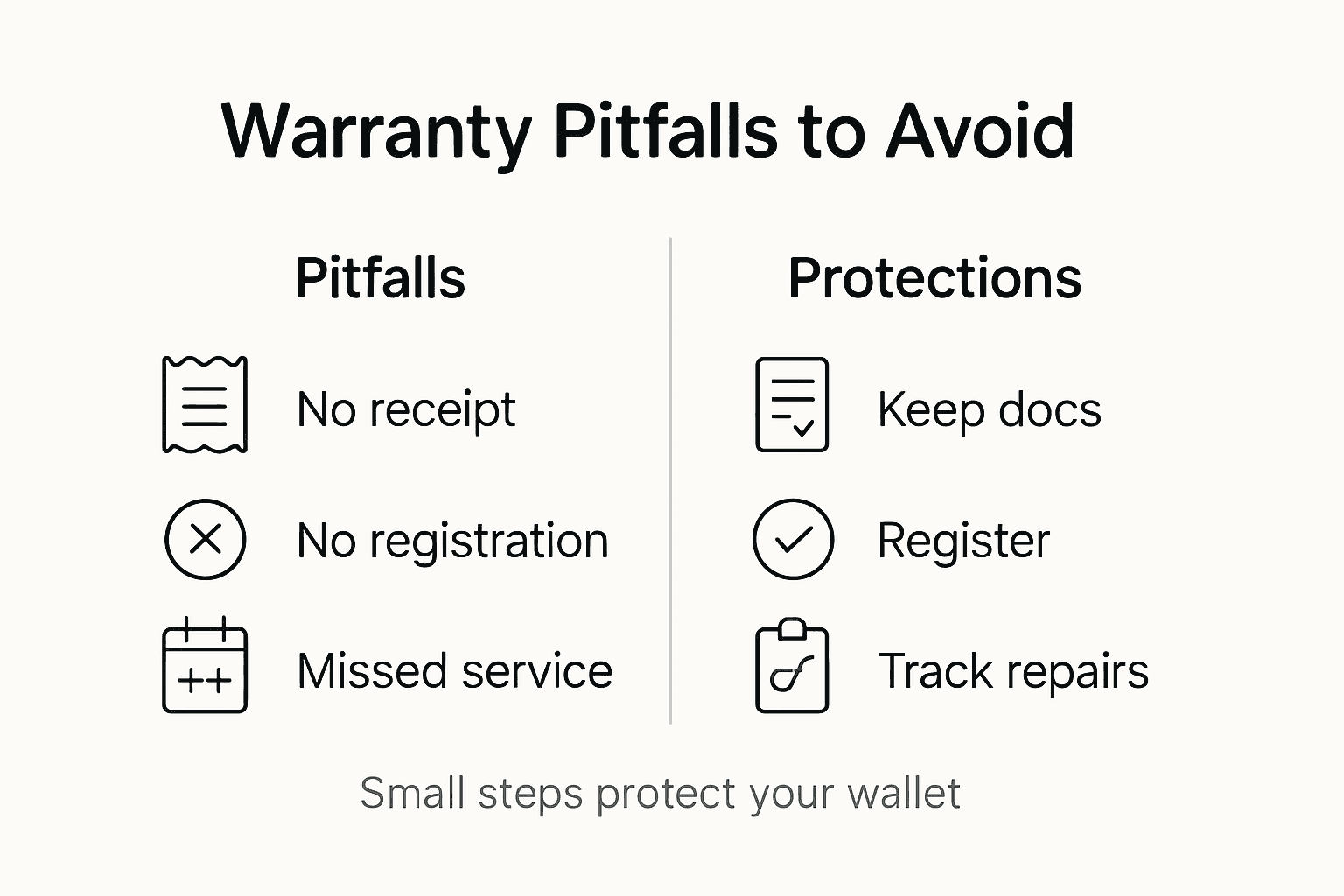
One of the most significant warranty traps involves product registration and maintenance documentation. Many warranties require consumers to complete product registration within a specific timeframe, keep detailed maintenance records, and use authorized repair services. Failing to register a product or maintain comprehensive service records can potentially void warranty coverage, leaving homeowners responsible for expensive repair costs. Manufacturers may require proof of regular maintenance, such as professional servicing or specific cleaning procedures, to keep the warranty valid.
Legal restrictions and deceptive warranty practices pose another significant challenge for consumers. Some manufacturers attempt to impose illegal warranty restrictions, such as requiring brand-specific parts or limiting repairs to authorized service centers. These tactics can unfairly restrict consumer rights and potentially violate federal warranty regulations. Consumers must carefully read warranty terms, understand their legal protections, and be prepared to challenge unreasonable restrictions. Keeping original purchase documents, maintenance records, and detailed communication logs can provide critical evidence if a warranty dispute arises.
Pro tip: Create a dedicated warranty file for each appliance, storing digital and physical copies of purchase receipts, registration confirmations, maintenance records, and warranty documentation to protect your consumer rights.
Protect Your Home and Wallet by Understanding Appliance Warranties Before Repair
Navigating appliance warranties can be confusing but critical to avoid unexpected repair costs and denied claims. This article highlights common challenges like warranty limitations, claim requirements, and financial impacts that many homeowners face when their appliances break down. At MDTech Services, we understand how frustrating it is to deal with appliance problems alongside complex warranty rules. Our team of licensed technicians in Orange County and Los Angeles County specializes in reliable appliance repair and installation, helping you make informed decisions about your coverage and service options.
Key benefits when you choose MDTech Services:
- Expert assessment to determine if your appliance issue is covered under warranty
- Clear explanations of warranty terms and repair options
- Prompt, professional service that respects manufacturer guidelines and your warranty status
Are you ready to take control of your appliance repairs and protect your investment? Visit MDTech Services to schedule your appointment today and get trusted, safe repairs from local experts.
[Image:cta_image]
Don’t wait until a simple fix turns into a costly mistake. Let our team help you understand your warranty and get your appliance running smoothly. Book your service now at https://mdtechservices.com and experience peace of mind with every repair.
Frequently Asked Questions
What is an appliance warranty?
Appliance warranties are legal agreements that protect consumers against defects and malfunctions in appliances. They outline what repairs or replacements are covered and the terms consumers must follow.
What types of appliance warranties are there?
There are primarily two types: full warranties, which offer comprehensive coverage and free repairs or replacements, and limited warranties, which provide restricted coverage and may require some repair costs to be covered by the consumer.
Why is it important to check warranty coverage before repairs?
Checking warranty coverage is crucial because it can save you from unexpected repair costs. Many appliance issues might be covered under warranty, allowing you to get repairs or replacements at no additional cost.
What common mistakes can void an appliance warranty?
Common mistakes that can void a warranty include failing to register the appliance, not maintaining proper documentation of maintenance, using unauthorized repair services, or missing the timeframe for reporting issues. Keeping accurate records is essential to ensure warranty validity.
Recommended
- Appliance repair or Installation service Appliance Repair vs. Replacement: How to Make the Right Decision for Your Home – MDTech Services
- Washer repair Washing machine repair. A Second Chance for Washers: How We Transformed Broken Machines into Like-New Appliances – MDTech Services
- What Is an Appliance Warranty? Complete Breakdown – MDTech Services
- Dishwasher repair installation service The Ultimate Guide to Dishwasher Repair: Troubleshooting Tips and Tricks – MDTech Services
- Kitchen Respray Troubleshooting Guide for Flawless Results – WordPress
- Preventive Maintenance Checklist for Diesel Injection Pros – My WordPress