
Installed water heater costs in California typically run from around $1,500 for a standard tank replacement to $6,500 or more for a heat pump system, depending on fuel type, venting, and permit work. Tankless units land in between. Before you accept any quote, check whether your project qualifies for ENERGY STAR federal tax credits or utility rebates, then compare at least two licensed, local installers.
TL;DR:
- Upfront costs for water heater installation in California range from $1,500 for standard tank replacements to over $6,500 for heat pump systems, depending on fuel type and site modifications.
- Seismic bracing, permit fees, and electrical panel upgrades are common additional expenses that significantly impact overall pricing.
- California’s strict energy and emissions codes, including Title 24 and ultra-low NOx standards, often increase installation complexity and costs compared to other states.
- Incentives and rebates from federal, state, and utility programs can reduce the net cost of heat pump and high-efficiency units, but require proper documentation and timing.
- Hiring a licensed, local installer with experience in California-specific requirements is crucial to avoid hidden costs and ensure proper permit, safety, and compliance procedures.
Table of Contents
- How Much Do Water Heaters Cost in California by Type?
- What’s Actually Included in Your Installed Price?
- How Do California Codes Affect Your Water Heater Price?
- What Rebates and Tax Credits Cut the Net Cost?
- How Do I Choose a Reliable Water Heater Installer?
- How Long Does Installation Take and How Long Do Units Last?
- What Should You Expect From a Local California Installer?
- What Homeowners Get Wrong Before Requesting a Quote
- Ready to Get a Local, Itemized Water Heater Quote?
- Sources
- FAQ
How Much Do Water Heaters Cost in California by Type?
The technology you choose sets the floor and ceiling for your project budget more than almost any other factor. A basic gas tank swap and a whole-house heat pump conversion can differ by thousands of dollars, and the gap widens further once you factor in California’s venting and electrical requirements.
Standard tank water heaters remain the least expensive option to install. A gas tank replacement, unit and labor combined, generally falls in the $1,500 to $3,000 range for a straightforward swap where the existing gas line, vent, and location all stay the same. Electric tank units run similarly, sometimes slightly less for the equipment itself, though electrical work can push the total higher if your panel needs attention. Tank systems suit homeowners who want the lowest upfront cost and don’t mind the shorter service life or steady standby energy loss.
Tankless water heaters cost more upfront, typically $3,000 to $6,000 installed, because gas tankless units often require upgraded venting and sometimes a larger gas line to hit their higher flow rate. Electric tankless units can demand a serious electrical upgrade since they draw a large amount of power in short bursts. Tankless makes sense for households that want endless hot water and have the gas capacity or electrical service to support it, but it’s a poor fit for homes with marginal electrical panels or long, indirect vent runs.
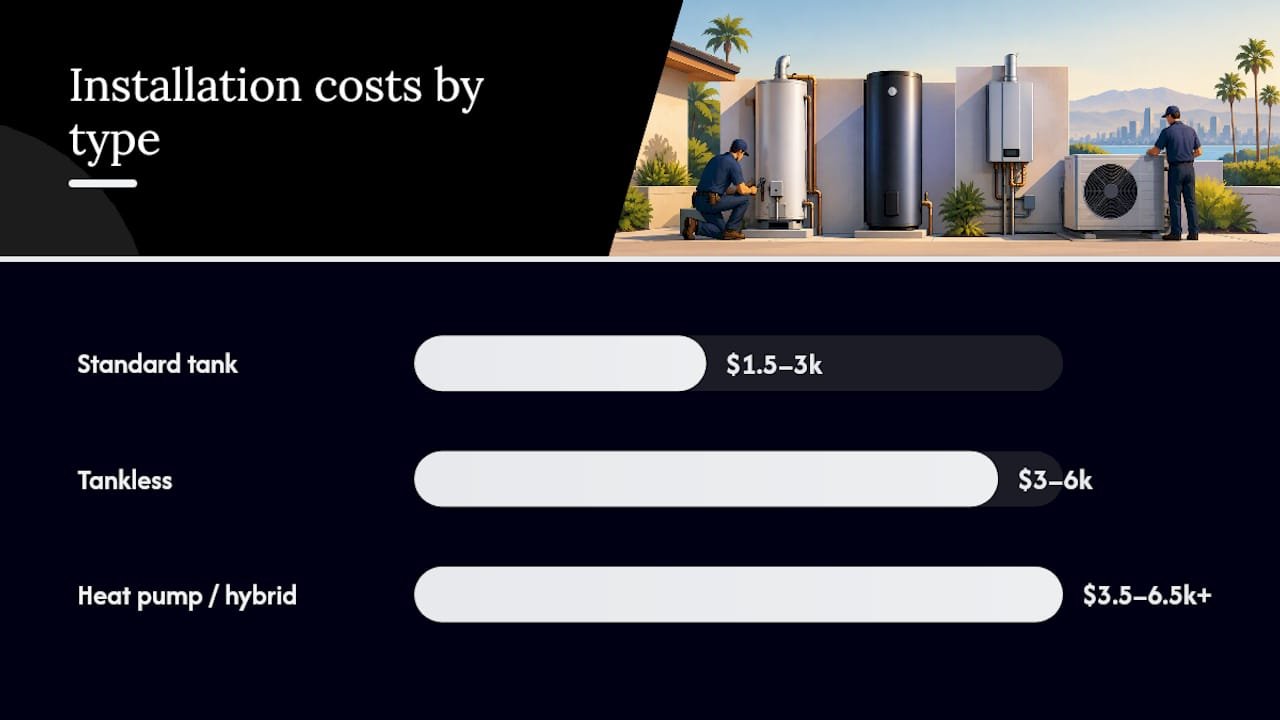
Heat pump and hybrid water heaters sit at the top of the price range, usually $3,500 to $6,500 or more installed, before incentives. The Department of Energy’s guidance on heat pump water heaters notes these units pull heat from surrounding air rather than generating it directly, which makes them roughly two to three times more efficient than a standard electric tank over time. That efficiency is exactly why California rebate programs prioritize them, even though the sticker price is the highest of the three options.
What actually pushes a quote toward the low or high end of these bands comes down to a handful of factors:
- Unit efficiency and capacity. A higher first-hour rating (how much hot water the unit delivers in the first hour) or a higher tankless flow rate costs more but serves larger households better.
- Fuel conversion. Switching from gas to electric, or LP to natural gas, adds line work, venting changes, and sometimes permit reclassification.
- Venting requirements. Tankless and heat pump units often need different vent configurations than the tank they’re replacing, which can mean new ductwork or wall penetrations.
- Site access. A water heater in an easy-to-reach garage costs less to service than one wedged into an attic or a tight closet with limited clearance.
Operating costs tell a different story than installed price. A heat pump unit costs more to buy but usually costs less to run every month, and the DOE’s comparison of tankless and heat pump systems points out that efficiency gains compound over a system’s full lifespan. Tank units typically last 8 to 12 years, tankless units often reach 15 to 20 years with proper maintenance, and heat pump units commonly fall in the 10 to 15 year range. A cheaper unit today isn’t always the cheaper choice over a decade.
What’s Actually Included in Your Installed Price?
A quote that lists only a lump sum is a quote you can’t evaluate. Ask any installer to break down the price into these categories so you know exactly what you’re paying for and what might be missing.
- Unit cost. The water heater itself, priced separately from labor. Efficiency tier, capacity, and brand all move this number.
- Labor. Removal of the old unit, installation of the new one, and connection to existing water, gas, or electrical lines.
- Permit and inspection fees. Most California jurisdictions require a permit for water heater replacement, and fees vary by city and county.
- Disposal. Hauling away the old unit, which sometimes carries a separate fee, especially for larger tank sizes.
- Electrical or panel upgrades. Needed when switching to an electric or heat pump unit and your existing panel doesn’t have available capacity or a dedicated circuit.
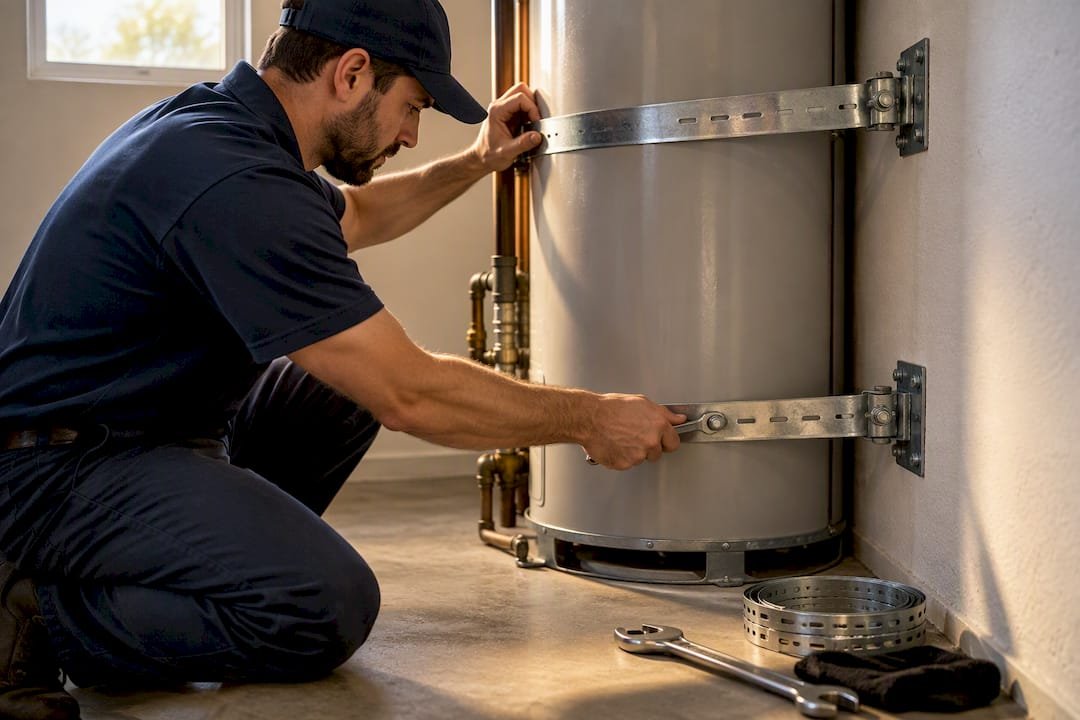
- Seismic strapping and platform work. California requires bracing to resist earthquake movement, and garage installations often need an elevated platform for gas units.
- Drain pan and overflow provisions. Many jurisdictions require a drain pan with a proper overflow line, particularly for units installed above living space.
Electrical upgrades are the line item that surprises the most homeowners. If your panel is already near capacity, adding a heat pump water heater’s dedicated circuit can mean a service upgrade that adds real cost to the project, sometimes more than the water heater itself. Ask your installer to check your panel’s available capacity during the estimate visit, not after the unit is already ordered.
Confirm before signing anything whether the contractor is pulling the permit or expects you to handle it. A properly licensed installer typically handles permitting as part of the job, and you should see that line item itemized rather than buried in a vague “installation” fee. Our guide to water heater permit requirements walks through what most California jurisdictions check during inspection.
How Do California Codes Affect Your Water Heater Price?
California’s energy and safety codes are stricter than most states, and that’s the single biggest reason water heater costs here run higher than the national picture you’ll find on generic comparison sites.
Title 24 governs energy efficiency for buildings statewide, and replacing a water heater can trigger compliance requirements depending on the scope of work. The California Energy Commission’s water heating guidance explains that a straightforward like-for-like swap usually follows a simpler prescriptive path, while switching fuel types or upgrading to a different system category can require a performance-based compliance approach with more documentation. That extra paperwork translates into extra time on your contractor’s invoice.
Ultra-low NOx emission standards apply to many gas water heaters sold in California, particularly in air districts with stricter smog rules like the South Coast and San Joaquin Valley. This standard limits which gas units installers can legally sell and install in your area, and it’s one reason a gas tank replacement here may cost more than the same unit in a state without emissions restrictions.
Before you approve any purchase, verify the specific model against two databases:
- The California Energy Commission’s appliance database (often called MAEDbS) confirms whether a unit meets state efficiency and emissions standards.
- The ENERGY STAR product list confirms whether a heat pump or high-efficiency unit qualifies for federal tax credit programs.
Seismic bracing deserves its own callout because it’s the item homeowners forget to budget for most often. California statute requires water heaters to be strapped or braced to resist earthquake motion, a requirement most other states simply don’t have. If your contractor’s bid doesn’t mention strapping, ask directly, because retrofitting it after inspection failure costs more than including it up front.
Quick fact check: California’s building code requires seismic strapping on water heater installations statewide, a rule tied directly to state law on water heater bracing. It’s rarely optional, and it’s rarely expensive on its own, but it’s almost always missing from a low-ball quote.
What Rebates and Tax Credits Cut the Net Cost?
The gap between a heat pump water heater’s sticker price and its net cost after incentives is often larger than homeowners expect, and it’s the main reason California pushes these units so hard.
At the federal level, heat pump water heaters that carry the ENERGY STAR certification qualify for a federal tax credit, with the exact credit amount and eligibility rules spelled out on ENERGY STAR’s own program page. Because this is a tax credit rather than an instant discount, you pay full price at installation and recover the savings when you file that year’s taxes, so it doesn’t help your immediate cash flow the way a rebate does.
State and utility programs work differently and often pay out faster. California’s Inflation Reduction Act rebate programs, including HEEHRA and TECH Clean California, offer income-qualified households point-of-sale rebates that reduce the price you pay right at installation rather than months later on a tax return. Eligibility and rebate amounts vary by household income and utility territory, so check your specific zip code through your utility’s program page before assuming you qualify.
Stacking incentives is usually allowed, but documentation matters. Keep your contractor’s invoice, the unit’s model number, and its efficiency rating on file, since most programs require proof of the exact model installed to process a rebate or credit claim.
- Verify federal eligibility through ENERGY STAR’s product finder before purchase.
- Check your utility’s rebate portal for point-of-sale programs tied to your zip code and income bracket.
- Save your itemized invoice and the unit’s certification label for tax filing or rebate submission.
Pro Tip: If you’re eligible for a point-of-sale rebate, schedule your installation after confirming enrollment rather than before, since some programs require pre-approval and won’t reimburse a job that’s already finished.
How Do I Choose a Reliable Water Heater Installer?
The cheapest bid is rarely the safest one, and in California, an uninsured or unlicensed installer can leave you covering the cost of a failed inspection or an insurance claim denial.
Before hiring anyone, confirm these basics:
- Active CSLB license. Every California contractor performing plumbing or gas work should carry a current license, verifiable through the Contractors State License Board’s lookup tool.
- Liability insurance and bonding. Ask to see proof, not just a verbal confirmation.
- A written, itemized estimate. It should separate unit cost, labor, permit fees, and any upgrade work rather than bundling everything into one number.
- Experience with your specific system type. Heat pump installations require different electrical and clearance knowledge than a standard tank swap, so ask directly how many they’ve completed.
- A clear permit and inspection process. The installer should tell you upfront who pulls the permit and roughly how long inspection scheduling takes in your city.
During the estimate visit, ask pointed questions: Does my electrical panel have capacity for this unit? Will you handle the permit, or do I need to? What’s the expected timeline from order to final inspection? What warranty covers the unit versus the labor? Who handles disposal of the old unit?
Watch for red flags that signal a corner-cutting bid: no mention of permits at all, a vague one-line scope of work, or a large deposit demanded before any work begins. Reputable installers typically request a modest deposit, not the full amount, and they don’t avoid permit conversations.
Pro Tip: DIY replacement is reasonable for a simple, same-fuel, same-location tank swap if you’re comfortable with basic plumbing, but any project involving gas line changes, electrical upgrades, or fuel conversion belongs with a licensed professional given California’s permit and safety requirements. Our DIY replacement guide covers which projects fall into the safe-to-attempt category.
How Long Does Installation Take and How Long Do Units Last?
A standard tank swap with no electrical or venting changes often finishes in half a day to a full day, start to finish. Add a panel upgrade, a fuel conversion, or a jurisdiction with a slow permit turnaround, and the timeline can stretch to a week or more before final inspection closes out the job.
Service life varies meaningfully by technology, and that lifespan difference should factor into your buying decision as much as the sticker price:
- Standard tank units typically last 8 to 12 years before corrosion or sediment buildup forces replacement.
- Tankless units often reach 15 to 20 years with regular descaling, especially in areas with hard water.
- Heat pump units commonly run 10 to 15 years, similar to a standard tank but with substantially lower operating costs along the way.
Maintenance is what closes the gap between a unit hitting its minimum lifespan or its maximum. Flushing sediment from a tank annually, replacing the anode rod every few years, and descaling a tankless heat exchanger on the manufacturer’s recommended schedule all preserve both warranty coverage and mechanical life. Skipping maintenance is one of the fastest ways to turn a 12 year unit into an 8 year unit. Our guide on water heater maintenance covers the specific intervals by system type.
The upfront versus lifetime cost trade-off comes down to how long you plan to stay in the home and how much you use hot water. A larger household running a tankless or heat pump system daily recovers the higher installed cost faster through lower monthly operating expenses than a household that showers twice a day and rarely runs the dishwasher.
What Should You Expect From a Local California Installer?
A local installer provides appliance installation, plumbing repair, gas appliance work, and the electrical coordination that heat pump and tankless installations often require, serving homeowners in the area. Licensed technicians handle the permit and inspection process directly, which matters given how many California jurisdictions enforce seismic strapping and drain overflow rules at the final walkthrough.
Booking typically runs through an online appointment system rather than a phone-tag process, and estimates often arrive itemized with unit cost, labor, permit fees, and any upgrade work listed separately. If you’re comparing quotes for a heat pump conversion or a fuel switch, ask directly about panel capacity and venting during that estimate visit rather than after signing.
For specifics on current service coverage, technician certifications, and completed project examples, the appliance installation services page is the most current source. Treat any capability claims here as a starting point for your own questions, not a substitute for verifying them directly with the team handling your job.
What Homeowners Get Wrong Before Requesting a Quote
The most overlooked cost isn’t the water heater at all. It’s the electrical panel check that never happens until the technician is standing in the garage, or the seismic strapping that shows up as a separate line item after the quote already felt final. Before you accept any bid, run through five quick checks: Is the permit included and who’s pulling it? Does the panel have capacity for the unit you want? Is seismic strapping listed separately or bundled in? What does the warranty actually cover, unit and labor both? And what’s the realistic timeline if a panel upgrade turns out to be necessary? Most homeowners do fine with a mid-range tank or tankless unit unless their household size or long-term energy costs justify the heat pump premium.
— MDTECH
Ready to Get a Local, Itemized Water Heater Quote?
Local homeowners have alternatives to online cost calculators, such as licensed technicians who check panel, venting, and permit needs in person before finalizing a price. Rather than piecing together a budget from national averages that ignore California’s seismic and Title 24 requirements, you get a quote built around your actual home.
To speed up your estimate, have your home address, current water heater type and age, a couple of photos of the existing unit and its location, and basic panel information ready when you book. Whatever installer you choose, confirm their CSLB license, ask who pulls the permit, and get the warranty terms in writing before signing anything.
Start with the appliance installation services page to request a quote, or explore plumbing repair and gas conversion services if your project involves a fuel switch alongside the water heater replacement.
Sources
- Heat Pump Water Heaters Tax Credit | ENERGY STAR
- Contractors State License Board license lookup (example entry)
FAQ
What Is the Average Cost to Install a Water Heater in California?
Most California homeowners pay between $1,500 and $6,500 installed, depending on whether they choose a standard tank, tankless, or heat pump system. Seismic strapping, permit fees, and any electrical panel upgrade add to that base range, so an itemized quote from a licensed local installer gives you the most accurate number for your home.
How Much Is a Water Heater for a 2,000 Square Foot House?
House size matters less than household size and hot water demand when it comes to sizing a water heater. A typical family usually needs a tank or an equivalent tankless flow rate, which falls within the standard $1,500 to $6,500 installed range depending on the system type chosen.
How Much Should a New 40 Gallon Water Heater Cost?
A standard gas or electric tank water heater typically costs $1,500 to $3,000 fully installed in California, including unit, labor, and basic permit fees. Costs rise if seismic strapping, a drain pan, or panel work isn’t already accounted for in the base quote.
How Much Is a Hot Water Heater in California Compared to Other States?
California installations often run higher than the national picture because of mandatory seismic strapping, stricter ultra-low NOx emissions rules, and Title 24 energy code requirements that don’t apply in most other states. These code requirements are a major reason to get quotes from installers who are already familiar with California-specific compliance, such as Mdtechservices, rather than relying on a national cost estimate.