
If a natural gas main already runs to your street, converting from propane (LP) is almost always worth doing. Natural gas runs roughly 2.5 times cheaper than propane on a per-MMBTU basis at current national-average prices, and a full home conversion typically costs $2,000–$8,000 when the main is accessible. Most homeowners recover that cost within a few heating seasons. The single best first step: call your local utility, confirm whether a gas main serves your address, and ask for a hookup estimate. If no main exists, the math changes significantly, and alternatives like heat pumps may be the smarter path.
Key Takeaways
Converting LP to natural gas is worth it when a gas main is accessible, because the fuel-cost gap of roughly $20/MMBTU typically delivers payback within three years on a standard home heating load.
| Point | Details |
|---|---|
| Availability is the deciding factor | Confirm gas-main access with your utility before evaluating any other cost or timeline. |
| Fuel cost gap is significant | Natural gas runs approximately $12/MMBTU versus propane’s approximately $32/MMBTU at 2026 national averages. |
| Typical payback window | A $2,000–$8,000 conversion with a gas main accessible often pays back in 1–3 heating seasons. |
| Appliance kits are required | Every gas appliance must be converted with a manufacturer-approved kit by a licensed technician. |
| Mdtechservices covers the full job | Orange County and Los Angeles County homeowners can book a site survey, conversion, permits, and inspection through Mdtechservices. |
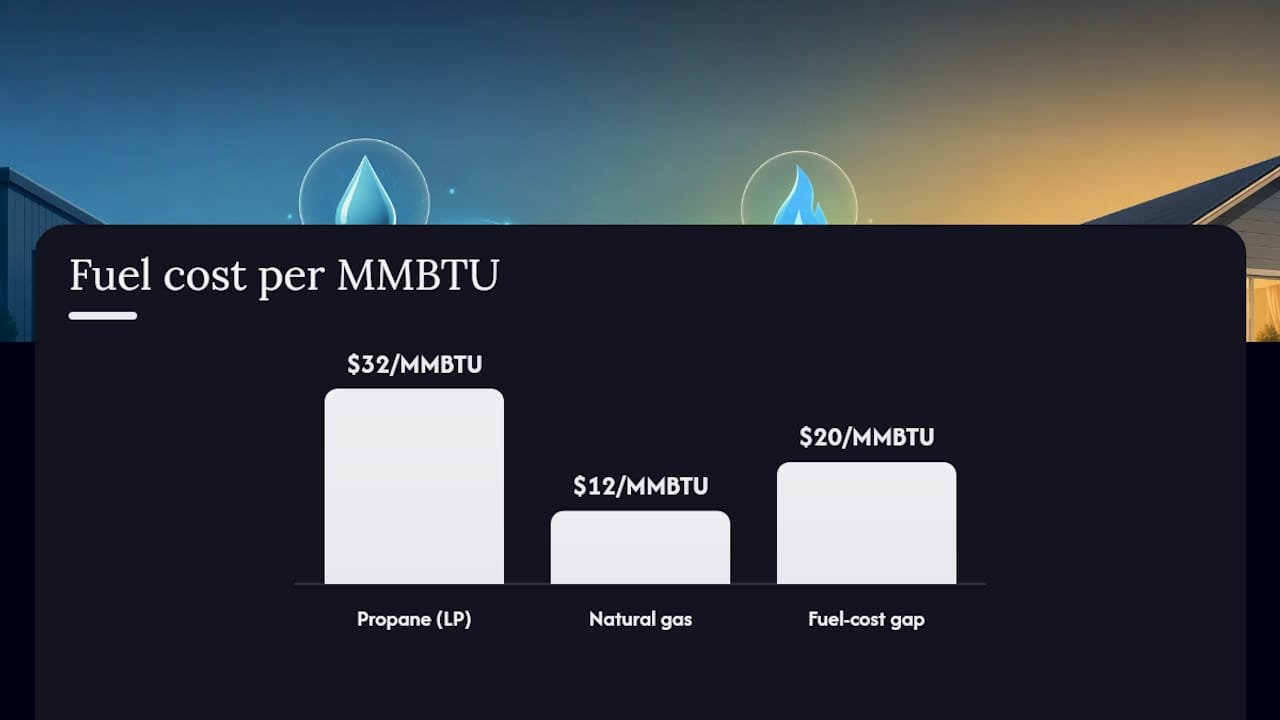
Table of Contents
- 1. Should you convert from LP to natural gas? Pros and cons
- 2. What does conversion actually cost, and when do you break even?
- 3. Which appliances can be converted, and when do you need a replacement?
- 4. What does the conversion process look like, and how long does it take?
- 5. Safety differences between propane and natural gas, and what permits protect you
- 6. When converting to natural gas isn’t the right answer
- 7. A homeowner checklist for deciding whether to convert
- 8. How Mdtechservices approaches an LP-to-natural-gas conversion
- 9. What contractors know that most homeowners don’t
- Mdtechservices handles your LP-to-natural-gas conversion from start to finish
- Sources
1. Should you convert from LP to natural gas? Pros and cons
The decision hinges on three factors: whether a gas main is nearby, how much propane you currently burn, and what your appliances will cost to convert or replace.
Pros of switching to natural gas:
- Lower fuel cost per BTU. Natural gas runs approximately $12/MMBTU versus propane’s approximately $32/MMBTU at 2026 national averages, a gap that compounds quickly in a heating-heavy home.
- Continuous pipeline supply. Natural gas arrives via underground pipeline with no delivery scheduling, no risk of running dry during a cold snap, and predictable monthly billing.
- No on-site tank. You eliminate propane tank rental or ownership costs, annual inspections, and the physical footprint of a tank on your property.
- Lower carbon output. Natural gas produces approximately 117 lb CO2/MMBTU compared to propane’s approximately 139 lb CO2/MMBTU, a meaningful difference for homeowners tracking their household emissions.
- Property value lift. Homes with connected natural gas service tend to be more marketable; buyers factor in lower expected energy bills and the convenience of pipeline delivery when evaluating a property.
Cons to weigh carefully:
- Upfront conversion cost. Even a straightforward job runs $2,000–$8,000, and that number climbs if appliances need replacement rather than conversion.
- Appliance changes required. Every gas appliance must be converted or replaced. Skipping this step is a safety violation, not a shortcut.
- Site disruption. Meter installation and any trenching for gas line extensions can cause temporary yard or driveway disruption.
- Not feasible everywhere. If no gas main exists near your property, extending one can be very costly, which often erases the payback entirely.
Pro Tip: Propane prices can spike in winter due to demand and delivery challenges. Natural gas billing stays flat month to month. If you’ve ever paid a premium for an emergency propane delivery, that seasonal volatility alone is worth factoring into your payback estimate.
2. What does conversion actually cost, and when do you break even?
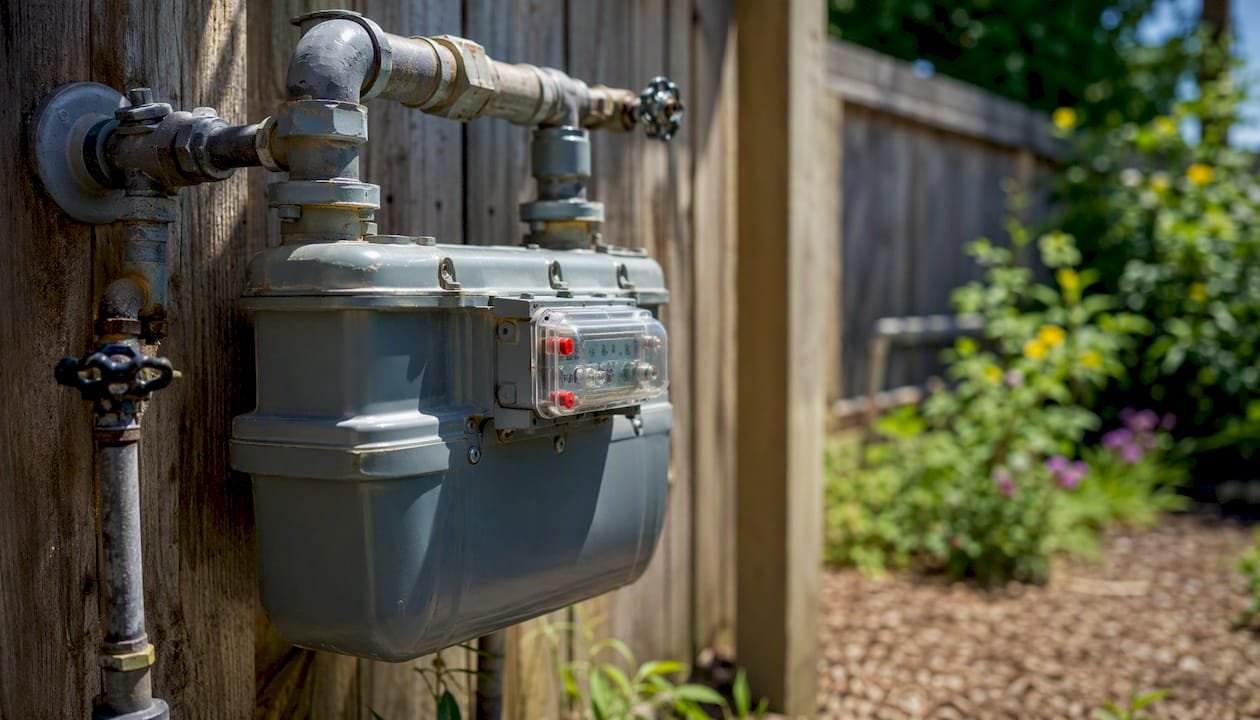
The total cost of converting LP to natural gas breaks into two buckets: utility-side work (meter, service line, any main extension) and appliance-side work (converting or replacing each gas appliance in your home).
Typical cost ranges:
When a gas main already runs to your street, total conversion costs commonly fall between $2,000 and $8,000, covering the utility hookup, meter installation, and appliance conversions. The high end of that range usually reflects multiple appliances, longer interior gas-line runs, or permit complexity. Main extensions, when needed, are quoted per foot by the utility and can run $20–$50 per foot, with total extension costs often reaching $10,000–$50,000 depending on distance.
How to compare fuel costs accurately:
To get a true apples-to-apples comparison, normalize both fuels to dollars per MMBTU. The key conversion factors: 1 therm of natural gas = 100,000 BTU, and 1 gallon of propane ≈ 91,452 BTU. If you pay $3.50 per gallon for propane, that works out to roughly $38/MMBTU. If natural gas in your area costs $1.20 per therm, that’s $12/MMBTU. The gap is real and consistent.
Sample payback calculation:
- Estimate your annual propane spend. A typical home burning 800 gallons of propane per year at $3.50/gallon spends $2,800 annually on heating fuel.
- Estimate the natural gas equivalent cost. That same heating load in natural gas (roughly 73 MMBTUs) at $12/MMBTU costs approximately $876 per year.
- Calculate annual savings and payback. Annual savings: $2,800 minus $876 = approximately $1,924. At a $5,000 conversion cost, payback arrives in about 2.6 years.
Cost snapshot: At 2026 national-average prices, natural gas costs approximately $12/MMBTU versus propane’s approximately $32/MMBTU, a price gap that translates to roughly $1,500–$2,000 in annual savings for a typical heating-heavy home.
Propane at $3.50/gal; natural gas at $1.20/therm; conversion costs are illustrative mid-range estimates.
3. Which appliances can be converted, and when do you need a replacement?
Not every propane appliance can be converted to natural gas, and understanding the difference before you get a contractor quote saves real money and avoids surprises.
Commonly convertible appliances:
- Gas furnace or boiler. Most modern units include a conversion kit from the manufacturer. A licensed technician swaps the burner orifices, adjusts the gas valve, and recalibrates the pressure regulator. Per-appliance conversion typically runs $150–$500.
- Gas water heater. Similar orifice and valve work; most tank-style heaters made in the last 15 years are convertible.
- Gas range or cooktop. Burner orifices are replaced and the regulator is adjusted. See Mdtechservices’s cooktop conversion guidance for appliance-specific detail.
- Gas dryer. Usually straightforward; most major brands include a conversion kit in the documentation or sell one separately.
- Gas fireplace or log set. Convertible in most cases, though decorative inserts with sealed burner assemblies sometimes require full burner replacement.
What conversion kits actually do:
Propane burns at higher pressure than natural gas and has a higher energy density per cubic foot. Conversion kits resize the burner orifices (smaller holes for propane, larger for natural gas) and reset the regulator to match natural gas supply pressure. Using a manufacturer-approved kit is not optional. A generic or mismatched kit can cause incomplete combustion, carbon monoxide production, or a gas leak. For safe appliance conversion, always verify the kit is approved for your specific model number.
Red flags that point to replacement instead of conversion:
- The appliance is more than 15–20 years old and showing efficiency decline.
- The manufacturer no longer produces a conversion kit for that model.
- The unit uses a standing pilot system that cannot be adjusted for natural gas pressure.
- Repair costs already exceed 50% of replacement cost.
When replacement is the better call, the new appliance purchase often costs only marginally more than a complex conversion on aging equipment, and you gain a warranty and improved efficiency. Mdtechservices’s appliance repair vs. replacement guide walks through that decision in detail.
4. What does the conversion process look like, and how long does it take?
A well-run LP-to-natural-gas conversion follows a clear sequence. Knowing the steps helps you plan around temporary outages and avoid scheduling surprises.
The standard conversion sequence:
- Utility survey and main confirmation. Your gas utility verifies whether a main runs to your property line and provides a hookup or extension estimate. This step can take a few days to a few weeks depending on the utility’s scheduling.
- Permit application. Your licensed contractor pulls the required building and gas permits before any work begins. Permit processing typically takes 3–10 business days in most California jurisdictions.
- Meter installation and service line hookup. The utility installs the meter and connects the service line from the main to your home. This is utility work; your contractor coordinates the timing.
- Interior gas line inspection and extension. The technician inspects existing interior gas lines for compatibility and extends or modifies them as needed to serve all appliances.
- Appliance conversions or replacements. Each gas appliance is converted using manufacturer-approved kits or replaced. This is typically a single-day job for a standard home with 3–5 appliances.
- Pressure and leak testing. The entire system is pressurized and checked for leaks using calibrated equipment before any appliance is lit.
- Municipal inspection and final sign-off. A city or county inspector verifies the work against permit drawings and local code. The inspector signs off before the system goes live.
Realistic timelines:
- Simple hookup (main at property line, no extension): 1–3 days of active work, plus permit lead time.
- Main extension required (short run, utility-subsidized): 2–4 weeks total, including utility scheduling.
- Long main extension or complex excavation: 6–12 weeks or more.
What to expect on the workday:
- Clear access to your gas meter location, utility easements, and all appliance locations.
- Expect appliances to be offline for several hours during conversion and testing.
- The technician will conduct a final leak test before restoring gas service to any appliance.
- Keep children and pets away from work areas during pressure testing.
Permit checklist:
- Building permit for interior gas line work (pulled by your contractor)
- Gas piping permit (jurisdiction-specific; often combined with building permit)
- Utility work order for meter and service line (handled by the utility)
- Final inspection scheduled by your contractor after all work is complete
5. Safety differences between propane and natural gas, and what permits protect you
Propane and natural gas behave differently in a leak, and that difference matters for how you set up detection and ventilation in your home.
Key safety differences:
- Propane is heavier than air. A propane leak pools near the floor and in low spots like basements and crawl spaces, where it can accumulate undetected. Natural gas is lighter than air and rises, dispersing more quickly in ventilated spaces.
- Both use odorant for detection. Utilities and propane suppliers add mercaptan (the “rotten egg” smell) to both fuels. If you smell gas, leave the building immediately and call 911 or your utility from outside.
- Natural gas requires proper venting. All gas appliances must be vented according to manufacturer specs and local code. Improper venting is the primary cause of carbon monoxide buildup.
Required permits and inspections:
- A gas conversion without permits is illegal in California and most other states. Unpermitted work voids homeowner’s insurance coverage for related incidents.
- Municipal inspectors check: correct pipe sizing, proper fittings and joints, appliance venting, regulator settings, and the presence of manufacturer-approved conversion kits.
- Final inspection sign-off is required before the utility will activate the meter in most jurisdictions.
Post-conversion safety checklist:
- Install or test carbon monoxide detectors on every floor, especially near sleeping areas.
- Verify that all appliance vents are clear and unobstructed.
- Schedule an appliance check 30 days after conversion to confirm stable operation.
- Know the location of your gas shutoff valve and confirm it operates freely.
- Keep the permit and inspection records with your home files.
Red flags of poor installation work:
- Contractor suggests skipping permits to save time or money.
- No written leak test results provided after completion.
- Conversion kits are not manufacturer-approved for your specific appliance models.
- No final inspection scheduled or completed before gas service is activated.
Pro Tip: Ask your contractor for a written pressure-test result before they leave the job site. A properly tested system holds pressure at a documented level for a set period. If a contractor can’t produce that record, the work isn’t done.
6. When converting to natural gas isn’t the right answer
The case for converting LP to natural gas weakens quickly when the gas main is far from your property. A main extension that costs $20,000 or more erases years of fuel savings and may never pay back on a typical home’s heating load.
When the math doesn’t work:
- The gas main is significantly distant from your property line.
- Your utility quotes a main extension with a high cost and offers no subsidy or allowance.
- Your annual propane spend is low (under $1,000/year), meaning the savings gap is too small to justify conversion costs.
- You’re planning to sell the home within two years and won’t capture the payback.
Viable alternatives for off-main homes:
- Air-source heat pumps. Modern cold-climate heat pumps operate efficiently down to 5°F and can replace a propane furnace entirely. Federal Inflation Reduction Act (IRA) rebates and tax credits can significantly offset the purchase price for qualifying homeowners.
- Ductless mini-splits. For homes without existing ductwork, mini-splits provide zoned heating and cooling without the cost of duct installation.
- High-efficiency propane equipment. Upgrading to a 95%+ AFUE propane furnace reduces fuel consumption meaningfully, cutting annual propane costs without a fuel switch.
- Hybrid systems. A heat pump handles the majority of heating load, with a propane furnace as backup for extreme cold. This approach reduces propane consumption by 50–70% in many climates while keeping a reliable backup.
When to consider heat pumps: For homes without nearby gas mains, heat pumps combined with available federal rebates are frequently a more cost-effective route than paying large pipeline-extension fees.
Decision scenarios at a glance:
- Gas main at the property line, high propane use: Convert. Payback is typically 2–3 years.
- Gas main 200+ feet away, moderate propane use: Get a utility extension quote first. If it exceeds $10,000, compare heat pump costs and IRA incentives before committing.
- Rural property, no main within a mile: Heat pump or high-efficiency propane is almost certainly the better path.
7. A homeowner checklist for deciding whether to convert
Before you call a contractor, work through this checklist. It takes about 30 minutes and will make every subsequent conversation more productive.
Availability and utility:
- Confirm your address is serviceable by calling your local gas utility directly.
- Ask for a written hookup estimate, including any main extension costs and available subsidies.
- Ask whether the utility pulls its own permits for meter and service line work, or whether your contractor handles all permitting.
Contractor evaluation:
- Verify the contractor holds a current California C-36 (plumbing) or C-20 (HVAC) license, or equivalent for your state.
- Ask for proof of general liability and workers’ compensation insurance.
- Request an itemized written quote covering: utility hookup allowance, per-appliance conversion costs, any trenching or boring, permit fees, and final inspection coordination.
- Ask specifically which manufacturer-approved conversion kits will be used for each appliance.
- Confirm the contractor will schedule and attend the final municipal inspection.
Red-flag contractor answers to watch for:
- “We don’t need permits for this type of work.”
- “We’ll figure out the appliance kits once we’re on-site.”
- “The inspection is your responsibility to schedule.”
- A quote with no line-item breakdown, just a single lump sum.
Questions to ask about your appliances:
- Is my furnace/boiler/water heater convertible, or does it need replacement?
- Does the manufacturer still produce an approved conversion kit for my model?
- What is the per-appliance conversion cost versus the cost of a new appliance?
8. How Mdtechservices approaches an LP-to-natural-gas conversion
A licensed conversion job follows a defined process, and knowing that process helps you evaluate any quote you receive. Here’s how Mdtechservices handles a standard LP-to-natural-gas conversion in Orange County and Los Angeles County.
Mdtechservices standard process:
- Site survey. A licensed technician visits the property to document all gas appliances, assess interior gas line condition, confirm meter location, and identify any code concerns before quoting.
- Utility coordination. Mdtechservices coordinates directly with the local gas utility on hookup scheduling, permit requirements, and meter installation timing.
- Appliance inspection. Each appliance is evaluated for convertibility. The technician identifies which units can be converted with manufacturer-approved kits and which should be replaced.
- Conversion work. Orifice swaps, regulator adjustments, and valve settings are completed per manufacturer specifications using OEM-approved kits only.
- Pressure and leak testing. The full system is pressure-tested before any appliance is lit. Results are documented and provided to the homeowner.
- Permit coordination and final inspection. Mdtechservices pulls all required permits and coordinates the municipal inspection. The technician is present at inspection.
- Final walk-through. The technician walks the homeowner through each converted appliance, confirms proper operation, and reviews the post-conversion safety checklist.
Sample itemized quote lines (illustrative ranges):
| Line Item | Typical Range |
|---|---|
| Utility hookup coordination allowance | $500–$1,500 |
| Per-appliance conversion (orifice/regulator) | $150–$500 each |
| Interior gas line modification or extension | $150–$500 |
| Trenching or boring (if needed) | $500–$2,000–$8,000 |
| Permit fees | $150–$500 |
| Pressure/leak testing and documentation | Included |
| Final inspection attendance | Included |
Mdtechservices serves homeowners throughout Orange County and Los Angeles County. Licensed technicians carry current state credentials, general liability insurance, and use only manufacturer-approved conversion kits. For a full overview of the gas appliance conversion process in California, including permit requirements and service area details, visit the Mdtechservices conversion service page. You can schedule an on-site inspection and quote directly through the website.
9. What contractors know that most homeowners don’t
The most common scheduling mistake homeowners make is booking a contractor before confirming utility availability. Utility hookup scheduling, especially in Southern California, can add two to four weeks to a project timeline. Locking in a contractor date before the utility has confirmed a hookup window often means rescheduling everything.
Site prep matters more than most homeowners expect. Clear access to the gas meter location, all appliance shutoffs, and any crawl space or utility room entry points before the technician arrives. A job that should take one day can stretch into two when a technician spends the first hour moving stored items or locating shutoff valves.
DIY gas work is not a gray area. California law requires licensed contractors for gas line work, and unpermitted gas conversions void homeowner’s insurance coverage for any related incident. The permit and inspection process exists specifically to catch installation errors before they become emergencies.
One practical tip contractors use to reduce disruption: stage the conversion by converting heating appliances first (furnace, water heater), then scheduling kitchen appliances (range, dryer) for a second visit. This approach keeps hot water and heat available throughout the process and avoids a full-day outage of every gas appliance at once.
Mdtechservices handles your LP-to-natural-gas conversion from start to finish
Converting from propane to natural gas delivers real, measurable savings, but the job requires licensed technicians, manufacturer-approved kits, and proper permits to be done safely and legally. Mdtechservices provides the full conversion service for homeowners in Orange County and Los Angeles County: site survey, utility coordination, appliance conversion or replacement, permit management, pressure testing, and final inspection attendance.
Every conversion starts with an on-site inspection so you get an accurate, itemized quote before any work begins. Mdtechservices technicians are licensed, insured, and use only OEM-approved conversion kits. For homeowners weighing appliance repair versus replacement as part of a conversion, the team can assess each unit and give you a clear recommendation. Visit the LP-to-natural-gas installation page to review scope and pricing details, or book an inspection online today.
Sources
The following sources back the core claims in this guide and are worth bookmarking if you want to dig deeper into the numbers or official requirements.
- Propane vs Natural Gas Heating: Which Is Cheaper in 2026?
- Natural gas vs propane: cost, safety, conversion math | Seenra
- Should You Make the Switch From Propane to Natural Gas? – Bob Vila