
Most homeowners spend between $200 and $300 to fix an ice maker, with the full range running from about $75 for a simple service call and minor adjustment to $660 for a major component replacement, like a motor or full ice-maker assembly. HomeAdvisor’s aggregated pricing puts the average around $260, and Angi’s pricing data confirms that same $200–$300 window as the most common outcome. Before you call a technician, try three quick checks: confirm the ice maker arm is in the down position and the unit is powered, verify your freezer sits at or near 0°F, and make sure the water supply valve behind the refrigerator is fully open. These three steps resolve a surprising share of no-ice complaints at zero cost. If those checks come up clean, a licensed technician from a provider like Mdtechservices can diagnose the actual fault on site and give you a written estimate before any repair begins.
At a glance: Typical ice maker repair cost is $200–$300. Try the three free checks first. If the problem persists, call a licensed tech for an on-site diagnostic.
Key Takeaways
Most ice maker repairs in the U.S. cost $200–$300 all-in, and running three quick free checks before calling a technician can eliminate the most common causes at zero cost.
| Point | Details |
|---|---|
| Typical repair cost | Most homeowners pay $200–$300; the full range is $75–$660 depending on part and location. |
| Three free checks first | Confirm the arm/power switch, freezer temperature at 0°F, and water supply valve before booking a tech. |
| Parts cost spread | Water filters cost $15–$55 (DIY); a full ice-maker assembly runs $150–$400 installed. |
| Repair vs. replace rule | If the repair estimate exceeds 50% of replacement cost, or the appliance is over 12 years old with other issues, replacement is usually smarter. |
| Mdtechservices booking | Licensed technicians in Orange County and Los Angeles County; book online for an on-site diagnostic with a written estimate before any work begins. |
Table of Contents
- How ice maker repair costs are calculated
- Quick troubleshooting steps to try before calling a repair tech
- Common failed parts and what they cost to replace
- What labor rates and service-call fees actually look like on your bill
- When should you repair the ice maker versus replace it?
- How to choose a reliable appliance repair service
- What to expect when you book Mdtechservices for ice maker repair
- Breakdown of labor rates and service-call fees
- Mdtechservices is the local repair option for Orange County and Los Angeles County homeowners
- Sources
How ice maker repair costs are calculated
Every repair bill has the same three building blocks: the service-call fee, labor, and parts. Understanding each one helps you read a quote and spot anything that does not belong.
Service-call fee: Most technicians charge a flat fee of $75–$150 just to show up and diagnose the problem. Many providers apply this fee toward the repair total if you approve the work, so always ask that question before booking. Providers who refuse to credit the diagnostic fee against an approved repair are worth questioning.
Labor: National labor rates for appliance repair run $70–$125 per hour, per Angi’s pricing summary. A simple part swap on a truck-stock component might take 30–45 minutes; a more involved assembly replacement can run 1–2 hours. On a $100/hr rate, that difference alone is $50–$150 on your final invoice.
Parts: This is where costs spread the widest. A water filter costs $15–$55. A water inlet valve runs $20–$80 for the part alone. A full ice-maker assembly can reach $100–$250 before labor. The table below shows how these components stack up.
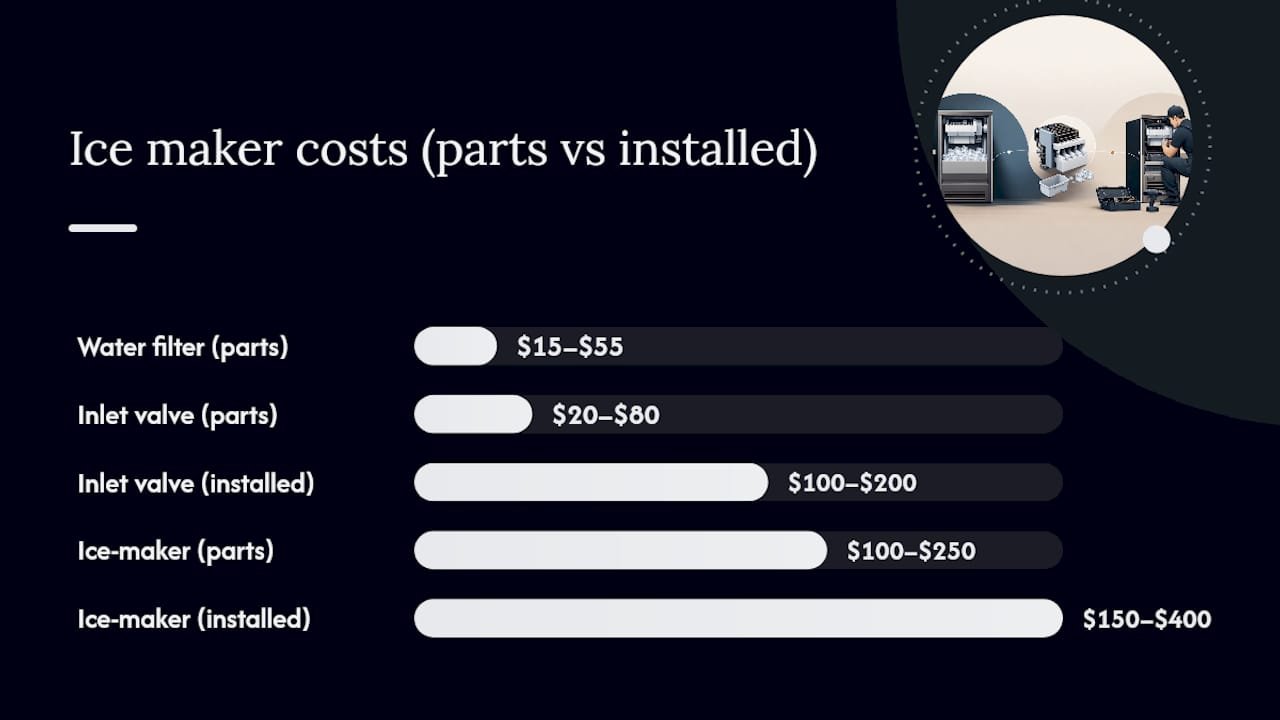
Regional variation is real. Urban markets in Southern California, for example, carry higher labor rates than rural Midwest markets, and travel distance adds time that some technicians bill.
| Cost Component | Typical Low | Typical High | Notes |
|---|---|---|---|
| Service-call / diagnostic fee | $75 | $150 | Often credited toward repair if approved |
| Labor (per hour) | $70 | $125 | Most jobs: 1–2 hours |
| Water inlet valve (installed) | $100 | $200 | Common mid-range repair |
| Ice-maker assembly (installed) | $150 | $400 | Includes parts + labor |
| Motor / gear assembly (installed) | $150 | $400 | Higher end of the range |
| Full repair (all-in) | $75 | $660 | Depends on part and location |
A few additional line items sometimes appear on invoices:
- Disposal fees for old parts or refrigerants, typically $10–$30
- Sales tax on parts, which varies by state
- After-hours or emergency premiums, usually a flat add-on of $50–$100
Quick troubleshooting steps to try before calling a repair tech
Running through these checks takes about 10 minutes and can save you the cost of a service call entirely. Whirlpool’s troubleshooting guidance and KitchenAid’s product support both recommend this same sequence before escalating to a technician.
- Check the ice maker arm or power switch. The wire arm (or toggle switch on newer models) must be in the down or “on” position. It can get bumped into the off position when you reach into the freezer.
- Verify freezer temperature. The target is 0°F (–18°C). At 10°F or warmer, ice production slows or stops entirely. Use an inexpensive freezer thermometer to confirm.
- Inspect the water supply valve. The shutoff valve behind or beneath the refrigerator must be fully open. A partially closed valve restricts flow enough to stop ice production without triggering an obvious error.
- Check the water filter. A clogged or improperly seated filter reduces water pressure below the threshold the inlet valve needs to open. KitchenAid specifically flags an improperly installed filter as a leading cause of no-ice complaints. Replace the filter if it is past its recommended service interval (typically every six months).
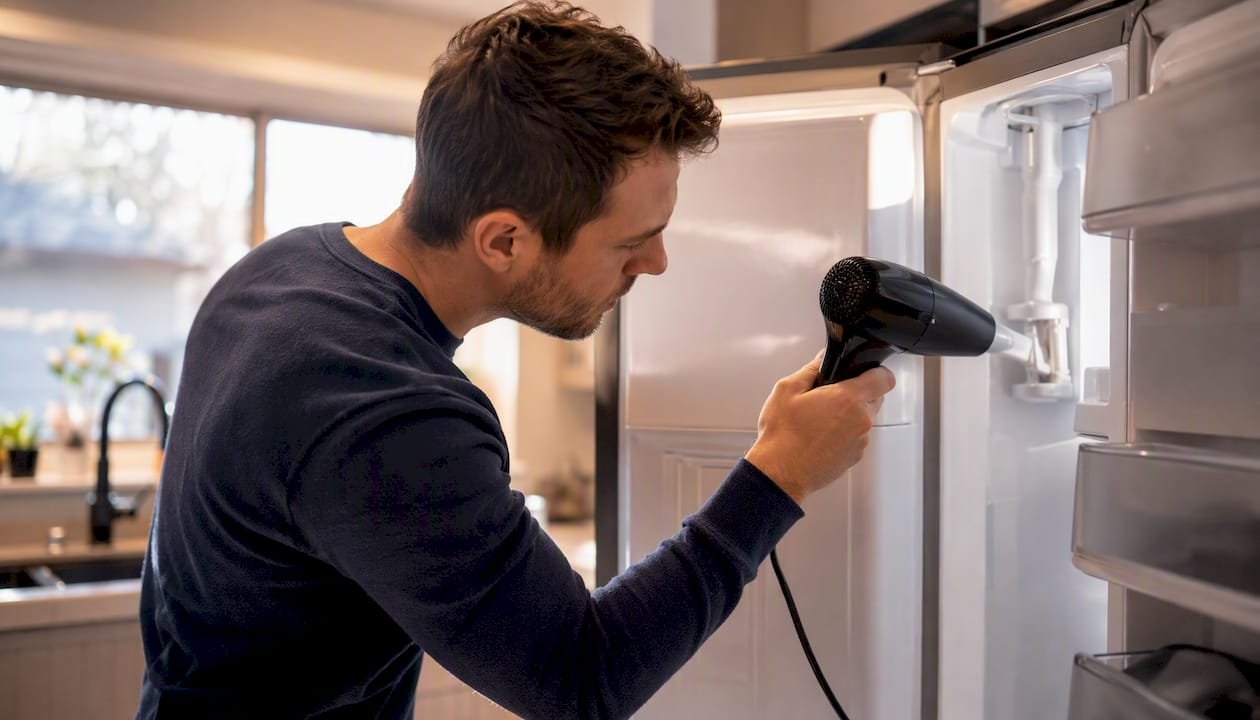
- Thaw the fill tube. The small plastic tube that delivers water to the ice mold can freeze solid, especially if the freezer runs colder than 0°F or the door seal is weak. Use a hair dryer on low heat, held several inches away, to thaw it gently.
- Clear any ice jam in the bin. A clump of fused cubes can block the ejector arm and prevent new ice from dropping. Remove the bin, break up any clumps, and replace it firmly.
- Reset the ice maker. Most units have a test or reset button on the module itself. Hold it for 3–5 seconds until you hear a chime or the arm cycles. Whirlpool’s guidance recommends this step after any power interruption.
Stop and call a pro if you notice: grinding or clicking from the compressor, coolant or refrigerant odor, metal or plastic flakes in the ice bin, or water pooling under the refrigerator. These symptoms point to sealed-system failures that are not safe or practical for homeowner repair.
Pro Tip: Check the fill tube first in winter or after a long freezer-door-closed period. A frozen fill tube is one of the most common “mystery” no-ice calls, and it is free to fix yourself. To prevent recurrence, confirm your freezer temperature is not set below 0°F and that the door seal closes completely.
For a more detailed diagnostic walkthrough, the homeowner diagnostic guide from Mdtechservices covers each step with photos and decision points.
Common failed parts and what they cost to replace
Knowing which part failed tells you whether you are looking at a $100 fix or a $400 one. The parts below account for the large majority of ice maker service calls in the U.S.
Water inlet valve is the single most common failure. It is an electrically operated valve that opens to let water into the ice mold. Parts run $20–$80; installed cost is typically $100–$200. Most technicians carry this on their truck, so same-day repair is common.
Ice-maker module or assembly covers the entire mechanism: the motor, thermostat, ejector blades, and mold heater as a single unit. Replacing the whole assembly rather than individual sub-components is often the smarter call. ExpressXpert’s 2026 guide puts installed assembly replacement at $150–$240, and notes that piecemeal sub-component swaps frequently cost more in labor than the assembly itself.
Motor and gear assembly failures show up as ice that forms but does not eject. Parts alone run $30–$100; installed cost reaches $150–$400 depending on brand and access difficulty.
Drive or ejector blade damage is usually caused by an ice jam that was forced. The blade itself is inexpensive ($10–$40), but labor to access and replace it adds $75–$150.
Water filter replacement is the lowest-cost fix on this list at $15–$55 for the part, with no labor charge if you do it yourself. Many homeowners skip scheduled filter changes and then pay a service-call fee to learn that was the only problem.
Thermostat or temperature sensor failures cause the ice mold to over-freeze or under-freeze. Parts run $20–$50; installed cost is $100–$200. Field data from DevicePitfalls shows sensors carry roughly a 65% repeat-failure rate in their sample, which is a strong argument for replacing the associated subsystem rather than the sensor alone.
Fill-tube heater or defrost component failures cause chronic fill-tube freezing. Parts run $20–$60; installed cost is $100–$200.
| Part | Parts-Only Range | Installed Range | Typically Truck-Stock? |
|---|---|---|---|
| Water inlet valve | $20–$80 | $100–$200 | Yes |
| Ice-maker assembly | $80–$200 | $150–$400 | Often |
| Motor / gear assembly | $30–$100 | $150–$400 | Sometimes |
| Drive / ejector blade | $10–$40 | $70–$125 | Sometimes |
| Water filter | $15–$55 | $15–$55 (DIY) | Yes |
| Thermostat / sensor | $20–$50 | $100–$200 | Sometimes |
| Fill-tube heater | $20–$60 | $100–$200 | Sometimes |
Brand notes: Whirlpool and KitchenAid parts are widely stocked by independent technicians, which keeps lead times short. Samsung ice maker assemblies have historically been harder to source locally, and some Samsung-specific parts require special-order, adding one to several days to the repair timeline. For ongoing maintenance that reduces the frequency of these failures, the ice machine maintenance guide from Mdtechservices covers filter schedules, cleaning cycles, and water-line inspections.
What labor rates and service-call fees actually look like on your bill
Labor is the variable most homeowners underestimate. At $70–$125 per hour nationally, a job that takes 90 minutes costs $105–$188 in labor alone, before parts or the service-call fee. In higher-cost urban markets like Los Angeles or Orange County, rates at the upper end of that range are standard.
Cost signal: A technician who quotes a flat rate for a specific repair (rather than hourly) gives you more budget certainty. Ask whether the quote is all-in or whether parts are billed separately on top.
Typical repair timelines:
- Quick diagnostic and minor fix (arm reset, filter swap, jam clearing): 30–60 minutes total, often billed as the service-call minimum
- Single-part swap with truck-stock part (inlet valve, sensor, blade): 1–2 hours including diagnosis
- Assembly replacement (full ice-maker module): 1.5–2.5 hours
- Sealed-system or compressor issue: Not typically repairable on-site; diagnosis takes 30–60 minutes, after which the technician will recommend replacement
Same-day or emergency service adds a premium. Most providers charge a flat emergency fee of $50–$100 on top of standard rates, or they apply a higher after-hours labor rate. Scheduling a standard appointment for the next business day is the most cost-effective path when the issue is inconvenient but not urgent.
Have these ready before the technician arrives to keep the visit short:
- Full model and serial number (on a label inside the refrigerator door or on the back panel)
- A brief description of symptoms and when they started
- Photos of any visible damage, ice buildup, or water pooling
- Clear access to the refrigerator (pulled away from the wall if possible)
Appliance repair labor costs follow similar patterns across home services categories. A partner resource on appliance repair costs provides useful context on how hourly fees translate into total bills across different job types.
When should you repair the ice maker versus replace it?
The repair-vs-replace decision comes down to four factors: the cost of the repair, the age of the appliance, the nature of the failure, and whether other problems are already present.
Step 1: Identify the specific failure. A water inlet valve or filter issue is almost always worth repairing. A sealed-system failure or compressor problem is almost never worth repairing on a standalone ice maker or an aging refrigerator.
Step 2: Check your warranty. Manufacturer warranties on refrigerators typically cover parts and labor for one year from purchase, with some brands extending compressor coverage to five years. If your unit is under warranty, the repair cost may be zero. Extended warranty plans (from the retailer or a third-party provider) vary widely, so read the terms carefully to confirm ice maker components are covered.
For a $200 standalone ice-maker assembly, that threshold is $100. For a $1,200 refrigerator, it is $600.
Step 4: Factor in appliance age. Beaconsaves’ guidance recommends weighing the refrigerator’s overall condition and age when deciding. A refrigerator older than 12 years that is already showing other symptoms (compressor noise, inconsistent cooling, door seal failure) is a poor candidate for a $300 ice maker repair. The money is better applied toward a replacement.
Step 5: Watch for safety signals that require replacement. Metal or plastic flakes in the ice bin, a burning smell near the compressor, or refrigerant odor are not repair candidates. These conditions require immediate shutdown and appliance replacement.
Warranty checklist when you call manufacturer support:
- Have the model and serial number ready
- Ask specifically whether the ice maker module is covered (some warranties exclude it after year one)
- Ask whether labor is included or just parts
- Confirm whether the warranty requires an authorized service provider
- Ask about any extended coverage you may have purchased at the point of sale
For a deeper look at the repair-vs-replace decision, the appliance repair or installation decision guide from Mdtechservices walks through the same framework with cost examples.
How to choose a reliable appliance repair service
The technician you hire matters as much as the repair itself. A poor diagnosis leads to a part swap that does not fix the problem, and you pay twice.
Quick buyer checklist:
- Licensed and insured (ask for license number and verify it with your state licensing board)
- Covers your specific city or county
- Offers a written estimate before starting work
- Warranties both parts and labor (30–90 days is standard; longer is better)
- Uses OEM or OEM-equivalent parts, not generic substitutes that fail faster
- Carries common parts on the truck to avoid multi-day waits
- Can give you a realistic time-to-fix estimate on the phone
Questions to ask when booking:
- Is there a diagnostic or service-call fee, and is it credited toward the repair if I approve the work?
- Do you charge extra for travel or after-hours service?
- How long is your parts and labor warranty?
- Do you carry water inlet valves and ice-maker assemblies on your truck?
- Can you give me a written estimate before starting?
Red flags that should end the call:
- Refuses to provide a written estimate
- Recommends replacement before completing a diagnosis
- Cannot confirm licensing or insurance when asked
- Quotes a price that is significantly below the market range without explanation (often a sign of aftermarket parts or unlicensed work)
Checking a provider’s listing on the Better Business Bureau or Google Business Profile gives you a fast read on service-area coverage, customer feedback, and how the business handles complaints. A BBB-listed provider that shows consistent reviews and a clear service area is a reasonable starting point for vetting.
What to expect when you book Mdtechservices for ice maker repair
Mdtechservices serves homeowners across Orange County and Los Angeles County with licensed technicians who specialize in residential appliance repair, including refrigerator ice maker issues for all major brands. The service flow is straightforward: book online or by phone, a technician arrives for an on-site diagnostic visit, and you receive a written estimate before any repair begins. When you approve the repair, the service-call fee is applied toward the total cost.
Technicians carry common truck-stock parts, including water inlet valves and ice-maker assemblies, which means many repairs are completed in a single visit. For special-order parts, Mdtechservices coordinates the order and schedules the return visit promptly.
What sets Mdtechservices apart: Licensed technicians, transparent written estimates, parts and labor warranty, and local coverage across Orange County and Los Angeles County. No surprise fees, no pressure to replace before a proper diagnosis is complete.
Have these ready for a smooth visit:
- Model and serial number from the refrigerator label
- A brief description of symptoms (when it stopped, any unusual sounds or smells)
- Photos of visible damage or ice buildup if you have them
- Refrigerator pulled away from the wall for easy access
To book a diagnostic visit or learn more about the repair process, visit the Mdtechservices ice maker repair page.
Breakdown of labor rates and service-call fees
Labor rates for appliance repair in the U.S. typically fall between $70 and $125 per hour, with the service-call or diagnostic fee sitting at $75–$150 as a separate line item. These two charges together form the baseline cost of any repair visit, even before a single part is ordered.
The service-call fee covers the technician’s time to travel, diagnose the problem, and provide a written estimate. In most cases, a reputable provider credits this fee against the repair total when you approve the work. That credit effectively makes the diagnostic free if you proceed, which is why asking about it upfront is one of the most practical questions a homeowner can ask.
Labor rates vary by market. In high-cost urban areas like Los Angeles County, rates at $100–$125 per hour are common. In smaller markets, $70–$90 per hour is more typical. Some providers use flat-rate pricing for specific jobs (a water inlet valve swap, for example), which removes the hourly uncertainty and makes budgeting easier. When comparing quotes, confirm whether the quoted price is all-in or whether parts are billed separately on top of the labor figure.
Emergency and same-day service carries a premium in every market. Expect to pay an additional $50–$100 flat fee, or a higher per-hour rate, for after-hours or weekend appointments. For non-urgent repairs, scheduling a standard weekday appointment is the most cost-effective option.
Mdtechservices’ perspective on repeat ice maker failures
The most common pattern in ice maker service calls is a water inlet valve that fails, gets replaced, and then fails again within 12–18 months. In most of those cases, the underlying cause is a temperature sensor or thermostat that was never replaced alongside the valve. The sensor causes the valve to cycle incorrectly, which shortens its life. Field data from DevicePitfalls supports this: sensors show roughly a 65% repeat-failure rate in their sample, and pumps carry a similarly high repeat risk when the associated sensor is left in place.
Pro Tip: When a technician replaces your water inlet valve, ask whether the temperature sensor and thermostat were also checked and tested. Replacing the valve alone without addressing a failing sensor is the single most common reason homeowners end up paying for the same repair twice.
For a step-by-step guide to diagnosing and repairing common ice maker issues yourself, the practical ice maker repair guide from Mdtechservices covers the full process.
Mdtechservices is the local repair option for Orange County and Los Angeles County homeowners
When the three free checks do not resolve the problem and the repair estimate is within a reasonable range, the next step is booking a licensed technician who shows up prepared. Mdtechservices offers on-site ice maker diagnostics and repairs for all major brands, including Whirlpool, Samsung, and KitchenAid, across Orange County and Los Angeles County.
The process is direct: book online, get a written estimate on-site, and approve the repair before any work starts. Technicians carry common parts on the truck, so most standard repairs are completed in a single visit without waiting days for a part to arrive. For homeowners weighing whether to repair or replace, the appliance repair decision guide on the Mdtechservices site walks through the cost comparison in plain terms.
Schedule your diagnostic visit at Mdtechservices and have your model number ready to speed the booking process.
Sources
The following manufacturer and pricing resources were used to build this guide and are worth bookmarking for your own reference:
- How Much Does Ice Maker Repair Cost? | HomeAdvisor
- How Much Does Ice Maker Repair Cost? 2026 Data
- Ice maker troubleshooting: how
- Ice Maker Not Working – Troubleshooting – Product Help | KitchenAid
- Ice Maker Repair vs Replace: 90+ Failures (Field Data)