
When a gas burner won’t light, the cause is usually simple: a wet or dirty burner, a cap that is not seated flat, clogged ports, or a gas or power supply that is off. Most of these checks take a few minutes and need no tools. If the burner still won’t ignite, or you smell gas at any point, stop and call a licensed technician.
This guide walks you through the checks in the order we would use them, explains what each symptom (clicking, silence, a flame that dies) usually means, and shows where a safe home check ends and professional gas appliance repair begins.
TL;DR
- Clicking with no flame most often means a wet or dirty burner, clogged ports, or a burner cap that is out of position.
- No clicking at all points to power, the igniter switch or the spark module, not to the burner itself.
- A flame that dies when you release the knob can be a draft, a shifted cap, or a safety device that has not warmed up. Hold the knob a little longer.
- Smell gas, hear hissing, or see scorched wiring? Stop, leave the area and call for help. Do not keep trying to light it.
- Gas valve, regulator and spark module work belongs with a licensed technician.
Table of Contents
- First, a safety rule for every gas burner
- Quick diagnosis: match your symptom to the likely cause
- Why gas burners fail to light
- Checks you can do in ten minutes
- Why the igniter keeps clicking
- When the igniter does not click at all
- When the burner lights but won’t stay lit
- What not to do
- When to stop and call a technician
- What a professional visit covers
- Get your burner lighting again
- Keeping burners lighting reliably
- FAQ
- Sources
First, a safety rule for every gas burner
A burner that clicks but does not light is releasing gas, or may be. If you smell gas, turn every knob to off and open a window. If the smell is strong, you hear hissing, or anyone feels dizzy, leave the home and call 911 and your gas utility from outside. Do not flip switches or use anything that could spark inside the house.
Do not keep clicking the igniter for minutes while gas flows. Give it a few tries, turn the knob off, wait a few minutes for any gas to clear, and then move on to the checks below.
Quick diagnosis: match your symptom to the likely cause
| What you see | Most likely cause | What to do first |
|---|---|---|
| Clicks, no flame, one burner | Wet or dirty burner, clogged ports, cap out of position | Clean, dry and reseat the burner head and cap |
| Clicks, no flame, every burner | Gas supply off, or a supply or regulator problem | Check the shutoff valve; call a technician if it is open |
| No clicking, one burner | That burner’s switch or igniter | Check that the cap and electrode are clean and seated, then call us |
| No clicking, every burner | No power, tripped breaker, or spark module | Check the outlet and breaker, then call us |
| Lights, then goes out | Draft, shifted cap, or flame safety device | Reseat the cap and hold the knob longer |
| Keeps clicking after it lights | Moisture, or a spill reaching the igniter | Dry the area, then call us if it continues |
Why gas burners fail to light
Manufacturers describe the same short list of causes. GE says a burner is often slow to light or won’t light because it is wet or dirty, the electrode is not seated properly, or the burner head and cap are mismatched. LG’s support page lists a closed gas valve, an incorrectly assembled burner cap or head, moisture or debris around the cap, a clogged burner hole, and a dirty spark plug or heat sensing rod.
Miele adds that a cooktop can fail to ignite when the power supply has been interrupted, the electronics have switched to a safe state, or a propane model’s gas cylinder is empty. Thermador points to a tripped circuit breaker, dirty igniters, or a regulator that is not installed properly. Wolf’s list includes a spark module, switch, electrode or ignitor that is not working, and a damaged regulator.
Some of those causes sit in the kitchen, and you can fix them. Others sit behind the cooktop and need a licensed technician with the right tools.
Checks you can do in ten minutes
Work through these in order. Make sure the burners are cool and the stove is not running.
1. Confirm the basics
Confirm the knob is turned to the light position and that nothing is blocking it. Check that the gas supply valve is open and the appliance has power. Electronic ignition needs electricity even though the fuel is gas, so a tripped breaker or an unplugged range stops the clicking entirely. Checking the gas valve, the cap, the ports and power covers the usual first pass.
If your home uses propane, check the tank level too. An empty cylinder looks exactly like a stove fault.
2. Reseat the burner cap and head
Lift the cap and head off and set them back down. A correctly placed cap lies flat and fits securely. A cap that rocks or sits tilted sends gas to the wrong place and keeps it away from the spark. Caps and heads are not interchangeable between burners of different sizes, so match each one to its position.
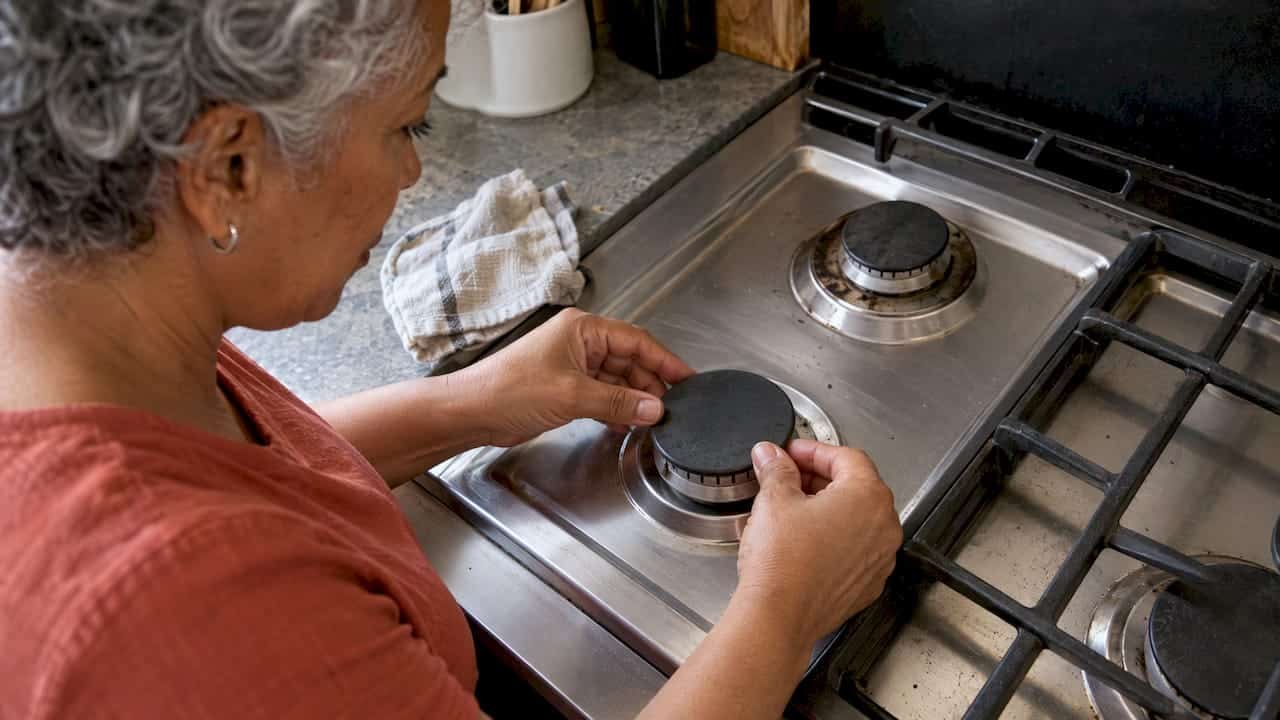
3. Clean the ports and the igniter area
Boiled-over sauce, grease and cleaning residue block the small slots around the burner head and the hole that feeds it. GE advises disconnecting power before cleaning, and making sure burners are cool before you inspect the electrodes. A straightened paper clip can clear the holes in the burner head and gas orifice. Use it gently, because scratching or enlarging a port changes how the flame burns.
Wipe the igniter electrode, the small ceramic nub next to the burner, with a barely damp cloth. Do not spray cleaner at it.
4. Dry everything completely
Moisture is the most common reason a burner clicks and never lights. Shake out excess water from the parts, and let them air-dry thoroughly or set them in a warm oven for 30 minutes. Then put the heads and caps back in their correct positions and try again.
5. Test, then stop if it fails
Turn the knob to light and watch. If the burner lights, turn it through the settings and confirm the flame is even and mostly blue. If it clicks and still does not light after a clean and dry reassembly, turn it off and move on to the next section. Repeated attempts will not fix a part that has failed.
Why the igniter keeps clicking
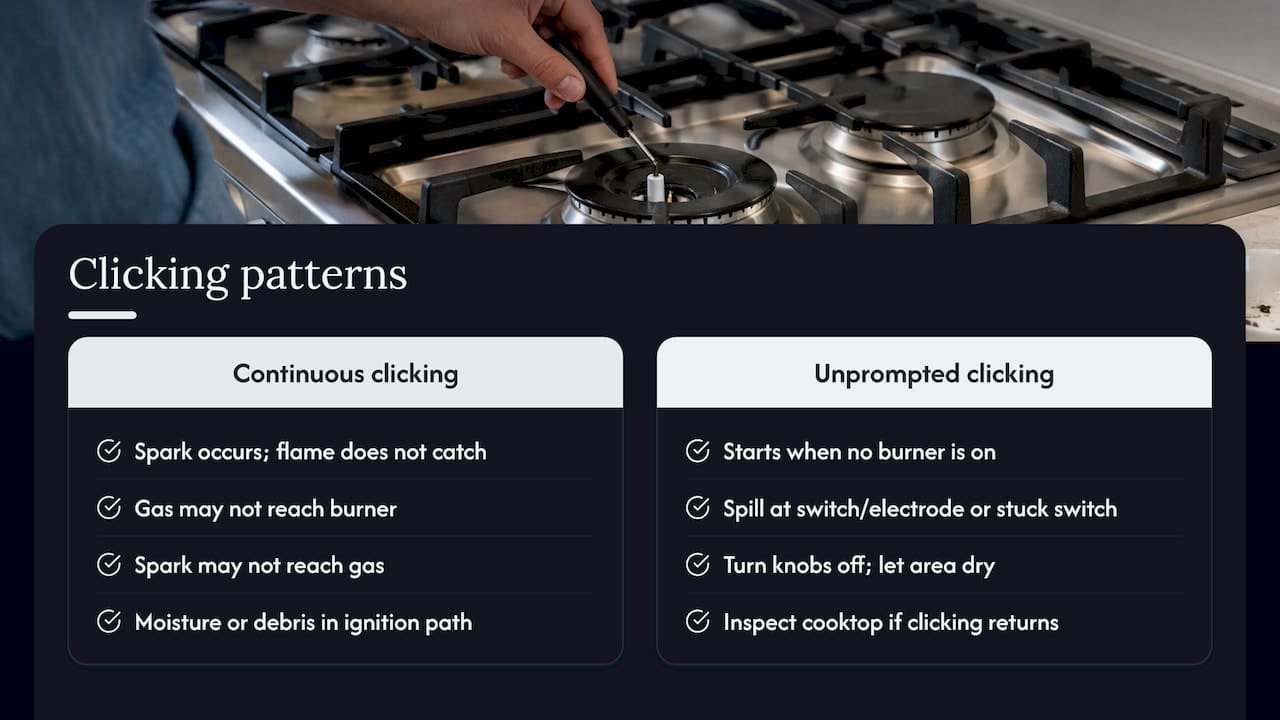
The clicking is the spark. It continues until the burner lights, so a stove that clicks for a long time is telling you the spark is happening but the flame is not catching. The causes are usually either gas not arriving at the burner or the spark not reaching the gas.
GE notes that continuous clicking often comes from moisture after spills or cleaning, or debris in the ignition path, and that drying the area is a primary first step. That is the fix for most kitchens.
Clicking that starts on its own when no burner is on is different. It usually means a spill has reached the igniter switch or the electrode, or the switch is stuck. Turn the knobs off, let the area dry, and if the clicking returns, have the cooktop inspected. A switch that keeps sending power to the igniter wears out and can create a safety problem.
When the igniter does not click at all
A burner that stays silent usually has an electrical cause rather than a gas one. Think about which burners are affected:
- One burner is silent. The problem is most likely that burner’s switch, electrode or igniter, or a wire to it. Check that the cap is seated first, because some cooktops will not spark if a part is out of place.
- Every burner is silent. The shared parts are the likely cause: the power supply, the breaker, or the spark module, the control that sends voltage to all the igniters.
- The unit lost power or was recently moved. Check the plug and the breaker, and confirm nothing was knocked loose during cleaning or a kitchen remodel.
Sub-Zero Wolf lists no electrical power, a spark module or switch that is not working, and a dirty ignitor among the reasons for a surface burner not igniting. Testing a spark module or replacing an igniter means working around live voltage and gas connections, which is where we recommend a licensed technician. See our page on gas stove igniter repair for what that visit involves.
No spark with a working light can also be a manual workaround for some models, but do not hold a match to a burner that is not lighting unless your owner’s manual describes how. Gas can collect, and a burst of flame can be larger than you expect.
When the burner lights but won’t stay lit
A flame that goes out as soon as you let go of the knob is a different problem from one that never lights.
Start with timing. Hold the knob in for longer after the flame appears. One stove accessory company reports that GE, Whirlpool, Frigidaire and Samsung manuals commonly recommend holding the knob for 15 to 30 seconds. Miele says the flame can go out when parts have shifted, a draft blew out a low flame, or the ignition safety device has not heated enough. Their advice for the safety device is to hold the knob another 8 seconds.
If the burner is dirty or the cap is off-center, clean and reseat it as above. If the flame still dies after a longer hold on a clean burner, the flame safety device on the burner may be worn or out of position. That safety part keeps gas flowing only while it is hot, so replacing it is not a job to improvise. Do not bypass or tape it.
Some ranges also have one working burner and a dead oven, or the reverse. That points to a separate oven igniter or safety valve, and our gas oven repair page covers that case.
What not to do
- Do not use the oven or a match as a substitute for a failed igniter on a model that is not designed for it.
- Do not bypass a safety device, tape down a switch, or force a knob.
- Do not spray cleaner into the igniter or the burner base. Moisture is the cause you are trying to remove.
- Do not keep clicking while a gas smell is present.
- Do not remove a regulator or gas fitting to troubleshoot. Gas line work belongs with a licensed professional.
When to stop and call a technician
Some symptoms mean you have reached the limit of a safe home check:
- You smell gas, hear hissing, or see a flame that is yellow, tall or uneven after cleaning.
- A clean, dry, correctly seated burner still clicks without lighting.
- No burner clicks, and the outlet and breaker are fine.
- The flame goes out even after you hold the knob longer.
- You see scorched wiring, melted knobs, or burning smells near the cooktop.
- The stove was recently moved, converted, or reconnected and has not lit properly since.
One appliance parts retailer lists gas leaks or gas line work, advanced electrical issues such as scorched wiring, and complex control board diagnostics among the repairs better left to a professional. We agree. Cleaning and drying are reasonable at home. Gas valves, regulators, spark modules and igniter replacement are safer with a licensed technician.
A conversion matters here too. A range set up for propane runs on different orifices and pressure than one for natural gas, and a burner that never lit well after a move or a fuel change may need a proper conversion rather than cleaning. We handle LP to natural gas conversions as well as repairs.
Our perspective on stoves that won’t light
Most calls about a burner that won’t light start the same way: the homeowner has already cleaned the burner, dried it and reseated the cap, and it still will not catch. That is the right order of steps, and it is where we come in. We look at the part that has actually failed, whether that is the igniter, the switch, the spark module, the safety valve or the supply, rather than swapping parts and hoping.
We treat gas appliances as a safety job first and a repair job second. Our technicians are licensed, and we aim to give you upfront pricing before work begins and a repair designed to last and keep your warranty safe. We also work on appliance brands many others refuse, and we offer 24/7 emergency availability for the problems that cannot wait.
If you are in Orange County or Los Angeles County and a burner will not light, you do not have to live with guesswork. Call us, book online, and we will diagnose the cause and fix it properly.
MDTECH
What a professional visit covers
A stove that will not light can have a short repair or a longer one, and a technician sorts that out by testing, not guessing. A typical gas stove visit with us follows this order:
- Safety check. We look for gas odor and confirm the supply and connections are secure before touching anything.
- Symptom review. We ask which burners are affected, whether there is clicking, and when the problem started. That separates burner issues from electrical ones.
- Burner and ignition inspection. We check the cap and head, the ports, the electrode and its wiring.
- Component testing. We test the switch, the spark module and the power supply, and check how gas is reaching the burner.
- Repair and confirmation. We replace the failed part, then light every burner and check flame quality before we leave.
We repair a range of cooktops, ovens and gas ranges. See our gas stove repair page for the service overview, or who to call to fix a gas stove if you are weighing your options.
Get your burner lighting again
If your burner still will not light after the checks above, we can help. MDTech Services repairs gas stoves, cooktops and ovens across Orange County and Los Angeles County, and our technicians are licensed. You can book an appointment online or call us, and we will tell you the price before we start work.
See our appliance repair services or our gas appliance repairs page to book a visit. Property managers and landlords can use the same booking to arrange repairs for units they manage.
Keeping burners lighting reliably
A few habits cut down on repeat failures:
- Wipe spills as soon as the burner cools, and clean the heads and caps regularly.
- After washing parts, dry them fully before reassembly.
- Check that caps sit flat each time you put them back.
- Keep pots from covering the igniter, and avoid sliding heavy cookware across the grate.
- Do not let water or cleaner run down around the igniter switch.
- Have gas appliances inspected from time to time, especially after a move or a conversion.
Our stove, gas oven and range cooktop repair tips go further on spotting a failing igniter early.
FAQ
Why does my gas stove click but not light?
The spark is working, but gas is not igniting. Usually the burner is wet or dirty, the ports are clogged, or the cap is not seated flat. Clean, dry and reseat the burner head and cap, then try again. If it still clicks, call a technician.
Why is my stove igniter not clicking?
Check that the stove has power and the breaker has not tripped. If only one burner is silent, the switch, electrode or igniter for that burner is the likely cause. If every burner is silent, the spark module or the power supply is the likely cause, and both need a technician.
Why does my burner light and then go out?
A draft, a shifted cap or a dirty burner can put the flame out. Some stoves need you to hold the knob in for several seconds after ignition so the safety device can warm up. If it keeps going out, the flame safety device may need replacing.
Is it safe to light a burner with a match?
Only if your owner’s manual says your model allows it. Gas can build up while the igniter is clicking or a knob is open, and a match can ignite a larger flame than you expect. Turn the knob off and wait a few minutes for gas to clear before any attempt. If you smell gas, leave and call for help.
Should I call a pro if only one burner won’t light?
Try cleaning, drying and reseating that burner first. If it is still clicking without lighting, or not clicking at all, the igniter or switch has probably failed. That repair involves gas and electrical parts, and we recommend a licensed technician.
Sources
- GE Appliances: Gas range and cooktop causes for slow ignition
- LG USA Support: Why won’t my burner light
- Miele USA: The gas cooktop burner does not ignite
- Miele USA: The flame goes out on the gas cooktop after lighting
- Thermador: Gas cooktop troubleshooting
- Wolf: Gas surface burner does not ignite
- Family Handyman: How to fix a gas stove that won’t light
- StoveShield: Gas burner won’t stay lit
- Appliance Parts Group: DIY vs professional appliance repair